Wednesday, October 21, 2015

Archive: Vic's Photos (#12)


Dear George,
I’ve been posting one of my dad’s family photos from the 1940’s and 50’s once or twice a week since I began this blog, and then I started posting accumulated batches of them as archives every few months.  My brother Peter reprinted many of Vic’s photos as postcards which he sent to family members, and the photos here are from Peter’s project as well as from family albums.  A large number of these are also available on my Flickr website: www.flickr.com/photos/lundgrdc/.  
Love,
Dave


My parents met while my dad was in college or law school at the University of Wisconsin.  This is the earliest photo I’ve seen of them as a couple.  They’re certainly dressed up, my mom (Doris) looking like a flapper (which she probably was in the late 1920’s) and my dad (Vic) a dapper young man about town. 


My mother looks very pretty against this backdrop of a snowy U.P. winter.  She and Vic were married on June 1, 1932, in Omaha.  Doris was 22, Vic was 24.  They lived in Omaha for a short time, then moved to Menominee where Vic began his law practice.


I’m not certain but I’d guess that this photo was taken sometime before my birth in July 1937, perhaps in 1936 or 1935.  Doris and Vic look very happy together here.  It was the midst of the Great Depression, and they had very little in the way of money, worldly goods, or security.  As did many couples and families, they struggled and eventually made their way to a better life. 


It’s a shame we can’t remember anything about our first year or two.  This is me in a tub in 1938, age one.  I look sort of serious, perhaps wondering what I’m doing in the world and why my father is pointing that strange machine at me.  


This is my Uncle Ralph Buscher as a young man.  He worked at my grandfather's Rexall Drug Store in Marinette, and he was my boss when I clerked there in my teenage years.  Ralph sang in a prize-winning barber shop quartet and a Marinette church choir.  He and my Aunt Martha lived at Pine Beach with our cousins, Ann and John, and our grandfather, V.A. Sr.  


This is my paternal grandmother and grandfather, Olga and V.A.L. Sr.  I didn't really know Olga who died on July 22, 1942, but who had suffered a major stroke several years before and was bedridden.  I learned from family history that she was an important figure in the state Republican Party in Wisconsin and influenced my dad's going to law school (having told him that he was a good talker).  V.A. emigrated to the U.S. from Sweden with his family as a teenager in the early 1890’s, worked in a lumber camp, went to pharmacy school, and opened and ran drugstores in Marinette and Menominee throughout his career.  Close to his four children, their spouses, and his nine grandkids, he died on Nov. 20, 1959.


My dad took an annual photo of our family every summer, almost always at our house on the Menominee River.  This one was in 1953.  Vic had a gizmo which enabled him to set the camera up, then run over and get in the picture before the shutter opened.  Peter’s at the left (age 8), then Steve (12), Vicki (6), and myself (16).  This was a big year for me since I got my driver’s license and could take the family car to cruise around town with my chums. 


Jean Worth and his wife Margaret were among my parents’ very closest friends.  Jean was the editor of the Menominee Herald-Leader during my youth, and he was widely known in the region as the U.P.’s most accomplished historian.  Their three daughters, Dooley, Jean, and Ann were childhood friends of my siblings and myself.  We spent many fun times at the Worth’s hunting camp at Cedar River, about 25 miles north of Menominee.  


This is my freshman hallmate and Antioch college friend, Arnie P.  I visited Arnie's White Plains NY home in 1959, and he drove up to Menominee with me that winter.  There was a blinding snowstorm in Wisconsin and the Highway Patrol closed Highway 41 north of Milwaukee, but we took a two-lane back road and made it through the three-foot snow drifts  We didn't see another car for 150 miles.  Arnie and my dad had a lot of good conversations at river house.  Vic was disappointed that Arnie didn’t enjoy his required military service.  After Arnie graduated from Antioch, he went on to become a psychotherapist.  


This is my mom, Katja, and myself at the Menominee C&NW depot in the late 1950’s.  On at least one occasion Katja and I traveled from Springfield, Ohio (near Antioch in Yellow Springs) to Menominee and back by train, nearly a 24-hour journey each way.  Vic and Doris were probably seeing us off on our way back to college.  


From the cigarette in my hand, this was definitely taken when I was on a visit home from Antioch, maybe in 1959.  We’re out near the driveway at our house, with the Norway pines and the river in the background.  If it was 1959, I would have been 22, Steve 18, Peter 14, and Vicki 12.   


This is my Antioch College psychology professor, Clarence Leuba, his wife Frances, and their daughter.  I worked as Dr. Leuba’s teaching assistant for Intro Psych in 1958-59, and he was my main adviser for grad school planning.  My parents met the Leubas when they came down to Yellow Springs for our graduation and then several months later at our wedding.  They all hit it off together and became friends.  Professor Leuba taught at Antioch from 1930 to 1962 and lived in Yellow Springs until his death at age 86 in 1985.   


This is my sister Vicki in her early teens.  Vicki could be serious, and she could be lots of fun.  I left for college when she was 8, so I wasn't around much for her adolescent years.  All of us kids got resistant to having our pictures taken, so that may be the case for Vicki’s non-ecstatic expression here. 


This was taken of me in 1960 in Yellow Springs.  My parents and siblings drove down for my graduation from Antioch in June of that year, then again for Katja's and my wedding in late August.  We were certain we were more than old enough to be getting married, though I look pretty young in this photo.  
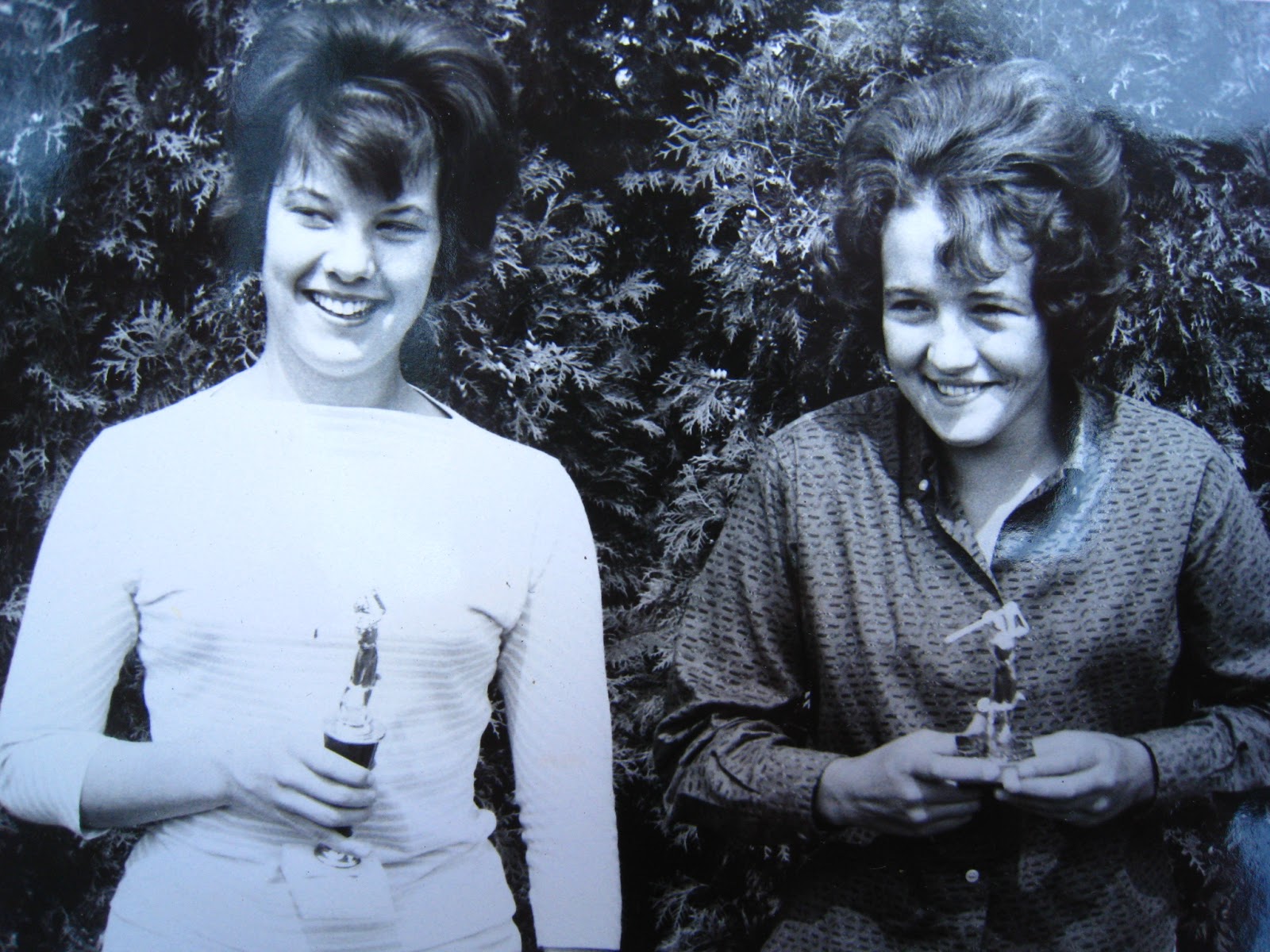


Here’s my sister Vicki (left) and her best friend Kiera, either at the O’Hara’s house on Green Bay or perhaps at our house on the river.  Our families were close, and the girls were inseparable from the time they were toddlers.  Vicki went to church with Kiera’s family so often that she wanted to become a nun herself.    


Peter came of age in the rock and roll era, and he had the most distinctive hairstyles of the four of us siblings.  I’m not sure if Peter’s style was directly patterned after Elvis, but I know it involved a special greasy mixture and careful pruning.  We teased Peter about his hair style, but he shrugged it off and did his own thing.  


Here are my brother Steven, Katja, and I on an unknown second floor building patio.  Because we’re well-dressed, I initially thought it might be our wedding.  However, that was on a very hot August 28th, and we wouldn’t have been wearing heavy coats.  More likely an Ann Arbor get-together.    


My brother Steve and sister-in-law Margie were married on June 20, 1964, in Elmhurst, Illinois.  Katja and I were delighted to have a second married couple in our cohort, and Margie brought a vivacious spirit to our family.  Steve and Margie were great dancers and made family gatherings full of fun.      


Wednesday, October 14, 2015

Sheepdog Season

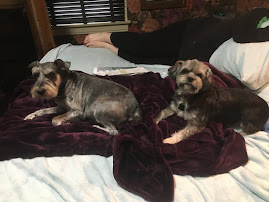
Sophie (left) & Mike on the back porch

Dear George,
Katja and Donna are touring in France, while I elected to stay home and take care of our respective sheepdogs, Mike and Sophie.  It’s definitely more exciting in France, but being home with the dogs has its own perks.  Because of Mike’s infirmities, I’m leery about leaving him home along for too long, so we’re all together at home most of the day.  Mike and Sophie get along fine, though they do their own thing.  We do go on a lot of individualized dog walks — Sophie usually down Ludlow Ave. to Burnet Woods and Mike on a 6-block walk in our immediate neighborhood.  The dogs are good companions — affectionate, attentive, loyal, patient — and I’ve always felt I have a lot to learn about giving and contentment from them.  Here are a few photos with poetic commentary that depict what life is like these days with Mike and Sophie.
Love,
Dave


We are spending more time on the patio
The dogs and I go there each morn
Mike enjoys rooting in the dirt
While Sophie chews an acorn


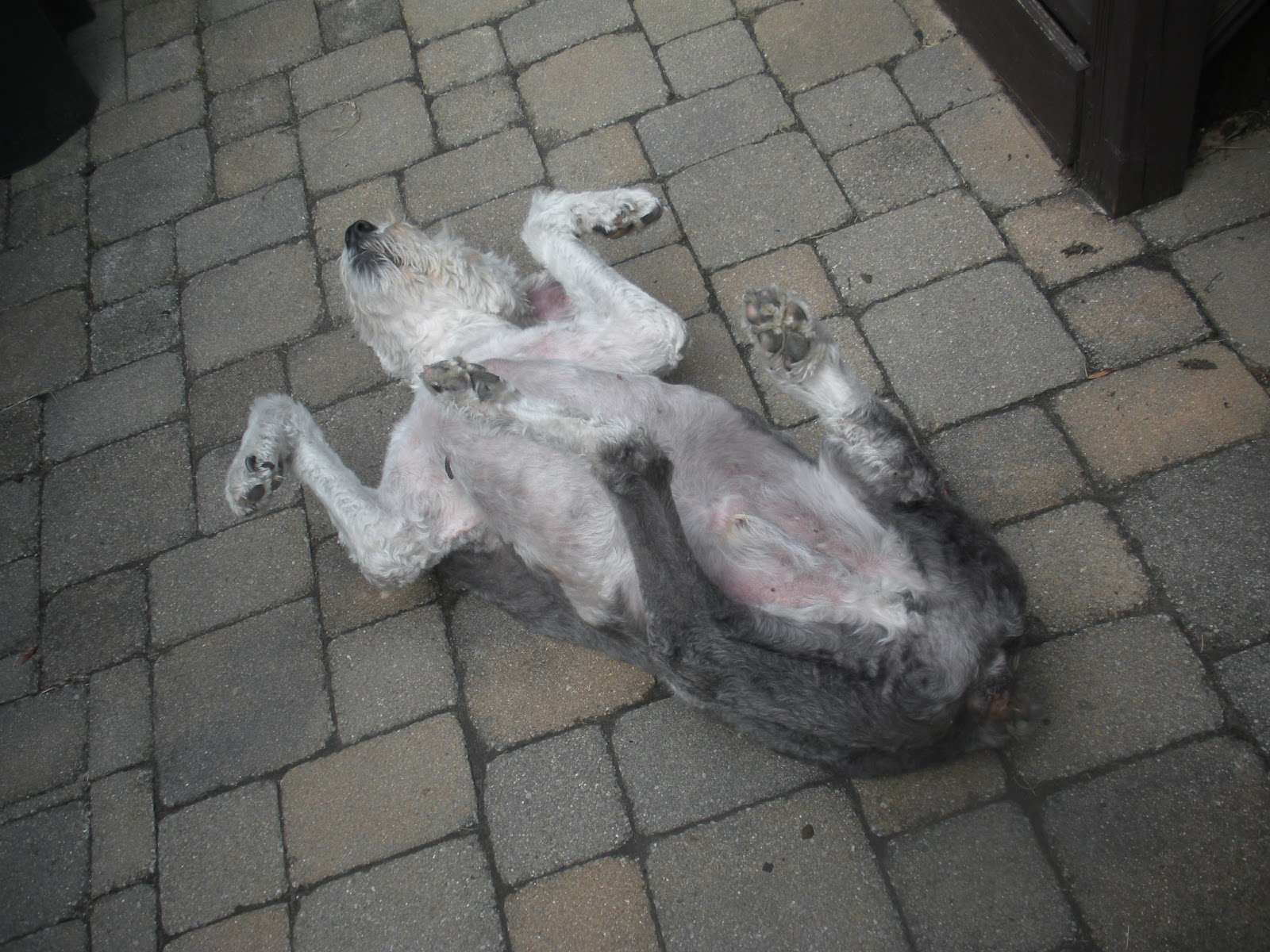
Ever since he was six months old
Mike’s had an extraordinary knack
He’s able to hold four legs in the air
While balancing straight on his back


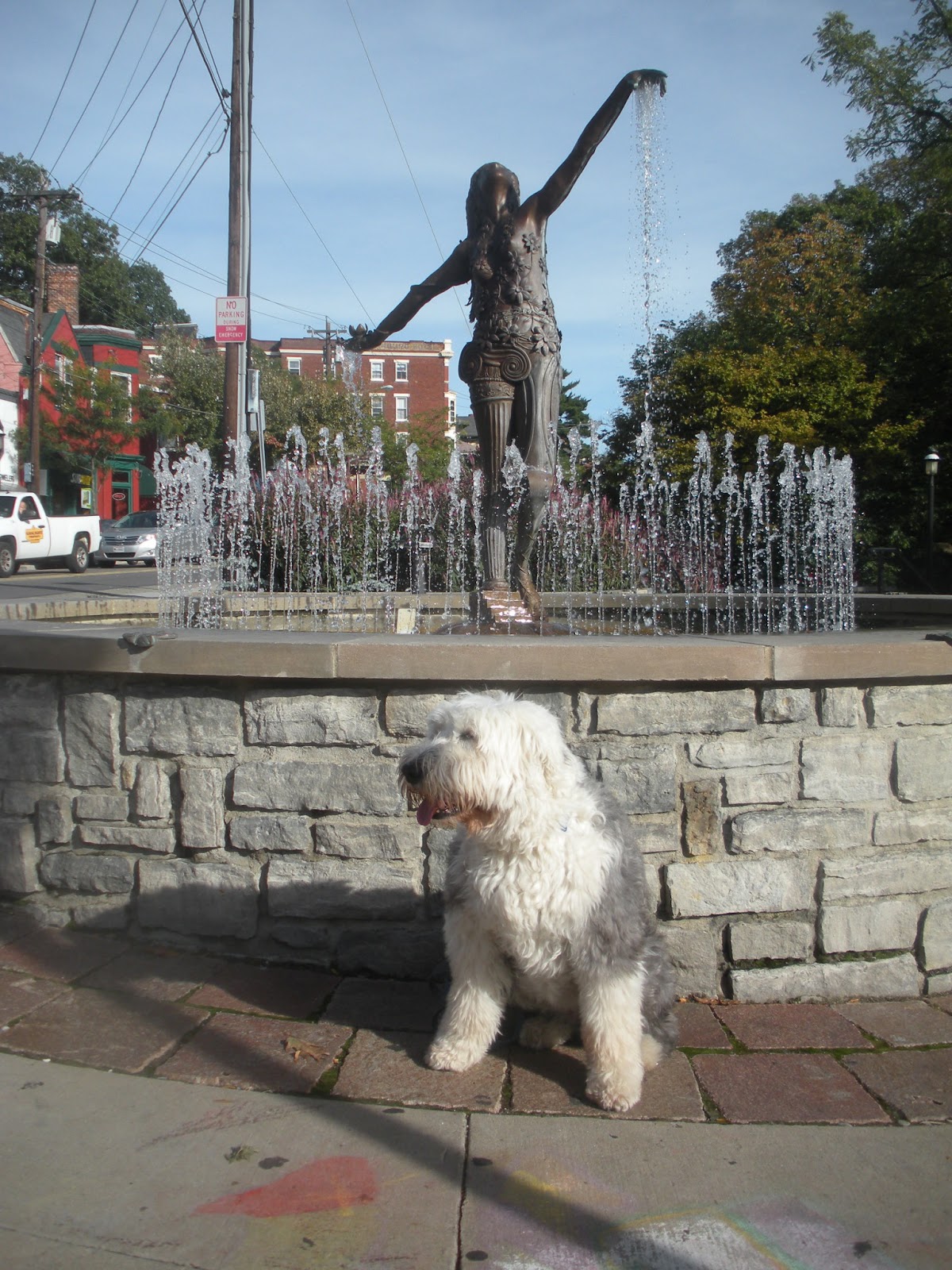
Sophie and I stroll down Ludlow
We stop at the fountain to rest
Sophie likes to watch the people who are out
She’s thirteen but still has her zest


We three are watching the Bengals game
The dogs bark and cheer for the team
Although they don’t watch every single play
They do when the game picks up steam


The dogs did drift off in the second half
The Bengals were clearly ahead
They gave a big bark for Andy Dalton
But then they were ready for bed


You might say the front porch’s a prison
The sheepdogs peek out through the slats 
The world going by holds their interest
They hope that they’ll see pussycats


Here’s Mikey with his rawhide bone
He carries it everywhere 
He’ll never chew on that rawhide bone
He keeps it under my chair


Burnet Woods is the forest primeval
And it’s only four blocks from our house
It’s Sophie’s favorite place to go hiking
She looks for a squirrel or a mouse


The dogs let me know when it’s time to eat
With meals they’re remarkably shrewd
Mike eats faster with Sophie here
He’s afraid she’ll get into his food


The dogs drink plenty of water
Their bowl’s on the kitchen floor 
But they both prefer the upstairs bowl
I never say “No” any more


I rarely leave the dogs home alone
But if I do — such despair
The dogs stand and wait at the kitchen door
Wondering when I will be there


The stairs have become much more daunting
I lift Mikey up step by step
Sophie still makes it on her own
Though she has lost a little pep


The dogs get in bed at nine o’clock
I beg them to leave me a place
But they cover up the entire bed
I’m lucky to find a small space


Wednesday, October 7, 2015

Which U.P. Town Is The Best?


Aerial view of Marquette, Michigan

Dear George,
My dad was a big booster of the U.P.  He’d traveled around the world, but his opinion was that there was no place better to live than the U.P. in general and our home town of Menominee in particular .  He embraced our natural surroundings — the forests, lakes, rivers, flora, and wildlife — as well as the virtues of small town life and the quality of the people.  When confronted with newspaper reports that the U.P.’s population was declining, Vic typically applauded, arguing that the fewer the people, the better things would become.   

Katja and I have lived for varied amounts of time in big cities (Cincinnati, Philadelphia, New York, Chicago, Milwaukee, San Francisco), in medium-sized cities (Ann Arbor, Madison), and in small towns (Menominee; Yellow Springs, OH; Bethel, ME).  While we’ve opted for big city living for most of our adult lives, it’s clear to me that a small U.P. town like Menominee has a number of unique and desirable qualities: e.g., location on the water; wilderness surroundings; ideal summer weather and a real winter; hunting, fishing, camping, boating, bicycling; outdoor sports of all kinds;  a low crime rate; a low cost of living; small town values of community and helpfulness; and ready access by car to larger metropolitan areas (e.g., Green Bay, Milwaukee, Chicago).    

There are various web-sites that provide detailed statistical data on American towns and cities.  Having accumulated a batch of information on Menominee in the past, I decided it would be interesting to compare major U.P. towns on “quality of life” dimensions.  I relied on two of the most comprehensive sources for this purpose: www.city-data.com and www.bestplaces.net.  I selected data for the ten largest towns in the U.P.:  Marquette (pop. 21,383); Sault Ste. Marie (14,251), Escanaba (12,609), Menominee (8,603), Houghton (7,692), Iron Mountain (7,662), Ishpeming (6,500), Ironwood (5,366), and Kingsford (5,164).  There are, of course, many different variables on which to compare communities.  For my purposes, I picked seven dimensions.  These were: (1) Education level (% of residents with a bachelor’s degree or higher, labelled “Educ” in the table below); (2) Income (estimated median per capita income, “Incom” in the table); (3) Unemployment rate (circa 2013, “Unemp”); (4) Crime rate (average of violent and property crime on a 1-100 scale, “Crime”), (5) City Parks budget (budget per resident allocated to city parks, “$ Parks”), (6) Doctors per capita (number of M.D.’s per 10,000 residents, “MDs”), and (7) Population Change (population growth or decline since 2000, “Pop. Chng”).  Cities were regarded as more favorable when they had higher education and income levels, lower unemployment, lower crime, a larger parks budget, more doctors per capita, and population increases since 2000.  The table below shows the raw data for each town, as well as its rank ordering among the ten communities, from 1 (most favorable) to 10 (least favorable).  I’ve also provided average scores for the U.S. as a whole on the various dimensions.  The towns are ordered sequentially in the table from Marquette, which had the highest average ranking on the seven indices (1.8), to Ironwood which had the lowest average ranking of 7.2 out of 10.       
  

Table:  Comparison of ten U.P. towns on seven dimensions (with towns ordered from the most favorable average ranking [Marquette] to the least favorable [Ironwood]). 

                                                                                                $                        Pop.
Town                      Educ    Incom    Unemp  Crime  Parks   MDs      Chng
                            
Marquette            35%     $21K      6.3%      32.7    $82        39        +9.3%
                                    (2)         (4)         (1)         (1)        (2)        (1.5)      (1)

Kingsford             15%     $23K      7.0%       37.8    $38        29         -7.3%
                                    (9)         (1)         (2.5)      (4)        (6)       (3.5)      (4)

Gladstone             25%     $22K      8.7%      32.9   $75         14        -9.1%
                                    (3)         (3)         (6.5)      (2)        (4)       (7.5)      (7)

Iron Mountain    24%     $23K      7.0%      40.1    $10         29        -8.6%
                                    (4)         (2)         (2.5)      (5)       (10)      (3.5)      (6)

Ishpeming           19%      $20K      7.4%      37.5     $29        39        -2.4%
                                    (7)         (8)         (5)         (3)        (9)        (1.5)      (3)
  
Houghton             51%      $15K      8.5%      60.0   $29        17         +4.8%
                                    (1)         (10)        (8)         (8)      (8)        (5)          (2) 

Menominee         14%      $20K      7.1%      45.4    $80         6          -9.2%
                                    (10)      (7)          (4)          (6)      (3)        (10)        (8) 

Sault Ste Marie  20%     $21K     11.4%    62.8   $87        12       -14.3%
                                    (5.5)     (5)          (10)       (10)     (1)       (9)           (9)  
         
Escanaba             17%       $19K      8.7%     60.6    $61         14         -7.4%
                                    (8)         (9)         (6.5)      (9)       (5)        (7.5)       (5)

Ironwood              20%     $21K      9.6%      46.4   $30         16        -14.6%
                                    (5.5)     (6)         (9)          (7)       (7)         (6)          (10)
- - - - - - - - - - - - - - - - - - - - - - - - - - - - - - - - - - - - - - - - - - - - - - - - - - - - - - - - - - - -
U.S. Average        29%     $29K      6.3%      42.5    NA         26.1     +8.5
- - - - - - - - - - - - - - - - - - - - - - - - - - - - - - - - - - - - - - - - - - - - - - - - - - - - - - - - - - -

The U.P. has been an economically depressed region for many decades, and it shows up here in terms of income levels below the national average for all ten towns and unemployment higher in 9 of 10 towns.  (I should note that cost of living is also well below the national average.)  Education levels are lower than the national average in all except two college towns, Houghton and Marquette.  Eight of the 10 U.P. towns showed a population decrease since 2000.  Crime rates and MDs per capita are similar, on average, to national trends.  

While most of the U.P. towns are clustered fairly closely on these seven dimensions, Marquette stands out as a clear favorite, ranking first or second on 6 of the 7 dimensions examined.  My brother Peter attended Northern Michigan University in Marquette for a while, and my brother Steven graduated from Northern before going to law school.  Both enjoyed their stays in Marquette, and that’s not surprising since the town has enjoyed many accolades.  It was recently identified by CNN/Money as one of the top five places in the U.S. to retire.  Gear Patrol, a travel adventure website, lists Marquette among the top 25 adventure travel destinations in the world, along with Tangier, Istanbul, and Bogota.  It’s also been ranked among the 10 Best Small Cities in America (Nerwdwallet), the top 10% of Towns for Outdoorsmen (Outdoor Life), one of the 10 best Winter Wonderlands for Retirement (US New & World Report), and the third best small city in the U.S. for raising kids (Forbes). 

Marquette has abundant outdoor activities — hiking on Sugarloaf Mountain or in Presque Isle Park, world-class mountain biking, and sweet water paddling on Lake Superior.  There’s Nordic skiing in the winter, boat tours in the summer.  In addition to the university campus, there are six museums and galleries in Marquette, including the Maritime Museum, the Iron Industry Museum, the Marquette County History Museum, and the U.P Children’s Museum.  The Superior Dome, home to the NMU football team, is the world’s largest wooden dome.  The downtown historic district houses boutiques, art galleries, antique stores, and good restaurants.  Da Yoopers Tourist Trap features the world’s largest working chainsaw.  At various times the city offers music festivals, food festivals, summer theater, ski and sled dog races, and an annual wife-carrying competition.

I’m disappointed that my home town, Menominee, didn’t come out at the top of the heap, but it’s our first choice for family visits nonetheless  Now I’m itching to visit the U.P. and take a trip up to Marquette.
Love,
Dave


Thursday, October 1, 2015

Hey Diddle Diddle: A Nursery Rhyme For Our Anguished Times


Dear George, 
Our Poetry Writing Workshop began anew last week, and I was happy to start up again.  Our first homework assignment was to take a fairy tale, a nursery rhyme, a Greek myth, etc., and tell the story from the perspectives of two or more different characters.  It took some thought, but finally I settled on the nursery rhyme, “Hey Diddle Diddle.”  You’ll remember it goes as follows:
            Hey diddle diddle,
            The cat and the fiddle,
            The cow jumped over the moon.
            The little dog laughed,
            To see such sport,
            And the dish ran away with the spoon.

I chose “Hey Diddle Diddle” because it has multiple characters who are clearly reacting in very different (strange) ways.  The hitch is that the reader has no idea what’s going on, and the various events appear unconnected.  To make it comprehensible, I decided, one has to set the rhyme in a specific context.  I started thinking about the recent happenings in the news, and, once I’d done that, Diddle Diddle seemed to fall into place.  Here’s how my poem wound up.
Love,
Dave


            Hey Diddle Diddle, Donald Trump

The day that The Donald took charge of the race
The world was turned topsy turvy
Carly Fiorina defended her face
And Jeb tried his best to be nervy

Our cat got out our fiddle that night 
So distressed by the Trumpmaster’s lead 
She played sad songs till the morning light
Haunting ballads of bluster and greed

Our cow tuned into a Fox News show
There was Donald berating Hispanics
The cow leapt so high he left Earth far below
That can happen when a thoughtful cow panics

Our little dog Spot found it all very merry
Bon voyage to Wisconsin’s Scott Walker
And what the heck happened to Governor Perry?           
That Donald’s the noisiest talker

Our friends in the kitchen can stand it no more
Said the dish, “Let’s exit this dump.”
“Hooray,” said the spoon, “it’s you I adore”
“In Aruba we’ll never see Trump.”

So it’s Hey Diddle Diddle for Donald Trump
He’s worth eighty times more than the rest
His hair stands up in a bright orange clump
That’s why Iowans think him the best!