Saturday, December 11, 2021

Idiot or Heartless Wretch?


Dear George, 
The other night I took our dog Iko out for his late evening walk. Earlier I’d brought the trash and recycling bins out to the curb for morning pick-up. As I came down the driveway I noticed a middle-aged man in a leather jacket and sporty cap holding his cell phone flashlight and going through envelopes, letters, and papers from our recycling bin. When I approached, he turned and walked away. Iko and I headed in the opposite direction. 

 I was puzzled for a second, but then it dawned on me that he was looking for correspondence containing personal information, whether for identity theft or some other nefarious purpose. While I very rarely do so, I was sufficiently annoyed that I went to our “NextDoor” neighborhood website when I got home and recounted the incident. I titled my message “Recycling Thief”. It read, “‘Tonight there was a middle-aged man rummaging through our recycling bin. I assume he was looking for credit card information or the like. I mention this to remind people to be careful of putting items in their recycling that might have personal information.” 

 My post was apparently provocative, garnering 144 comments in the first 48 hours. Perhaps this is a record for Next-door, at least for our neighborhood. Five of the responses agreed with my account and thanked me for sharing my tip. The other 139 couldn’t seem to decide if I were an idiot or a heartless wretch. The vast majority pointed out that I was totally mistaken in my interpretation and that this was simply a person who was collecting aluminum cans to resell for a few pennies apiece, a commonplace and harmless activity. I’m not sure why 75 or 80 people had to make the same point, but everybody wanted to get their two cents in. One NextDoor member said that I’d written “the paranoid post of the day”. Some reported knowing the man — “a kindly old gentleman.” Many added that the man was probably a homeless person. Aluminum can proceeds would help him find shelter in this freezing weather or get something to eat, with the added implication that I was a heartless wretch. One person said if I couldn’t tolerate someone collecting aluminum cans I’d discarded, perhaps I should think about contributing to a homeless shelter. 

 The vast majority, of course, rejected my label of a “recycling thief”. Many said that going through people’s recycling and trash containers is completely legitimate and legal. Once trash is put at curbside, they said, it is in the public domain and open to anyone. Several respondents proudly disclosed that they are “dumpster divers” themselves. A few better-informed readers cited a Cincinnati ordinance which defined removal of items from trash and recycling bins as illegal. But even when people were aware of the law, they said that it is rarely enforced, and one should simply assume that strangers will go through one’s trash. 

 I had thought of my post as a public service announcement, reminding people to be careful about their recyclables, but hardly anybody seemed to take it this way. Several commented that only “idiots” would put valuable personal information in their recycling bin, and many gently explained to me that I should buy a shredder and shred my personal documents. (Actually we have a shredder but we haven’t used it since it got filled up several years ago.) One person conjectured that I seem to be the sort of person who puts valuable personal stuff in my recycling bin. Another said that if I am putting credit card information info in the recycling bin, I deserve to have it stolen. 

 Aside from acquiring a community reputation as a nitwit, I’m not losing too much sleep over my online experience. Most of the replies were not hostile, presumably because people simply thought me naive or stupid. And this sort of collective outcry happens all the time on our NextDoor website. Actually the hoopla was largely my own fault. If, instead of saying the man was “rummaging through our recycling bin, I’d said something like “going through envelopes and letters”, a lot of confusion would have been avoided. Having been burned once, I’m ambivalent about posting anything on our Next-door website in the future. There is always the risk of being verbally molested by a horde of strangers. On the other hand, perhaps I could say something that would repair my miserable public persona. 
Love, 
Dave

Friday, December 3, 2021

THE NEEDLE-EATING DOG


Dear George, 
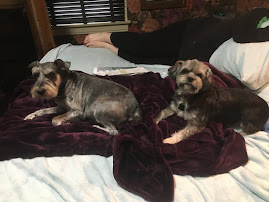
Iko has lived with us for twenty months. He’s a Miniature Schnauzer, about nine years old and twenty-two pounds, full of spunk and sweet as can be. He spent his growing up years in a brothel on Tulane Avenue in New Orleans. Then he escaped, became a street dog for a while, wound up in the pound, and was rescued by our son Justin and his family. When the pandemic began, Justin brought Iko up to Cincinnati for safekeeping, and he’s been here ever since. He enjoys his walks, during which he barks at every dog and person in sight, and is particularly happy to have his daily wrestling match, rolling on his back and feigning fearsome bites to my forearm. 

 Iko has been in good health until a recent night-time walk when he squatted 6 or 7 times but was unable to produce anything. The next day he started vomiting and having diarrhea, became disinterested in food, and slept most of the time. No wrestling even. Katja said she was going to call the vet, but I tried to dissuade her. “The vet costs a fortune, and this is just a routine bug that will go away in a day or two.” Accustomed to my frugality, Katja paid no attention and soon we were on the way to the animal clinic. 

 We sat in the waiting room while the vet examined Iko. After an hour he came back out. They’d done a lot of tests, taken X-rays, and given Iko intravenous fluids. The vet said his symptoms looked like pancreatitis which is common to Miniature Schnauzers, but the X-rays had also revealed a needle in his abdomen. He might have swallowed it recently or it might have been there for a long time. He asked Katja if she were a seamstress, but we couldn’t imagine when or where Iko had found a needle to swallow. The test results for pancreatitis were due back in 24 hours, but the vet was concerned that the needle could pierce his stomach wall and Iko could bleed to death. He recommended that we take him to the emergency 24/7 veterinary hospital where they have more sophisticated equipment that would pinpoint the problem. 

 The 24/7 vet hospital was out in the suburbs. A big elegant place, designed to impress pet owners like us. The technician took Iko in for a sonogram, and Katja and I left for supper at LaRosa’s. The vet had finished by the time we came back. She said that the earlier X-rays might have looked like a needle in Iko’s abdomen, but, in fact, the sonogram showed that he had two needles and they were embedded in the muscle in his back. She thought the needles might have broken off during vaccinations and been in his back muscle for a long time. They weren’t causing any problems and could stay there forever. She agreed with our neighborhood vet that Iko’s symptoms looked like pancreatitus. She offered to keep him for the night, but it would have cost between $1500 and $2000. Given $800 in bills already, we opted for tender loving care at home. 

 I googled “pancreatitis” on the computer. It scared the wits out of us. While the symptoms appear to be ordinary, it’s an inflammation of the pancreas that can be life-threatening. In the worst cases, the enzymes produced by the pancreas actually begin to digest the pancreas itself, causing extreme pain to the dog and ending in an excruciating death. 

 The vet called the next morning with Iko’s pancreatitus test results. The normal range is 200 or below. Iko’s reading was 1000, the highest the vet had ever seen. He prescribed pills for pain and dehydration and recommended a bland diet of white rice and chicken. The vet said that if Iko’s diarrhea continued, we should take him back to the hospital immediately. 

 We were on pins and needles for a week, but Iko improved a little bit each day, and I’m happy to say that he now seems back to normal. He’s eating a veterinarian-prescribed low-fat diet ($50 a bag), his diarrhea is gone, and he’s pretty much his perky self again. Such a relief. I learned two things from the episode. First, I should stop worrying about spending a lot of money for a pet’s health. It’s worth it. Second, my spouse has better instincts in these matters than I do. 

Love, 
Dave

Monday, November 22, 2021

A LETTER TO AARON RODGERS


Dear Aaron, 
I’ve thought about writing a letter to you in the past. I grew up fifty miles north of Green Bay, and, aside from God, family, and country, people in my home town worship the Green Bay Packers. I followed Don Hutson in grade school, cheered rabidly for the Packers during the Lombardi Super Bowl era, and have been thrilled by the team’s resurgence during Brett Favre’s and your tenures as quarterback. In addition to your world-class athletic skills, I’ve also respected you as an intelligent, articulate person with good values and a sense of humor. Needless to say, I’ve been confused and disappointed by the recent uproar regarding your choice to not get a Covid-19 vaccination. You’ve expressed your desire to have a conversation about the issue rather than continued confrontation and hostility. Hence, this letter. 

Here is my understanding of the situation. While the NFL encourages vaccinations, it does not require them of players Approximately 5% of players have chosen not to get vaccinated, and there hasn’t been much hullabaloo about this. According to NFL rules, unvaccinated players are required to be tested daily and to wear masks when in public situations. When you were asked if you were vaccinated on the weekly radio show on which you appear, you replied, “Yeah, I’m immunized.” As you subsequently acknowledged, this was a misleading statement since you haven’t been vaccinated with any of the approved Covid-19 vaccines. Regarding mask-wearing, you’ve said, citing Dr. Martin Luther King Jr., that you consider this to be an unjust rule and have deliberately chosen not to follow it in various situations. 

 The most widespread criticism of your behavior has to do with judgments that you lied to the public about being vaccinated. While you claim that you were telling the truth that you’ve been immunized (by an alternative homeopathic treatment), you have acknowledged and taken responsibility for misleading people with your statement. Personally, I think you made an unfortunate mistake in the radio interview, and owning up to it is the best course available. (You should have just said that you’d chosen to do an alternative treatment.) 

 A further issue is the nature of the treatment you have undergone. The main component is ivermectin, an anti-parasitic drug used to treat intestinal worms and lice in horses. However, the Food and Drug Administration has not authorized ivermectin for use against Covid-19, stating that there is no evidence of its effectiveness in combatting the disease and that use of large doses in humans can cause comas and seizures. You indicate that a major influence in your decision was advice from podcast host Joe Rogan, but, of course, Rogan has no medical expertise. Nor does Fox News host Laura Ingraham, another major proponent of ivermectin. From a medical and scientific standpoint, there don’t seem to be adequate grounds for your decision. Consistent with this, the NFL rejected your appeal to have your alternative treatment accepted as a substitute for Covid vaccines. 

 You’ve also argued that “personal health decisions in my opinion should be private.” While this sounds almost self-evident, it’s also the case that, with a world-famous figure like yourself, health decisions can have significant consequences for teammates, loved ones, the many persons you come into contact with, and millions of fans. That’s neither personal nor private. One concrete example is your being excluded from the Kansas City game because of a positive Covid test, a Packers loss which the team might well have won if you’d been vaccinated and eligible to play. You’ve stated that “I’m not, you know, some sort of anti-vax, flat-earther.” But your public statements have given impetus to the “anti-vax, flat-earther” movement. According to recent CDC data, unvaccinated people are 6 times as likely to contract Covid-19, 10 times as likely to be hospitalized, and 11 times as likely to die from it, compared to vaccinated people. Recommending and modeling non-vaccination to the general public by someone of your celebrity increases the likelihood of infection, hospitalization, and death in the general population. 

My sense is that you’ve been surprised and distressed by the media controversy regarding your health choices and would have much preferred that these matters had remained private. It’s as though you’ve been caught up in a furor not entirely of your own making, and I sympathize with that. What to do about it is a puzzle. You could, of course, opt to be vaccinated and make that information public. I’m struck by the fact that none of your public statements advocate vaccination for the general public. Since your own reasons for an alternative treatment are idiosyncratic (i.e., your report of an allergy to an ingredient in the Pfizer and Moderna vaccines), I personally think that you could draw upon the great bulk of scientific information available and encourage others to get vaccinated. I hope you consider this possibility and change tactics. 
Sincerely yours, 
David L

Friday, November 5, 2021

OPENING NIGHT


Dear George, 
Such a lucky break — I checked my calendar late Saturday afternoon and was shocked to find that we had a symphony concert in just ninety minutes. Katja was sound asleep and she had had no idea either. It always takes me less time to get ready, and I paced the floor, getting more and more jittery. Finally we left a little before 7:00 for the 7:30 concert. I checked out the Washington Square parking garage across from Music Hall, but they were charging $15 (a violation of my principles). Because Katja’s foot was aching, I dropped her off at the front entrance and headed around the block to Central Parkway where the old parking garage costs $10 (still annoying). I always park on the top floor there because you can just drive down the ramp and go right out the 12th St. exit. 

I locked the car and hurriedly walked two blocks to Music Hall. A volunteer at the door asked for my vaccination card and photo I.D. He carefully checked my photo even though my face was covered by my mask. Next I went through a metal detector to get screened for revolvers and knives. The guy asked if I had an umbrella under my raincoat, but I said no. A third man scanned the bar code on my ticket and I was finally cleared to enter. The lobby was filled with chatting symphony fans, but, because all the people were wearing masks, no one looked familiar to me. I couldn’t tell who was pretty or handsome, smiling or frowning, young or old. A strange scene. 

Katja had already gone to her seat. Our tickets were for the third row, the closest we’ve ever been. We had to look upward toward the stage, we could only see the front line of performers, and the music was pretty loud. At precisely 7:30 conductor Louis LangrĂ©e came out to welcome the audience. This was the first weekend of the new 2021-22 season, and he was exuberant because it has been nineteen months since the orchestra has given a performance. The audience was excited too, and Louis got a lengthy round of applause. 

The guest artist was the prize-winning pianist Drew Pearson, and he paired with Symphony Concertmaster Stefani Masuo for a rousing piano-violin duet rendition of Brahms” “F-A-E” Sonata. Then Pearson was the soloist with the orchestra for an avant-garde fantasy by contemporary composer Andrew Norman, and the orchestra wound up with Brahm’s Symphony No. 3 in F major, also filled with fire and explosions. Katja is the classical music lover in our family, and I am more like a gigolo who serves as her male companion at high culture events. Perhaps because of our long absence, I found the music more exciting than usual and look forward to our next outing. 

At the intermission the man sitting next to me asked if I had been bothered by the radio broadcast. Apparently somebody sitting behind us had been listening to the Ohio State football game via ear pods throughout the performance. I hadn’t heard it myself (an example of how bad hearing can actually be to one’s advantage), but I agreed with him that this was pitiful. (As a University of Michigan alumnus it also confirmed my worst stereotypes of Ohio State fans.) 

After the concert Katja and I chose a pick-up spot in front of Music Hall, and I went to get the car. I drove down the ramp, but to my horror the exit barricade was closed, and no one was moving. The line of waiting cars extended back as far as I could see. A woman got out of the lead car at the exit and, with a strenuous effort, managed to shove the gate arm up and hold it there while her husband drove through. Then the arm came back down, and the next car was stuck. The car right in front of me gave up, got out of the line, and headed back into the parking garage. Certain that I’d never get out the 12th Street exit, I followed him. We made some right turns and left turns and eventually got back to the main entrance where we’d come in before the concert. Happily, that gate was wide open, and the other driver and I exited onto Central Parkway. I didn’t see any cars following us, and there were no parking employees anywhere. I wonder how many hours it took people to get out. 

Katja was in a happy post-concert mood when I picked her up. I was a bit nervous about having spent two hours at our first mass gathering since the start of the pandemic, even with required vaccinations and masks. Despite my worries, it was another baby step toward normality for us and a huge, life-changing step for our orchestra and the Music Hall staff. 
Love, 
Dave


Wednesday, October 27, 2021

THE BEST OF TIMES


Dear George, 
 I lived in four places while growing up in Menominee between 1937 and 1955. Up until I was six my parents lived had a second floor apartment in a large white house on Ogden Avenue (now 10th Ave.) at the foot of the Interstate Bridge. My age-mate and first friend, Sally Fernstrum, and her parents lived on the first floor, and Sally and I walked four or five blocks each day to kindergarten at Boswell School. At the end of that year my family moved to Sheridan Road (now 1st St.) around Michigan Ave. (now 16th Ave.), next to the State Street neighborhood where many family friends lived (Burkes, St. Peters, Worths, Sawyers, Murphys, and others). With the U.S. entry into World War II, my dad went for officer training at the Great Lakes Naval Station and was then shipped off to the Pacific. My mother, my younger brother Steve, and I moved to a second floor apartment at the corner of Quimby (3rd Ave.) and Sheridan Road. I think the building might have been owned by my paternal grandfather, V.A. Sr. Then when my dad returned in 1946, we moved to our house on the river that had been built by my maternal grandfather, Guy Cramer. That move was monumental for our family. For us kids, we went from being town kids to country kids — entirely new lives. I wrote a poem about this some time back, and recently I’ve worked at revising it for my OLLI poetry class. Here is the current version. 
Love, Dave 

              The Best of Times 

With the war finally over  
and my father back from the Pacific, 
our family, poorer than magpies, 
moved into my dead grandpa’s cottage, 
set among the white oaks 
on the banks of the Menominee, 
the only house on River Road, 
built of Norway Pine 
and boulders from the field, 
no electricity, 
no running water, 
no indoor toilet, 
no telephone, 
six-foot pine snakes in the foundation, 
a gaggle of bats in the attic, 
porcupines nesting in the evergreens. 
We grilled hot dogs at the outdoor fireplace, 
took weekly baths in the river, 
and caught fireflies in a Mason jar. 
With big snowstorms, 
the County took half a week to plow River Road, 
giving us kids private holidays from school. 
We pioneers of the Great North Woods, 
we children of the forest. 

As the oldest I had many tasks, 
to light the kerosene lanterns at sundown, 
to keep the firewood bin stocked, 
to bring water from the outdoor pump 
for the dog’s bowl and my parents’ coffee, 
to gather wild strawberries for breakfast, 
to shovel the walk in winter, 
and, most of all, to raise Old Glory, 
then fold her up again at dusk. 

My favorite times 
were going with my father to the city dump, 
a twenty-minute trek up the road, 
pulling my red wagon 
to lug found treasures home. 
I collected bottle caps 
while Dad searched for household goods, 
a bedside table with a chipped leg, 
a discarded flower vase, 
someone’s seashell ashtray 
from their Florida vacation, 
rusty old tools or perhaps a tin bucket. 

We loved our years on the river, 
swimming from morn till dusk, 
riding our bikes down the old road, 
camping out at Brewery Park, 
shooting at beer cans with the .22, 
acorn fights with my brother Steven, 
taking our green rowboat 
with its one horsepower motor 
for picnics on Indian Island 
or into the channel with its 
family of Great Blue Herons. 

Then came the summer of 1948 
and new neighbors, the Orths and the Meads,
built houses down from ours  
and the County strung up telephone and electric lines. 
Our wilderness world would never be quite the same.


Thursday, October 14, 2021

Skipper B


Dear George, 
        Recently I was saddened to learn that one of my best childhood friends, Skipper B, died several years ago. Our parents were close friends, so Skipper and I became close friends too. Our family lived on Sheridan Road at the time, and Skipper’s family lived a block away on State Street. We cruised the neighborhood on our bikes, played softball and touch football at Triangle Park, got ice cream cones at the Producer’s Dairy, swam in the bay at the end of a neighborhood street, built snow forts, and played cops and robbers or cowboys and Indians in my back yard. 
         Skipper was seven months older than me but several years more worldly, and I learned a lot about life from him, including most of what I knew about the birds and the bees. In fourth grade I had a crush on one of our classmates named Louise. Skipper got tired of my talking about how beautiful Louise was, and one day he took me up to his parents’ bedroom, opened up one of his mother’s women’s magazines, and showed my a two-page Clairol ad with dozens of pictures of models who had hair dyed in different shades. He asked me if I thought these women were beautiful, and, when I agreed, he asked me to show him one model that looked like Louise. I looked and looked but couldn’t find a single one. Skipper explained that a girl named Maxine in our class was beautiful and looked most like these models and that Louise, in comparison, had a big nose, a square jaw, and a large Adam’s Apple. That ended my crush on Louise (but started my crush on Maxine). 
         My own family was pretty non-religious, so Skipper provided a lot of my spiritual education as well. His family were good Catholics, and he went to Sunday School and mass every week. Every Monday morning Skipper told me the story of a new saint he had learned about. I also learned a lot about the priest’s drinking indiscretions and which of the nuns were the meanest. 
         Both of us were comic book enthusiasts. I liked Bugs Bunny and Donald Duck the most, but Skipper owned a complete collection of Classic Comics, i.e., the comic book adaptations of literary classics (Moby Dick,The Three Musketeers, Hamlet, the Iliad, etc.). When we debated which superhero was best, I picked Superman, but Skipper liked Batman the best because his powers relied on human abilities rather than fantasy super-powers. 
         In fourth grade our teacher devised a competitive system by which students could move through the military ranks by accumulating points for various extracurricular activities — e.g., going to church, participation on sports teams, singing in the Glee Club, belonging to the Boy or Girl Scouts. All the children began the year as buck privates, and, as they accumulated points during the year, they could proceed through the ranks of sergeant, lieutenant, captain, major, colonel, etc. The highest possible rank was Gold Star General. It involved so many points that it seemed impossible that anyone could every achieve that rank. For the most part, that was true. However, one of our classmates did become a Gold Star General by the school year’s end. Skipper belonged to the most groups, participated in the most activities, went to the most events, and had the most interests. 
         After fourth grade Skipper transferred to parochial school, and two years later he and his family moved to Minneapolis. That was the last time I saw or heard from him until I ran across his obituary. It was amazing and gratifying to read about the rest of Skipper’s life. He attended a top private school in Minneapolis where he lettered in three varsity sports, then went on to Yale University where he continued to excel academically and starred in Yale dramatic productions. After law school at the University of Chicago, Skipper joined a top law firm in Minneapolis and became Chair of the Litigation Department. An avid athlete who enjoyed sailing and skiing, Skipper took up marathon running at age 41 and completed nearly 90 marathons and several 50 mile and 62 mile races. Married four times and mentor to many fellow members of AA, Skipper owned homes in Minneapolis, Colorado, and Wisconsin; was a foster parent to several children; opened and ran a gourmet health food restaurant; wrote several plays, one novella, and an autobiography; and created a successful art fair in Minneapolis.                                                       
        When I knew him, Skipper was an extraordinary kid, but that was only a precursor to his extraordinary adult life. It’s like Freud said — our basic character structure is firmly in place by age 6 or 7.  I’m sad that I lost touch with Skipper.
Love, Dave 


Monday, October 4, 2021

On the Road Again

DEAR GEORGE, Recently long-time friends, Lois and Bob A, invited us to come up to visit them in Menominee, my Upper Peninsula home town. It was our first trip in 18 months. We drove up from Cincinnati via Chicago and Milwaukee in two days, arriving in Menominee in the late afternoon on Sunday. Menominee (pop. 8,150) is located on Green Bay at the southern tip of the U.P., about 55 miles north of the city of Green Bay. It’s right across the Menominee River from Marinette, Wisconsin (pop. 10,608), our twin sister city and the site of my father’s family home. Returning to Menominee and Marinette is always an emotional experience for me. I left for college in 1955, yet much of the town remains the same some 66 years later: the layout of the streets, most of the houses and buildings, the churches, the city parks, the courthouse, the library, the marina, the cemetery, the airport. On the other hand, many of the important places of my youth have either disappeared or been relocated: my grade school and high school, my father’s law office, my uncle’s Rexall drugstore, the DAR Boys Club, the Lloyd and Menominee Theaters, the Five and Dime, the GI Surplus Store, Harry Cooney’s gas station, Garbell’s soda shop, Sonny’s grocery, Trautners, the Gateway Cafe, the hospital, Herb Beyersdorf’s garage, the Ideal Dairy. While I was clearly home again, a big chunk of “home” now exists only in my mind.
Our friends live in a magnificent home that they built by hand themselves on the shore of Green Bay. Because we are so landlocked in southwest Ohio, it’s easy to forget how wonderful it is to live on the water. Menominee is spread out for three miles along the shoreline of Green Bay, Lake Michigan’s largest inlet, and the town’s southern boundary is along the Menominee River (the border between the U.P. and Wisconsin). Menominee’s main business district is situated on the bay, as are its five city parks. You never forget being on the water, the visual scenes are hypnotic, and the ready access to the bay and the river make the outdoors a central part of residents’ everyday lives: swimming, fishing, boating, water-skiing, kayaking and canoeing, skating, ice boating.
We have a regular routine as tourists when we visit Menominee and Marinette, and we did much of it this trip: driving around the loop, Henes Park (with a brand new pavilion bathhouse), the boutiques in the historic downtown district, the marina, the magnificent Spies Public Library, art galleries (including Marinette’s Rusty Wolfe Gallery which could just as well be on Madison Avenue in NYC), “Simply Charming”, Pine Tree Mall, antique malls, thrift shops, the Riverside Cemetery, Riverside Drive in Marinette, Sequins, Joe’s Cheese Shop, and a trip on River Road to the location of our old family home. We were saddened by the loss of Weathervane Antiques and Younkers department store, but pleased with the new Menekaunee Harbor Park and boat launch with its attractive regional sculptures and with the new House of Yesteryear antique store in downtown Menominee. I bought a Menominee Maroons T-Shirt for $12.95 at the drugstore, and Katja got us two U.P. hoodies and some $75-a-pound cheese at Joe’s. Katja and I had a date night at Berg’s Landing, Menominee’s finest restaurant, and enjoyed a lot of other local eateries as well: The Watermark [successor to Schloegel’s], Applejacks, The Brothers Three, the Serving Spoon, and Culvers where we had our traditional lunch with my cousins Ann and John B.


In the late 1960’s and early 1970’s my parents purchased and renovated an 1880’s farm near Birch Creek, five miles north of town, and my Seattle niece and nephew, Jennifer and Greg, currently operate the family property as a successful Airbnb. Katja and I went out to Farm on a day between rentals and Jim and Sharon K gave us a tour. My parents, Vic and Doris, would have been thrilled. There were new roofs on four of the buildings, the Barn’s sagging foundation had been shorn up, the guest house had been renovated, the bridge over Birch Creek repaired. All in all, the property was more inviting than it’s ever been, and it’s no wonder that nearly all of the Guest Book comments refer to it as “magical” or “mystical”. We thoroughly enjoyed our visit, though it was bittersweet. We’ve had so many happy family reunions over the years with lots of joking and laughter, but now, with the loss of parents and siblings, it’s more of a place for quiet reminiscing and nostalgia.
We decided to return to Cincinnati by way of the Upper Peninsula and the Mackinac Bridge. The 195-mile trip from Menominee to St. Ignace and the bridge reminded me of how remarkable the U.P. is. We passed through about a dozen villages and small towns, but only one had a population of 10,000 or more (Escanaba) and most had 200 people or less. The U.P. is largely a wilderness area, and we spent the vast majority of time driving through evergreen forests along the Lake Michigan shoreline — a wild and beautiful country. The Upper Peninsula is about the size of Denmark, but contains only 3% of Michigan’s population. Population density is 19 people per square mile (compared to 94 people per square mile for the U.S. as a whole). Yoopers, as natives are colloquially called, enjoy an outdoor life — hunting, fishing, boating, camping, hiking. Our trip made me once again contemplate how much my personality and attitudes were shaped by growing up in the U.P. LOVE, DAVE

Monday, September 27, 2021

ONLINE NIGHTMARES

DEAR GEORGE, When our long-time Menominee friends invited us up for a visit, we jumped at the chance. We haven’t gone on a real trip for almost two years. Because I haven’t driven anywhere more than 20 miles away in all that time, I was a bit wary about a 1500-mile road trip to the U.P. and back. However, it all went smoothly — not counting the blip outside Chicago.
It was rush hour so we decided to use the Illinois Tollway on the city’s western edge to avoid the heaviest traffic. As we entered the tollway I was puzzled by a digital display that read “NO CASH — Use I-Pass or Pay Online”. We didn’t have an I-Pass, of course, and I had no idea how paying online was even possible. Sure enough, when we got to the first set of toll booths, all of the booths that formerly housed human toll-takers were barricaded off. There was a new set of lanes designated for people who had I-passes, and the cars breezed through at 60 miles an hour, but there was only one single lane for people who wanted to pay online. No human toll-taker in sight. Since the online lane was my only option, I held up my cell-phone to the windshield and drove through. I didn’t really think that my cell phone was smart enough to pay my toll, and I was acutely aware that when I had last done this in Florida I wound up paying a $65 traffic ticket.
Ten miles later we came to an identical set of barricaded toll booths and I-Pass lanes. This time, faced with the prospect of a second $65 ticket, I pulled over to the side of the road and parked. I noticed a small sign that said, “To apply for an I-Pass, go to ipass.com." Hooray! I breathed a big sigh of relief and went to ipass.com on my cell phone. To say that the web-site was user-unfriendly would be an understatement. It required a couple dozen pieces of information, some of it very confusing, at least to me After twenty minutes, I was still not close to finishing. I couldn’t believe that the authorities subjected innocent drivers to this nightmare, and I fantasized that we would be marooned for days on the tollway. There was an official-looking building to the right of the toll-booths, so I got out of the car, climbed a fence, and went over to it. I banged on the front door, then walked around and banged on the back door, but there were no humans around. As I headed back toward my car, a tollway truck pulled into the parking lot. Thrilled by my good luck, I rushed over, holding out my cellphone to the driver. He just shook his head, refused to look at my phone, and told me to go to “illinoistollway.com" to pay online. Even if he hadn’t solved my problem directly, I was certain I was now on the right track.
“illinoistollway.com" turned out to be disappointing because it required all the same responses as did “ipass.com". I misspelled the first word I typed in, listing my name as “davif”, and I couldn’t figure out how to correct my mistake. After a lot of personal information, the website eventually asked for a password. I typed in my favorite password, “12345”. “Failure,” the website said, “ use a small letter”. I tried “d12345” but that too was a Failure: “Use a capital letter.” “Dav12345”, I responded. No luck — “Use a non-alphanumeric character”. I typed“ Dav@12345”, and — Voila! — I finally had created an acceptable password. After inputting my credit card information, the last step involved a box labelled “Verification”. I had no idea what Verification meant. I typed “verified” in the box but that was more “Failure”. Likewise for “yes” and “david.lundgren” and “finished”. Finally I noticed a box just above Verification that contained some squiggly fuzzy numbers and letters. They were very obscure and I couldn’t make them out clearly, but I guessed they might be “mN08”. I typed “mN08”in the Verification box but that too was “Failure”. I looked at the characters even more carefully. Perhaps they were “nW06”. I typed that in, and, miracle of miracles” the website said that I had successfully completed my Pay by Plate application.
It was exactly one hour since we had stopped to apply for our I-pass. My wife was ready to kill someone. No other cars had had to stop during that time, and I wondered if I were the only technologically inept traveller passing through Chicago. We zipped through the remaining five “pay online” lanes without a moment’s hesitation. I’m hopeful that we paid our tolls online though I’m uncertain and still nervous. I definitely don’t know about the first lane that we passed through without paying, but, if we only wind up with a $65 ticket, I will be content. I’m sure next time will be easier. LOVE, DAVE