Friday, March 25, 2022

ANXIETIES


Dear George, 
 Between the volatile international situation, the ups and downs of the pandemic, and daily Republican atrocities, the world is becoming increasingly unpredictable and dangerous, and my sense is that these macroscopic tensions are filtering down to the nitty gritty details of our personal lives. In my own case, I’ve come to feel more and more that the entire world around me is disintegrating. Here are a few examples. 

The End of Musical Parking. When we go to the symphony, there are two main parking garages. One, directly across from Music Hall costs $15, and the second, behind Music Hall on Central Parkway is $10. Needless to say, we always park at the latter. On our last visit we were shocked to find that, despite being an hour early, the sign at our parking garage entrance said FULL. We pulled in anyway, and the attendant explained that it was opening night for the professional soccer team down the street, and their patrons had taken up all the spaces. Dismayed, we went to the more expensive garage, but they too were FULL. Though against my principles, I decided to use Valet Parking for $20. No luck, the valet guy said; they were restricted to a total of 10 spaces for pre-paid customers because of the soccer game. Likewise, all of the open-air parking lots in the vicinity were full. After some cogitation, I dropped Katja off to go to the symphony by herself, returned home, and came back two hours later to pick her up. Not only did my $90 ticket go to waste, but I anticipate this being a regular problem in the future. 

Demented Driving. I was backing our of our driveway a few weeks ago when I heard a loud thud and my car came to an abrupt stop. I looked in the mirror and discovered I’d backed into a pickup truck that was waiting for the traffic light to change. I couldn’t believe it. I’ve backed out of that driveway a thousand times without incident. I suspect I was looking right and left but not behind me. The pickup driver was miffed and unpleasant. He said he’d paid $50 thousand dollars for his truck, and he planned to keep it in mint condition. We discovered a small scratch at the bottom of his front door which he said was my fault. He asked for my insurance info, but I said I preferred to pay out of pocket. He was on his way to Northside and said he would go to the body shop and get an estimate. He didn’t call back that day, nor did he call the next. In my mind, I imagined he was searching around for an estimate that would involve replacing his entire door at a cost of several thousand dollars. Weeks later he still hasn’t called. My rational mind tells me that he won’t ever be calling for a minor scratch that probably wasn’t even my fault. However, my lizard mind still goes into a state of panic whenever the phone rings. 

Insane Driving. While my fender bender involved a speed of 2 or 3 miles per hour, the drivers on the major street in front of our house, Ludlow Avenue, have gone insane during the pandemic, regularly reaching speeds of 50 to 60. There are at least six places on our block where tire tracks on the lawn indicate that cars have careened off the roadway, sometimes knocking over lamp posts, fire hydrants, or sections of front porches. Wary that our sidewalk is now a battlefield, I’ve taken to walking our dog Iko on the back streets. 

Uninvited Guests. I was annoyed a couple of years ago when our insurance company insisted that we trim the oak tree next to our house to keep animals from climbing up and getting into the house. We did have some trimming done, but apparently not enough since we’ve started hearing loud thumping noises from our attic. These are large animals — not squirrels or chipmunks. In my mind I envision small black bears, but raccoons or opossums are a more likely possibility. Following a suggestion from the Internet, I started playing WLW talk radio loudly in the attic. This seemed to help for a few days, but now the thumping has resumed. As an Upper Peninsula guy, I’m mildly comfortable with sharing our house with wildlife, but I remain nervous about the potential destruction. 

Miscellany. There are so many other sources of anxiety in my life that it’s hard to list them all. All our services have become unreliable. Many days we get no mail, newspaper delivery is haphazard, and sometimes we get no trash pickup. My spouse forgets to lock the car door and the patio door, leaving us vulnerable to the many burglars who are roaming about our neighborhood. We lost HBO MAX for a week for no reason, our bedroom TV has stopped showing any programs, and my word-processing program on the computer is acting up so that I’ve decided to never close it. Gas and food prices have shot up. Perhaps because of the food shortages hordes of little crawling bugs visit our kitchen counter and sink late at night. Our gardener billed us a thousand dollars for raking leaves in the autumn and winter. My triglycerides are much too high. The dog sporadically gets diarrhea. On top of all this, because of my advanced age my doctor won’t give me the tranquilizer I’ve relied on for years. I am hopeful that we can just come to accept that the world is crumbling around us and manage to carry on despite it all.
Love, 
Dave

Saturday, March 5, 2022

A YOOPER ADRIFT IN THE BIG APPLE


Dear George, 
My second Antioch coop job was at Popular Science Magazine in New York City. As a homegrown Upper Peninsula kid, I’d never been on my own in any big city, much less the biggest, and the prospect of living in Manhattan filled me with a mix of excitement and terror. I had taken the sixteen-hour overnight train from Springfield, Ohio, arriving at Grand Central Station on a mid-April morning. The crowd in the great hall of Grand Central was the biggest I’d seen in my life. I had brought most of my worldly possessions in my uncle Kent’s World War Two army trunk, and it was a chore to lug around — 70 or 80 pounds worth. Before leaving from college I’d arranged to stay temporarily with two acquaintances, Jim S. and Jim H., who were also starting coop jobs. They’d given me their new address — 243 W. 166th Street in Washington Heights.  Uncertain how to use the subway, I took a taxi to meet up with them. 

The taxi ride was an experience in its own right. I was amazed by the street scenes, crowds, and tall buildings, and the driver drove like a maniac. Most of all I became more and more nervous about the rapidly escalating charge on the taxi meter. I’d brought about 25 dollars in cash to tide me over till my first paycheck, and the meter was steadily eating into my reserves. It was a horrendous bill by the time we got to 166th Street, and I knew I was supposed to tip the driver as well. The building was about 20 stories high, and tenants’ names were listed next to buzzers at the front door. I scoured the list, but I couldn’t find either Jim S. nor Jim H. That wasn’t altogether surprising since they were arriving about the same time as me, and there probably hadn’t been time yet to add their names. I did find the apartment of the building super — M. Gonzalez — and I pushed his buzzer. 

I lugged my trunk downstairs to the basement and knocked on the super’s door. Mr. Gonzalez opened it in a second. He was a swarthy, middle-aged Puerto Rican man with a three-day growth of beard, wearing dirty blue jeans and a sleeveless white undershirt. His three little girls stood behind him, watching. I explained that my friends, Jim S. and Jim H., had rented an apartment in the building, but their names weren’t on the front door listing yet, so I needed to get their apartment number. Mr. Gonzalez shook his head, indicating that he didn’t recognize the names, but he did go and get his current tenant record. He went through the 50 or 60 names, but neither of the Jims were there. I asked if I could see the list, and he handed it to me. Much to my dismay, no Jim S., no Jim H. Mr. Gonzalez explained that many permanent tenants rent out rooms, and those private room rentals wouldn’t appear on his records. I asked him who might have rented rooms to my friends, and he said he had no idea. Confused and uncertain what to do next, I asked Mr. Gonzalez if I could leave my trunk in his apartment. He said no, I couldn’t do that. I couldn’t imagine lugging my 80-pound trunk around the city. I explained that to Mr. Gonzalez, but he still said no. I was near tears. I begged him one more time, and he finally relented. I pulled the trunk into his hallway, then headed back out to the street.

I did have one possibility. Jim S.’s girlfriend, Joyce, lived in Fairlawn, New Jersey, about 20 miles south of Manhattan, and she had given more her home phone number. I found a pay phone on Broadway and made a collect call to Joyce. She hadn’t heard from Jim yet but said I could stay at her house until she did. She said she was going out of her mind from boredom at home and suggested that she join me in the city. We arranged to meet at at the New Jersey bus line’s drop-off point near the foot of the George Washington Bridge. 

I walked up to bridge, and Joyce arrived about 90 minutes later. I had no idea what to do in the city, but Joyce said we should go to Greenwich Village, and we took the subway down — the first time I’d ever seen a subway. We hung out for a while in Washington Square, then had tea in a McDougall Street coffee shop, reportedly frequented by luminaries of the Beat generation. For supper we each had a fifteen-cent cent slice of pizza from a sidewalk vendor. Walking along Seventh Avenue we came across a small open-air club with a live band, and we went in and started dancing. I wasn’t much of a dancer, but, even so, it was fun, and we lost track of time. Finally Joyce said we had better catch the bus to Fairlawn, and we took the A-train uptown to 178th Street. 

Much to our dismay, the last bus of the evening for Fairlawn had just departed. The schedule was posted at the nearby White Castle, and the next bus wouldn’t leave until 6:30 a.m. The White Castle appeared to be the gathering spot for the underlife of northern Manhattan. Scary-looking guys, suspicious women with heavy rouge and lipstick, destitute persons in raggedy clothes, a few cool dudes in zoot suits. We were the only so-called normal looking people in the vicinity, and I worried about protecting Joyce during the wee hours of the morning. We found a large tree near the White Castle and staked out spots, leaning back against the tree trunk while we tried to sleep. We did make it through the night without any assaults or murders, slept fitfully, and woke with the rising sun. The bus was waiting, and we eagerly bought our tickets and got on. I felt a great sense of relief, certain I was ready to handle whatever else the city might throw at me. 
 Love, Dave
Wednesday, February 23, 2022

THE LIMERICK CONTEST


Dear George, 

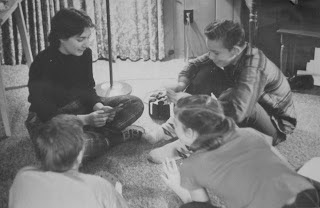
 One of the pleasant things about my checking Google News on the computer is that the website contains a category called “For You”. Presumably based upon my prior searches and stories that I’ve opened to read, it’s remarkably on target: the Bengals, the Packers, tennis, Federer and Djokovic, poetry, HBO and Netflix offerings, Donald Trump (yes, that’s true), Cincinnati, the Bearcats, Menominee, etc. A week ago it steered me toward a story about the Saturday Evening Post Limerick Contest. Held every two months, the Post invites readers to submit limericks about a past Post cover. The current contest is about the 1924 Normal Rockwell illustration shown above. As a limerick admirer I couldn’t pass the opportunity by. One can submit as many limericks as they like, and I submitted the following five. There is a $25 prize for the winner. Please keep your fingers crossed for me. 
Love, Dave 

 I have a young neighbor named Freddie
 For amour he’s never felt ready 
 Then Cupid whispered rules 
“Buy her chocolates and jewels” 
 And now sweet Alicia’s Fred’s steady 

There was a young lad from Peoria 
Who desperately craved affection from Gloria 
Then Cupid showed up 
Brought some vim to this pup 
And now our young couple’s in euphoria 

There once was a chap from Toledo 
Who suffered a torpid libido 
 Cupid whispered in his ear 
“You can master your fear” 
And amour became his new credo 

There was a young bloke from Deer Creek 
Who was out of his mind for Monique 
This affair had no zing 
Until Cupid did his thing 
And now these two dance cheek to cheek 

There was a young dandy from Raleigh 
Whose love life aroused melancholy 
Cupid gave him advice 
“Add some sugar and spice” 
And now he is sweethearts with Molly

Wednesday, February 9, 2022

FOOTBALL REVERIES


Dear George, 
        It’s amazing and wonderful that the Bengals have reached the Super Bowl. In recent months I’ve been falling prey to the pandemic, gloomy and listless because of our restricted and uneventful lives. Then, suddenly, the world became filled with magic again, and I have Joe Burrow and teammates to thank for the transformation. All the excitement has reminded me that football is one of the very few things that have been a continual part of my life since middle childhood. I grew up fifty miles north of Green Bay, Wisconsin, and, of course, all my home town residents were and are avid Packer fans. Star receiver Don Hutson was my first athletic hero when I was seven or eight. We kids spent a lot of afternoons playing football at Triangle Park, and my brother Steven and I practiced passing, catching, and kicking in our front yard. My parents bought me a leather football for my eleventh birthday, and, because I was the only kid in sixth grade with his own football, my associates urged me to bring it each day to play at lunch hour. I was more than happy to do so. However, the principal appointed me Captain of the Safety Patrol, charged with arranging for the sixth grade boys to take daily turns as crossing guards. My peers immediately made it clear that, since I got to wear the badge of Safety Patrol Captain, I would have to do their turns as crossing guards while they played ball. They also made it clear that if I disagreed I’d get beaten to a pulp. It was one of my early lessons about the hidden burdens of being in charge of stuff. 
         Being in a small town in a rural environment, high school football was one of the main local attractions. In junior high we raced down the hallways when the bell rang to be first in line at the cafeteria and get out quickly to play ball on the lawn. I think I had my clearest sense of having grown up was when I started going to Friday night football games on my own with my junior high friends. The biggest local event of the year was the annual M&M game in late November between the Menominee Maroons and the Marinette Marines, the high school in our twin city across the river. This was the oldest interstate public school rivalry in the nation. Emotions ran so high that as teens we were cautioned not to drive to Marinette with our Michigan license plates because our cars would be vandalized. 
         When I went to college, phys ed was required of all freshmen, and at the first class the coach asked us to divide ourselves into three groups, based upon football experience: The “Advanced” group was for skilled players who had been on their high school varsity teams; “Intermediate”, those who had played football but were more who average in skill; and “Beginners” who barely knew the rules of football. My non-athletic roommate Bud, a brash New Yorker from the Bronx, assigned himself to the Advanced group, even though he’d never touched a football, confident that he would pick the game up easily and deserved to play with the best. I, on the other hand, not certain whether I knew all of the rules of the game, assigned myself to the Beginners group, despite having played thousands of hours of football. It was an interesting lesson in the vagaries of self-evaluation. 
         My college didn’t have inter-collegiate sports team, but instead had an extensive intramural sports program, and my freshman hall fielded a football team in our first quarter on campus. One of my friends, Arnie Projansky, was captain of the team, and he assigned me to the role of kick returner on punts and kickoffs. I was more than reluctant since several other hallmates were faster runners, but Arnie was insistent, deciding it would be good for me. I wasn’t very successful in gaining yardage, but I felt good about never dropping a kicked ball. 
         After college we went off to graduate school at the University of Michigan. Having gone to a small liberal arts school, I was completely skeptical about going to a large public university, especially a Big Ten school with all the implications of Greek life, partying, and big-time sports hoopla. However, we did get free student tickets to U of M football games, and, out of curiosity, my wife and I went to the first game of the season. Caught up in the crowd of 100,000 crazed fans, cheerleaders, the marching band, etc., we became immediate converts, and we never missed a home Michigan game. During those same years my parents arranged for tickets to Green Bay Packers games when we returned home during Christmas vacations. We got to see several Packers games during the Vince Lombardi Super Bowl era. Bart Starr, Paul Hornung, Jim Taylor, Jerry Kramer, and other legends. We practically froze to death at Lambeau Field, but I still count those Packer games among the highlights of my life. 
         We came to Cincinnati in 1966, and Paul Brown founded the Bengals a year later, so we’ve been Bengals fans from the start. Tight end Bob Trumpy lived in our apartment complex, and he did several question-and-answer sessions with residents which gave us a more personal connection to the team. We moved from Finneytown to Clifton in the early 1970’s, and I started tossing footballs in the back yard to my son J when he turned six. I’d step back one yard with every toss, and he’d never miss, catching the ball at 25 or 30 yards or more. When our backyard got too small we moved across the street to the bank parking lot. After a month or so we came out one day and the bank had erected a steel fence so we couldn’t get in. I thought it was an unnecessarily expensive way to keep fathers and sons from throwing footballs in the parking lot. Now it’s fifty years later, our son is tossing footballs to his own teenage kids, and we’re still following the Bengals. Lots of ups and downs with the home team over the years, but the 2022 Super Bowl is the pinnacle. It’s been worth the wait.

Love,
Dave

Monday, January 31, 2022

WHAT'S ALL THIS FUSS ABOUT THE FILIBUSTER?


 Dear George, 
I’m by no means a political junkie, but I try to keep abreast of the news as best I can. Recently I’ve been confused about all the controversy regarding use of the ilibuster in the Senate. The Democrats are pressing for reform but can’t get consensus in their own ranks. Joe Biden has changed his opinion in recent months. What’s been most confusing to me is how the filibuster is connected to 60 votes being necessary to pass legislation in the 100-member Senate. After some reading I did manage to figure that out. Here’s what I learned about that and other matters. 
Love, 
Dave 

 What is the definition of “filibuster”? The U.S. Senate defines “filibuster” as “the tactic of using long speeches to delay action on legislation.” (11) 

 Where does the word “filibuster” come from? The word derives from the Spanish “filibustero” (“freebooting”), a reference to 16th century pirates who plundered ships and colonies. Its first use in a political sense occurred in the late 1800s when it was an insult directed toward lawmakers who held up legislation by effectively “raiding” the Senate like pirates. (4) 

 When did the filibuster begin in the Senate? The filibuster is not part of the Constitution, nor was it recognized in original Senate rules. The original rules specified that cutting off debate of a motion required a simple majority. The filibuster was accidentally created in 1806 when Vice President Aaron Burr argued that the rarely used majority rule was redundant, and the Senate eliminated it as a housekeeping matter. Though not their intent, the change gave senators the right to unlimited debate, meaning that they could indefinitely delay a bill without ever getting to a vote. The filibuster wasn’t used regularly until the mid-1800s when Southern senators employed the tactic to block debate over abolishing slavery. In order to support the American war effort in World War I, the Senate in 1917 passed the cloture rule which made it possible to end a filibuster with a two-thirds majority. Because a two-thirds majority proved difficult to obtain, the Senate in 1975 reduced this requirement to 60 votes. While a final vote to pass legislation in the Senate requires a simple majority of 51 votes, a supermajority of 60 votes is needed to start or end debate on the bill. Consequently 60 votes has become the minimum needed for most bills to advance to a vote. In a highly partisan, polarized Senate with a 50-50 split between parties, obtaining 60 votes to end a filibuster is often impossible. (1, 3, 16) 

 What’s the difference between “talking” vs.“silent” filibusters? Originally, filibusters involved long speeches in which a senator attempted to block a vote from proceeding by refusing to yield the floor. The longest filibuster ever recorded was by South Carolina Senator Strom Thurmond, whose speech opposing the Civil Rights Act of 1957 lasted for over 24 hours. Since the early 1970s, however, senators have been able to use a “silent” filibuster. Any time a group of 41 or more senators threatens a filibuster, the Senate majority leader, knowing the legislation lacks sufficient support, can refuse to call a vote and instead moves on to other matters. Use of the filibuster escalated dramatically with the availability of the silent filibuster. Of the more than 2000 filibusters in the last century, over half have occurred in the Obama, Trump, and Biden administrations. (3) 

 Are there exceptions to the filibuster rule? Yes, in 2012 Democrats changed Senate rules to enable confirmation of executive branch positions (e.g., Obama’s cabinet) and non-Supreme Court judicial nominees by a simple majority vote. In 2017 Senate Republicans expanded this change to include Supreme Court appointments, enabling President Trump to fill three Supreme Court vacancies over the course of his term. Both changes involve what is known as the “nuclear option”, i.e., changing a Senate rule to pass legislation with a simple majority and overcome obstruction by the minority. (“Nuclear” because both parties saw it as an unthinkable final recourse, much like nuclear war.) “Budget reconciliation” is one such way to get around the filibuster. That is, a bill may be passed with a simple majority if all of its provisions relate to the federal budget. This process was used to pass the Democrats’ $1 trillion spending package to help people struggling during the pandemic (the American Rescue Plan). In addition, the Senate has also exempted certain other types of legislation from the 60-vote requirement, e.g,, certain trade agreements, military base closures, arms sales. (2, 9, 10) 

 What are pros and cons of the filibuster? Pros include the argument that the filibuster makes the Senate more deliberative and prevents hasty legislation from being pushed through without adequate debate. It’s also argued that the filibuster encourages bipartisan compromise, forcing the majority to negotiate a version more acceptable to the minority, thus protecting rights of the minority party. Without the filibuster, the majority party would be able to pass anything for which it could get a simple majority. The major con is that the filibuster has made accomplishing anything in Congress extremely difficult. In effect, it’s argued that the filibuster gives the Senate minority too much power. Additionally use of the filibuster prevents other critical issues from being addressed. In the current congress Republicans have used the filibuster to successfully block legislation on police reform, immigration reform, voting rights, and a host of other measures. Finally, no other part of the government requires a super-majority to pass a law. (7, 15) 

 What are options to reform the filibuster? Six options are evident. First, eliminate the filibuster altogether. (However, ending debate on changing the Senate’s standing rules requires a two-thirds majority, making this change extremely unlikely.) Second, use the nuclear option in which the Senate majority leader would use a nondebatable motion to bring a bill to a simple majority vote. Third, go back to the talking filibuster and require that objectors to a bill be present with one of them speaking at all times. Fourth, shift the burden onto the filibustering Senators to muster the required number of 41 votes to maintain the filibuster (instead of requiring votes from 60 who wish to proceed). Fifth, get rid of the 60-vote hurdle to start debate on a bill but keep it in place for ending debate. Sixth, do not eliminate the procedure altogether, but make an exemption for voting rights legislation and other pro-democracy measures (similar to the existing procedure for budget reconciliation). (3, 5, 14) 

 What is likely to happen with the filibuster? The future is uncertain. Many Democrats see the 60-vote rule as a stranglehold on their agenda, and the pressure to pass at least some party priorities is pushing Democratic leaders to call for filibuster changes. Last week the Democrats brought to the floor a proposal to change Senate rules to force GOP senators to use a talking filibuster in their opposition to voting rights legislation. However Kyrsten Sinema (D-Ariz.) and Joe Manchin (D-W.Va.) opposed the proposed rule change, resulting in its defeat. Nonetheless, there is near-unanimous support for filibuster reform among Democrats, and if they are able to hold the House and add a few Senate seats in 2022, experts suggest that change is likely in the near future. In 2022 the late Senate Majority Leader Harry Reid predicted: “The filibuster is on its way out, It’s not a question of if but when. It may not be tomorrow or six months from now, but the filibuster is doomed for failure. You can’t have a democracy that requires 60 percent of the vote on everything.”  (6, 7, 13) 

 SOURCES: (1) abcnews.go.com, “What is the Senate filibuster?; (2) ballotopedia.org, “Filibuster and reconciliation in the United States Congress”; (3) brennancenter.org, “The Filibuster, Explained”; (4) britannicacom, “filibuster: parliamentary tactic”; (5) brookings.edu, “Filibuster reform is coming — here’s how”; (6) brookings.edu, “What is the senate filibuster, and what would it take to eliminate it?”; (7) cnn.com, “Why Democrats want to change the Senate’s filibuster rules”; (8) filibusterreform.com, “What is a Filibuster and Why Reform is Good”; (9) nbcnews.com, “The Nuclear Option: What It Is and Why It Matters”; (10) nor.org, “Senate Democrats plan a vote to change the filibuster. So what is it?”; (11) senate.gov, “About Filibusters and Cloture: Historical Overview”; (12) theblaze.com, “2 pros and 3 cons of ending the filibuster”; (13) thehill.com, “Democrats say change to filibuster just a matter of time”; (14) thehill.com, “Manchin: ‘Heavy lift’ to change the filibuster through nuclear option”; (15) thinkehevote.com, “Should the Senate Reform the Filibuster?”; (16) usatoday.com, “What is the filibuster?”

Tuesday, January 11, 2022

ARCHIVE: VIC'S PHOTOS #15


Dear George, 
 Here is another archive of my dad Vic’s family photos, mostly taken between the mid-1930s and the mid-1950s. The source for most of them is my brother Peter’s postcard project in which he printed Vic’s negatives in postcard form and sent them to family members. I’m very grateful to my dad for keeping such a good visual record of our family history and to Peter for keeping them alive. 
 Love, 
Dave


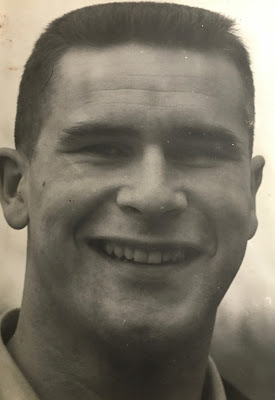
Here’s my dad, Vic L., as a young man from his senior high school yearbook photo.  Vic was born and grew up in Marinette, Wisconsin, across the river from Menominee, with his siblings, Kent, Karl, and Martha.  He graduated from Marinette High and went on to St. Thomas College in St. Paul and the University of Wisconsin where he obtained his law degree.    


Here’s our mom, looking like a bathing beauty.  Given the high hills in the background, this was nowhere near Menominee or the U.P., and it looks like California to me, probably taken in the 1930s before any of us were born.  


Here are my mom and myself on the Green Bay shore, perhaps at Henes Park or the Caley’s Northwood Cove beach.  I wonder if I caught something to put in the pail.  In any case, I look quite pleased.  


Here is our family in 1941, posing in from of the Tourist Information Lodge on Ogden Avenue.  Vic, Dave, Doris holding infant Steven.  Vic would be joining the Navy in two years, and Doris would be at home with Steve and myself. 


Christmas was a major celebration at our house from early on.  I will guess that Steve was 1 and I was 5 in this photo (if so, it would be 1942).  It looks like we got a bonanza of presents, and we children look pretty happy.  


Here’s my dad, looking trim and fit in his Navy uniform, with Steve (maybe 3) and me (maybe 7).  Vic was sent to the Pacific around this time, and we boys missed our father badly.  He spent time in occupied Japan, then returned home in 1946.


These are my parents’ close friends Bill and Florence Caley at their family home on Sheridan Road in Menominee.  Bill was the president of the Signal Electric Company in Menominee, and Florence was a former teacher and homemaker, mom to Bill Jr., Tom, and Bruce.  


The Cedar River is 25 miles north of Menominee along M-35.  We knew it best because Jean Worth’s hunting camp was on the banks of the Cedar, and we took many hikes along the river bank trail on visits.  This was the most beautiful primeval forest that we knew in our youth.   


Jean Worth, one of my parents’ closest friends, was the editor on the Menominee Herald-Leader and a pre-eminent U.P. historian.  Our family had many adventures and good times at Jean’s hunting camp at Cedar River, along with his and his wife Margaret’s three kids, Dooley, Ann, and Jeanne.  


Here is baby Vicki (my sister) and our Irish setter Mike on the window seat in the living room at river house.  Dog and baby seem very compatible, and Vicki loved Mike more and more as she grew up.  


My brother Peter is intently soldering together components of the ham radio set that Vic bought for him to put together.  Though I was away at college at the time, my recollection is that the radio actually wound up working.  Good for kid and father.  


I’m in the background with the bow, and my younger brother Steve is lying dead with an arrow in his chest.  Since, in real life, I was a bully older brother to Steve, I suspect my photographer father was documenting my various travesties.  


Here is an entertaining fire hydrant portrait, probably dolled up for the purposes of this photo.  I don’t know the back story, but I’d have to guess that this is my father’s humorous creation.  


A year older than me, Bill Caley was one of my childhood friends, and our family would visit his  in their Northwood Cove home on Green Bay.  Bill was a star football player for the Menominee Maroons, played football and graduated from Dartmouth in 1958, and established the successful Twin City insurance agency in Menominee and throughout northern Michigan.  An avid sailor, Bill passed away in 2017.


Here is my brother Steve with his motorcycle in the driveway at river house.  As you can tell from his taped up leg and bruised face, he took a nasty spill on his bike and wound up at the hospital.  I was away at college at the time and only heard the gory details afterwards.  


Here are a pair of lovebirds making faces.  Steve and Margie met on spring break during college in the early 1960’s and got married on June 20, 1964, in Margie’s home town, Elmhurst, Illinois.  


Friday, December 31, 2021

BEST CINCINNATI NEWS STORIES OF 2021


Dear George, 
While I grew up in a town of ten thousand, Greater Cincinnati’s population is over 200 times greater, and consequently there are 200 times as many newsworthy events each year. Many of these border on the weird, silly, or perplexing. Here are my favorites for 2021 (note: pseudonyms used throughout). 
Love, 
Dave 

 ANTI-VALENTINE’S DAY 
 In support of people who plan to hold an anti-Valentine’s Day celebration to purge themselves of past relationships, Cincinnati’s Junk King company is sponsoring a “Dump Truck” in suburban Blue Ash. People are invited to dump all reminders of their ex-lovers, from photos and stuffed animals to clothes and jewelry. For each item dumped, Junk King will donate $1 to the American Heart Association. (local12.com, 2-3-21). 

 BAD WIFE 
Linda Cretch, 67, has a parole hearing next month for her life sentence for murdering her husband. Cretch shot her husband, Walter, in the head, then wrapped his body in a rug and kept him in the basement before finally burying him in their backyard. She enlisted the help of her three young children, a neighbor, and her father-in-law with digging the hole on the pretense of fixing drainage issues and planting grass seed. Cretch then went on a spending spree. Her father became suspicious about the backyard hole, dug it up, and found Walter’s body a week later. (cincinnati.com, 2-5-21) 

 FOLLIES OF YOUTH 
A 15-year-old boy is facing criminal charges, accused of secretly recording video footage in a girls’ locker room at his high school. Two girls found the boy’s phone on a pipe in the rafters during a swim meet, and it was recording video. Minutes later the boy came to the locker room and asked if anyone had seen his phone. The girls gave the phone to the authorities, and the boy now faces three counts of attempted voyeurism. He was not successful in capturing any illicit images. (cincinnati.com, 2-18-21) 

CORN FLAKES WITH A KICK 
U.S. Customs officers in Cincinnati reported finding 44 pounds of cocaine-coated cornflakes that had been shipped from Peru to a Hong Kong home. A narcotics detection dog named Bico alerted officers to the package. The corn flakes had an estimated street value of $2,922,400. (wlwt.com, 2-19-21) 

 SALES SURGE 
Cincinnati’s Gorilla Glue company has been in the news a lot, even making Saturday Night Live, ever since Tessie Brawn tried catastrophically to straighten her hair with Gorilla Glue. Local fans worried that the bad publicity would harm the company. Quite to the contrary, Google searches of “Gorilla Glue” are up 50%, and national sales have more than doubled. It’s not clear whether recent buyers are using the product on their hair. (wcpo.com, 2-19-21) 

 BAD MAN UNDER THE BED 
A Cincinnati mother of a teenage girl discovered that a 20-year-old man had been living under her daughter’s bed for three weeks. Jared Wight from Barberton met the girl on instagram. He came out during the night to have sex, take nude photos, and then return to his hideaway. Authorities charged him with three counts of rape and child pornography. (cincinnati.com, 3-18-21) 

 GUN COUNTRY 
According to federal authorities, Addyston police chief Darian LeCour, 65, procured hundreds of machine guns under the guise of testing them for police use, then sold them to two Indiana gun dealers who resold them for a profit. One of the guns with a vehicle-mounted M2 .50 caliber machine gun designed to be used against armored vehicles and low-flying aircraft. Chief LaCour faces 5-10 years in prison on each of 17 counts. (cincinnati.com, 3-26-21)

 MISSING MONKEYS 
Sammy Trinch reported to the police that she saw at least five monkeys across from her home near St. Joseph’s Cemetery on West Eighth Street. Her neighbor Lucy Griffin recorded a video, although the quality is grainy. Trinch said the video shows three monkeys in a tree, but there were two more on the ground. Another woman said she saw one of the monkeys. “I was right here and it was standing over by the garbage can…Its arms were real skinny.” Police responded the next day but only found owls mating — a noise that could sound like monkeys. The Cincinnati Zoo said that none of their monkeys were missing, leaving the monkey mystery unsolved. (wlwt.com, 4-16-21) 

 WORST MOTHER EVER 
 Brittany Gorney, 29, and her boyfriend, James Hamil, 42, are charged with murder, kidnapping, endangering children, and abuse of a corpse. The couple hog-tied Gorney’s three kids, tying their hands and feet, and placing a cloth material in their mouths for a period of hours. Later they drove the three children to the Rapid Run Wildlife area in order to abandon them. Six-year-old James grabbed the door handle as Gorney sped off. When she returned 40 minutes later, she found James dead. They put the body in the car with the other children, kept it at home for 48 hours, then tied it to a concrete block and dumped it into the Ohio River. The body hasn’t yet been recovered. Brittany pled not guilty by reason of insanity. (wlwt.com, 4-26-21) 

 EIGHT ARRESTS THIS YEAR 
Cassandra Richards, 28, of nearby Blanchester was arrested for the eighth time in a year after at an incident at Gold Star Chili. Richards came to the store to demand a refund for food and was asked approximately 20 times to leave the premises. When employees called the police, Richards went outside, opened the drive-thru window, and tried to climb through. She resisted arrest and repeatedly banged her head against the interior of the police cruiser while being taken to jail. Richards already faced nine criminal trespassing charges, one aggravated menacing, one possession of drug paraphernalia, and six resisting arrest. (local12.com, 4-1-21) 

 CICADA CRASH 
Vince Bingram, 20, of New Richmond was driving his 2017 Chevy Cruze along Riverside Drive during the dinner hour when a cicada flew in through his open car window and struck him in the face. Bingram lost control and crashed into a pole, totalling the car. The cicada stayed in the back seat. Bingram was not alone. Cincinnati police reported responding to four different local crashes involving cicadas. (10tv.com, 6-9-21; wlwt.com, 6-11-21) 

 BB ATTACKS 
Sisters Brittany Hepper, 29, and Kelsy Hepper, 28, and driver David Wright, 30, were arrested for shooting at homeless people from their car in downtown Cincinnati and Over-the-Rhine with BB guns. The results were recorded by cameras on the scene which led police to the car. The Heppers had spray-painted the hood of the car to avoid detection, but their effort was unsuccessful. Both Hepper sisters face assault charges. (wcpo.com, 6-9-21) 

 GREAT CINCINNATI CICADA ROBBERY 
This month marks the 34th anniversary of the Great Cincinnati Cicada Robbery. According to police reports, two men walked into the Grand Slam Restaurant brandishing a cicada. They thrust the bug at the cashier Marquita Kellagg, 22, who then fled from her post. Later, after Ms. Kellagg had recovered and returned to the register, she found that it was missing $25. The cicada robbers were never found. (cincinnati.com, 6-19-21) 

 THE MAGNETIC VACCINE LADY 
Republican State Rep. Jennifer Grotch of West Chester helped spread the claims of Dr. Sherry Tenperry when she invited the doctor to testify before the Ohio House Committee in support of “Vaccine Choice”. Tenperry reiterated her claims that COVID-19 vaccines turn people magnetic and “interface” with 5G cell towers. The publicity promoted a slew of social media videos of vaccinated people trying to get spoons to stick to their noses. (citybeat.com, 7-15-21) 

 OUR NEW HIPPO 
Tucker, an 18-year-old Nile hippopotamus, arrived at the Cincinnati Zoo from the San Francisco. He will be the new boyfriend of 22-year-old Bibi, and they have begun to spend time by the pool bonding and sharing beets, squash, melons, and hay. Male hippos are typically 1,000 pounds larger than females. Also, when pooping, they spin their tails like a propeller and spray feces everywhere. A big mess for keepers in the hippo barn. (wlwt.com, 9-17-21) 

 NEEDS A HUG 
40-year-old Trenton Antonio Fortey of North College Hill was arrested after stabbing his mother multiple times with a kitchen knife while she laid in bed in an apartment. His mother, Vanessa Quarreles, was pronounced dead at the scene. Booked into the Hamilton County Justice Center, Fortey asked Sgt. Marc Drones for a hug. When Drones asked why, Fortey responded, “Because I stabbed my mother.” (cincinnati.com, 12-20-21)


Saturday, December 25, 2021

Tales of Christmas Past


Our family's 1940 Season’s Greetings card (Dave with Santa, V.A.L. photo) 

 Dear George, 
I’ve never re-posted something from my blog before, but, when I looked back over Christmas posts, I decided that my 2012 story covered everything about the holiday I could think of. So here it is again: 

 Dear George, I’ve written about our family Xmases on a couple of occasions.  Those childhood celebrations have to be among the most thrilling times of our lives.  But post-childhood Xmas holidays are important too.  Some elements remain stable over the years, e.g., Santa, gifts, the Xmas tree, “Jingle Bells”, eating too much fruitcake.  But other aspects of the holiday season change dramatically.  Once you reach that post middle-age milestone, you’ve accumulated a lot of Xmases.  Here are a few personal tales that illustrate the striking discrepancies in holiday experiences that can occur as one moves through the life course. 

 I started college in September 1955, so Xmas of that year was the first time that I’d been living away from home.  My freshman hallmate Newt, who was from Walla Walla, traveled to Menominee with me from Yellow Springs. I arranged dates for us for the Holly Hop, the annual holiday dance held at Menominee High.  We all went to dinner first at the Cholette Hotel in nearby Peshtigo.  When Newt tried to pay his bill with an American Express Traveller’s Check, the clerk had never seen such a thing and refused to honor it.  None of us had sufficient cash in hand.  After a lengthy, heated negotiation, the clerk finally reached the hotel owner by phone and reluctantly accepted a twenty-dollar traveler’s check.  Newt, disgusted, decided he had truly entered the wilds of rural America.  After the dance we went and parked under the light of the moon in Henes Park.  A police car pulled up behind us moments later.  Nervous because we were under-age teens with open bottles of beer in the car, I started the car, slowly backed up, and crept through the park at its ten m.p.h speed limit with the police car following closely behind.  We managed to escape without further incident.

 
My younger brother Peter and I in our driveway with my first car (circa 1957) 

 December 1957 was the first time that I didn’t come home at all for Xmas.  I was on a coop job in New York City.  I lived on 163rd St. in Washington Heights, and I decided to spend Xmas eve at an Irish bar in the neighborhood.  After three or four shots of whiskey, I called home to exchange holiday greetings before my speech got too slurry.  A little while later some of the men in the bar decided from my newly acquired accent that I’d recently come from Ireland.  Another guy disagreed saying I sounded more Scottish.  I admitted to being from Scotland rather than Ireland, and, as the questioning from my barmates unfolded, we determined that I had jumped ship in New York harbor and was in the country illegally.  Two of my new Irish friends said that they had contacts in the criminal underworld and that they could arrange to get fake papers to keep me in the country.  At that point I decided that I’d enjoyed enough Irish Xmas cheer and bid my farewells. In 1958 my college friend Arnie P. came to visit our family.  Arnie was from White Plains just outside NYC, and he was curious about visiting the U.P.  He’d jokingly referred to me for some time as coming from Menominee, Mishigas (Yiddish for “craziness”).  A major winter storm moved in as we drove north from Chicago.  Shortly after we’d passed through Milwaukee we were stopped at a state police barricade shutting down Highway 41, the main highway to the U.P.  A policeman explained that the roads were impassable, and all the roads heading north from Milwaukee had been closed except one county highway.  He cautioned us not to risk it, but we decided to try it anyway.  With at least two feet of freshly fallen snow on the ground, we couldn’t see the roadway at all, so I just steered the car straight ahead through the open space between the trees. We rarely saw a house with a light on, and we didn’t see a single other car between Milwaukee and Green Bay.  It was a long, tense, probably dangerous trip, but we did eventually make it.  I think Arnie enjoyed his Mishigas visit.  He and my dad had a spirited debate about the military.  Arnie described his Army Reserve military experience as a thoroughly unpleasant waste of time, while Vic considered his experiences in the Pacific in World War II as the most meaningful of his life.  Their discussion may have marked the beginning of the generation gap.    

 
Arnie P. at river house in Menominee

 Though we’d been dating for two years, Katja didn’t make her first Xmas visit to our house until Xmas of 1959.  Vicki was 12; Peter, 14; Steve, 18.  They and my parents took to Katja immediately, and she to them.  She remembers Peter getting a barbell set for Xmas and embarking on his teenage body-building career. We went with my dad to cut down an evergreen tree on our back lot and then take it to town to have it spray-painted (perhaps yellow or red) at Van Domelen’s auto body shop.  Katja and I walked across the river to Pig Island and spotted a mud puppy through the ice lying on the river bottom, looking like the prehistoric creature it was descended from.  All our extended family came for dinner on Xmas eve, Uncles Kent and Ralph distributing cosmetic samples from the Menominee and Marinette drugstores and bachelor Uncle Karl bringing extravagant gifts from Neenah-Menasha. As she did each year, my mother made a delicious turkey Xmas dinner, topped off with her famous cherry, pineapple, whipped cream molded jello salad.  Katja couldn’t get over the parade of wonderful friends who came through our front door throughout the holidays. All in all, it was a memorable Xmas.

 
Katja playing cards with Dave, Vicki, and Peter (circa 1959)

Katja and I graduated from college and got married in 1960.  That year was our first Xmas in Menominee as a married couple.  The main thing I remember is that my parents turned over their bedroom to us, and I was totally embarrassed to come out in the morning, having spent the night there with a strange woman.  Thanks to my parents subsidizing us, we started flying up to Menominee for Xmas on North Central Airlines, the line of the Grey Goose.  North Central had smallish, propeller-driven planes.  On one of our trips Katja had a bad cold and her ears felt like they were going to explode.  She asked the stewardess if there was anything she could do, and the stewardess recommended swallowing deeply.  Five minutes later, the stewardess came back and asked Katja if she were feeling better.  She said she was, and the stewardess explained that the pilot had dropped the plane’s elevation by 3000 feet.  We decided North Central was the best. Our son J was born in September 1969, and we made a big deal about Xmas from the outset, even though J was only three months old.  Once he reached two or three we’d take him to a big local toy store to look over the merchandise (in order to get clues for Santa).  J would get very excited seeing all the wonderful things, but after twenty minutes he would invariably wind up in tears because of the over-stimulation.  I always enjoyed Xmas morning at least as much as J because I got to play with the new toys too.  Usually I was more of a playmate than a dad.  One December I went to the Digby tennis courts and cut down a sumac tree on the forested hillside.  I made dozens of paper mache ornaments over balloons with painted faces, hanging them from the sumac’s branches.  It started out as our Xmas tree, but became a permanent year-round decoration in our dining room.  As J got older we began making snowmen in our side yard each Xmas, then switched over to snow rabbits.  They were the hit of the neighborhood.

 
J in his Xmas cowboy outfit (circa 1973)

 With our families living in opposite directions, we decided in the early 70s to go to Menominee each summer and to Katja’s family in Philadelphia and New York City each December.  Katja’s parents, Helen and Buck, lived on Sherwood Road in west Philadelphia, and her sister Ami and brother-in-law Bruce lived in Manhattan.  We’d drive the turnpike to Philadelphia four or five days before Xmas.  We’d typically do the Art Museum, the Franklin Institute, the Italian market, Philly cheesesteaks at Pat’s, the Wanamaker tearoom, supper at Howard Johnson’s, a great G.I. surplus store, Bookbinder’s downtown bookstore, Katja’s shopping expedition to the suburban Lord & Taylor’s, sometimes a visit to the zoo, sometimes Independence Hall.  Bucks’ relatives would have a big family gathering at Aunt Miriam and Uncle Moe’s, along with Aunt Beatrice and Uncle Joe, Aunt Sophie and Uncle Nate, Katja’s aged grandmother, and various cousins.  Katja’s parents didn’t celebrate either Channukah or Xmas, so we were always eager to move on to New York for Xmas eve.    
Buck and Helen enjoy a holiday hug in their kitchen on Sherwood Road (ca. 1972) 

 We’d set off on the New Jersey Turnpike on the morning of Dec. 24th in order to exchange gifts with Ami and Bruce at their Upper West Side condo.  Bruce, J, and I would go out on Broadway and bring home a Xmas tree (always over-priced by Cincinnati standards).  Katja and Ami were both extravagant gift-givers, and they’d shower us all with numerous presents.  Ami would usually invite friends for Xmas eve or Xmas day dinner, and we’d get together with Bruce’s Bronx family as well.  We’d go to the Met, to MOMA, and to the Whitney or the Guggenheim.  Ami and Bruce would treat us to dinner one night at a cutting edge Manhattan restaurant.  We’d do Rockefeller Center, St. Pat’s, Soho, Canal St. and Chinatown, the East Village, sometimes South St. or the Battery, Madison Ave. galleries, Times Square (mostly of interest to J and myself), the Metropolitan Opera, and one or more Broadway shows.  As J got older, he and I would spend a lot of time walking about the city while Katja and Ami went shopping at Bloomingdale’s or ABC Carpets and had lunch at the Grand Central Oyster Bar.  J loved the city so much that it was the only place he wanted to go to college, and he wound up at Columbia as a result of our Xmas trips.  On one of our visits our car trunk was broken into and all our Xmas gifts were stolen.  We went to the district police station to report the theft.  The officer on duty explained that they didn’t investigate car robberies, saying simply, “Welcome to Fun City.”  Another time J and I were walking along the edge of Central Park East in the 90s, talking and laughing, and I noticed an attractive woman in a fur coat watching us and smiling.  I looked more closely, and it was Jacqueline Kennedy Onassis.  I blushed a bit and looked away, but was privately pleased that Jackie seemed to be enjoying our father-son camaraderie.
Ami at Xmas in NYC (ca. 1973)  

 When Katja’s parents moved to Cincinnati in 1992, we began staying home over Xmas vacation.  Our son J and daughter-in-law K would join us occasionally, but more often they were away in Michigan, New Orleans, or California, and we’d communicate by phone and electronically. When we’ve been in town over the years, our long-time friends Eleanor and Sam Minkarah have made us a part of their family for the holidays.  Their son Jay and his kids and daughter Randa and her spouse come in from New Hampshire and Washington state, and it’s a festive gathering with a Xmas eve cocktail party and a family dinner on Xmas day.  This year (2012) Randa held a  50th birthday dinner party for her brother at the Cincinnatian Hotel.  Jay was ten when we first started sharing Xmas with their family, so it was a noteworthy and nostalgic occasion.   

 
Katja with the Minkarah women: Maria, Randa, Grace, Katja, Eleanor (2011) 

 Looking back, Xmas has been a significant event every year since we were teeny kids. What amazes me on reflection is the enormous changes that we’ve experienced over this time span – running the gamut from being little kids in the family awaiting Santa to being young adults, honeymooners, then parents, empty nesters, and now grandparents ourselves.  I’m glad we’ve hung around to enjoy it all.  Despite the constant change, I’m pleased to say that all our Xmases have been good in their own way.  That’s what the spirit of Santa will do for you.  
Love, 
Dave