Saturday, March 15, 2014

Bodily Functions


“The Irish Curse”

Dear George,
I was skimming through the “Things to Do” section of the newspaper when I ran across a play being produced at our neighborhood theater called “The Irish Curse.”  It was an Off-Broadway hit about a support group for Irish men who saw themselves as suffering from a problem of under-sized private parts that was supposedly characteristic of their ethnic group.  Katja thought that sounded amusing.  I didn’t think so.  While the play might have been fine for Soho or Noho, it didn’t sound to me like an appropriate topic for Cincinnati.  I certainly didn’t know any masculine men who would want to go to it.  Disregarding my opinion, Katja arranged with friends Donna and Kathy for a theater night out.  They had dinner beforehand at a favorite restaurant where Katja ordered fig pizza, then walked down the block to the theater.  All agreed afterward that the play was very funny, touching, had a serious message, and was superbly performed. They said I really missed out, though the whole idea still made me uncomfortable.  Katja did bring home half of her fig pizza in a takeout box, and I ate it for a late night snack.  I’m sure the play was better than the pizza, because fig pizza is the worst idea anybody’s ever come up with.

Thinking about the Irish curse was mildly discomfiting, but it didn’t come close to the embarrassment from our toilet a few days later.  Toilets used to be a mostly neutral and innocuous part of life, but we’ve had nothing but woe ever since renovating our bathroom.  Our new toilet is ecologically sound and environmentally friendly, but it has the minor drawback of using minimal amounts of water and minimal pressure.  You might say it’s the household appliance analogue to small genitalia.  The toilet works fine as long as we’re talking about liquid waste, but anything more tangible is hazardous.  (I have to note here that this observation only applies to male usage, probably because of larger intestines.)  In any case, our upstairs toilet recently got jammed up for the umpteenth time.  I worked on it for the first day with our plunger, then resorted on the second day to the 3-foot snake that I’d purchased at the hardware store.  No luck.  The plumber arrived on Monday morning, and it was thoroughly embarrassing to show him the yucky problem in our bathroom.  He probably was accustomed to such matters, but it seemed to me to require an intimate, disgusting level of disclosure.  I quickly excused myself from the scene, and, happily, the plumber was successful in a matter of minutes.  He explained that this was a regular problem with modern toilets, and he recommended “courtesy flushing.” I’m sure I looked confused.  The plumber laughed and said he was familiar with the phrase from growing up in a household of girls.  “Courtesy flushing” means flushing an extra time when halfway through whatever it is one is doing.  I can’t believe that I’ve lived this long and never heard of “courtesy flushing” before, but it sounded like a good idea.

It was actually the perfect week to get some toiletry tips because I was due just days later for a gastric test that raises havoc with your innards.  I was actually happy about the test because of the amazing visual experience of traveling through the interior of one’s own stomach on a TV monitor.  It’s just like that old movie, “The Incredible Journey.”  Katja came along since you’re not allowed to drive yourself home.  When I met the doctor, I said I was looking forward to the procedure.  He gave me an odd look, probably because he’d never heard this from a patient before.  I told him that how I’d previously found it remarkable to go inside my stomach organs via TV.  However, he explained that the anesthesia they were using would put me into a deep sleep and I wouldn’t be aware of anything.  That was totally disappointing.  They turned the IV on, and that was the last thing I remembered.  When I woke up the procedure was all over; I appear to have passed.  The doctor said I should come back in four years.  He said that when patients reach my age doctors usually stop doing these kind of tests altogether.  “But,” he said, “they shouldn’t just throw people on the trash heap because of their age.”  I was glad he felt that way.  Ever since, though, I’ve been thinking about being in an age group where most doctors just throw you on the trash heap.  That’s not a reassuring thought.   
Love,
Dave


G-mail Comments
-Jennifer M (3-17):
Omg. It This terrible that the doctor said anything like that to you! 
-Donna D (3-17):  very very funny david...especially "minor drawback of using minimal amounts of water and minimal pressure.  You might say it’s the household appliance analogue to small genitalia."  clever, very...
-Phyllis S-S (3-15):  Dave,  Have a good trip to New Orleans.  Brave Blog - I wouldn't think that the topic of the play would ever, ever be possibly funny.  All over Europe they have the new toilets where you can choose the amount of flush power - like yours.  I always just chose powerful.  Glad you passed the colonoscopy…     Phyllis 

Tuesday, March 11, 2014

Menominee Michigan: Historical Tidbits (Part 1, 1869-1899)


In the Main Street Historic District

Dear George,
Our hometown of Menominee has such a rich history.  Menominee is located at the southernmost tip of Michigan’s Upper Peninsula.  It’s on the shore of Green Bay off Lake Michigan and along the mouth of the Menominee River.  Its twin city of Marinette, Wisc., is right across the Interstate Bridge; Green Bay, Wisc., is 55 miles to the south; and Milwaukee is 170 miles away.  Menominee’s first white settler was French-Canadian fur-trapper Louis Chappee who established a British-American Fur Company trading post on the Menominee River in 1796.  The first sawmill was built on the river by William Farnsworth and Charles Brush in 1832.  Between the early 1840s and 1910 Menominee was the biggest lumber-shipping center in the U.S.  In 1889, its busiest year, the Menominee River Boom Company processed 4,245,000 pine logs.  The city of Menominee was chartered in 1883.  By 1900 Menominee and Marinette had a combined population of nearly 30,000, about 50% larger than today.  The lumber boom peaked in 1895, and the last log drive on the Menominee River was held in 1917.  While there are still a couple of small lumber mills in the area, the twin cities’ industrial base today is much more diversified, including paper mills, a shipyard, a chemical plant, auto parts, furniture, and helicopter manufacturing.  Each time I visit Menominee I take some photos of places, usually those of significance to my siblings and myself.  Here are a few notable landmarks that date back to the late 1800’s, given in chronological order.
Love,
Dave


First Presbyterian Church
Though we were only occasional attenders, my father was a deacon in the Presbyterian Church, and I went to Sunday School for a while. When my mother died, the Presbyterian minister, Reverend Rank, came out to our Farm property for a private family service, and my dad’s memorial was held at the church.  The First Presbyterian is Menominee’s oldest existing church.  In 1868 the pastor of the Presbyterian church in Marinette, Rev. John Fairchild, organized the "First Presbyterian Church of Menominee."  A young seminary student named Henry Loomis from New York State had come to Menominee to regain his health, and he quickly led efforts to build a church.  The Kirby-Carpenter Company donated a lot, and Loomis and volunteer helpers cleared the land.  The Building Committee consisted of Samuel M. Stephenson, E. S. Ingalls, and William P. Newberry.  B. W. Porter of Waukegan, Ill., was in charge of the construction.  The new church was erected in 1968 and was dedicated on July 18, 1869.  The First Presbyterian initially had nine members, and Henry Loomis was its pastor for its first four months.  Rev. A. W. Bill succeeded him.  According to E. S. Ingall's history of Menominee County, 73 members were enrolled by 1876.  (2) [Note: numbers in parentheses refers to sources listed at the end] 


Menominee Fire Department
Probably once a year my dad would take us to visit the Menominee Fire Department, and we enjoyed climbing around on the fire engines and slide down the fireman’s pole from the second floor to the first.  The Department was formed in 1871, a dozen years before the city itself was formally chartered.  Its creation was a direct response to the great Peshtigo Fire of 1871 which devastated the region, destroying 1875 square miles of forest land and killing an estimated 1500-2500 people, the most fire deaths in American history.  A hand engine was bought in 1872, and the Kirby Carpenter lumber company bought another engine about the same time.  Because these were deemed insufficient, an Amoskeag (New Hampshire) steam engine was bought in 1874.  According to E.S. Ingalls’ history (1976), the Foreman of Engine No. 1 was George Harter, and the Captain of Engine No. 2 (the steamer) was Robert Stephenson.  The Fire Department today is staffed by three crews of four full-time firefighters each and responds to an average of 390 calls per year in Menominee and neighboring towns.  (2, 8) 


The Menominee County Courthouse
The courthouse has always been regarded as one of Menominee’s grandest structures.  My dad, Vic L., did an excellent oil painting of the building which hung in our living room throughout our youth.  Vic was a lawyer, and he spent many hours at the courthouse in his capacity as Municipal Judge and later as Prosecuting Attorney.  I never saw him in action there, though I regularly visited the courthouse in the late 1950’s because the Selective Service Office was located there and I was worried about being drafted for the Korean War.  After Menominee County was created in 1863, residents decided in 1874 to build a courthouse and bonds were issued for fund-raising.  A plot of land on Ogden Avenue was purchased, and a Chicago architect named G. P. Randall was hired.  The building, a three-story red brick Classical Revival structure, cost $29,680 and opened in 1875.  There was a jail on the first floor, county offices on the second floor, and the courtroom on the third floor.  Additions were completed in 1909 and 1938, and the original attached jail and sheriff's residence were demolished later.  The courthouse was added to the National Register of Historic Places in 1975.  It was most recently renovated in the early 1980's.  (6, 7)


Riverside Cemetery
Our family moved to Riverside Boulevard shortly after my dad returned from the Navy at the end of World War II.  Ours was the first home on Riverside, and the only other destination of note on the road was the cemetery, located about halfway between our house and the city limits.  As a teenager on my way home from school I’d sometimes ride my bike through the cemetery to enjoy the scenery and the eery feelings of being among the dead.  At nighttime it was scary to ride past the cemetery because of the potential for ghosts and ghouls, and I’d pedal at my fastest pace.   I haven’t been able to find the date of the cemetery’s founding, though I’ve run across listings of burial locations going back to the mid-1880’s.  The Menominee City Council established the cemetery at the foot of Stephenson Avenue on the banks of the Menominee River. A. L. Sawyer (1911) describes the cemetery as located "on a nicely elevated portion of ground where the rippling sounds of the shimmering river may forever soothe the endless sleep of its inhabitants."  William E. Kuhule was the cemetery's sexton in the early 1900’s.  There are currently about 20,000 people buried there.  (5)


The First National Bank
My father did his banking at the First National Bank.  He also created a trust for his adult children, and we’d meet with one of the bank vice-presidents each time we visited home to review our family account.  The First National was Menominee’s oldest bank, organized in 1884.  In 1910 the bank moved into its permanent home at Main St. and Ogden Avenue (now First St. and Tenth Ave.). It’s a Beaux Arts design in the style of a Roman temple.  The architect was Albert E. Calcorn of Chicago.  As of 1911 its officers were: Augustus Spies, president; John Henes, vice president; Gustavus A. Blesch, cashier; and Clinton W. Gram, assistant cashier.  According to A. L. Sawyer's history, the bank's "history is one of continued success with never a taint of suspicion from any quarter, even in the most trying of panics.”  Alas, Wells Fargo closed its downtown office and vacated the building a decade or so ago, and, when I last saw it a year ago, it still stood empty on Electric Square.  (5, 9)


The Menominee Water Plant
Located on Green Bay at the northeast corner of Electric Square, just across the street from the First National Bank, the Water Plant is a splendid historical landmark.  It was right across the street from my grandfather’s Menominee drugstore, so we’d pass by it multiple times a day.  The water plant was built in 1884 and was originally owned by a private company in Boston.  It was constructed because of the presence and effects of typhoid fever in the community.  Menominee was the first city in Michigan to use chlorination in its water system.  (9)


St. Joseph's Hospital
I was born at St. Joseph’s Hospital in 1937, followed by my brother Steven in 1941, Peter in 1945, and Vicki in 1947.  The hospital had been around a long time before those family events.  It was built in 1891 on Ogden Ave., next to the Epiphany Church (now the Holy Spirit Church).  Nuns from the Sisters of the Third Order of St. Francis operated it, providing medical and hospital care and traveling by foot to area lumber camps to solicit money.  Expansions between 1900 and 1911 added a surgical suite, 16 additional beds, a three-story structure with 16 private rooms, a lab and x-ray department, a maternity department, a chapel, and quarters for the Sisters.   According to A. L. Sawyer in his history of Menominee County (1911), "The Sisters are ever on the alert.  Day and night they are at the service of the patients, silent, serene, and cheerful, leaving no want unattended and no wish ungratified."  When Menominee industrialist Marshall Lloyd died in 1927, he left his fortune to the people of Menominee to be used for health care, and a new hospital, next door to St. Joseph’s and also operated by the Sisters, was dedicated in 1950.  The new hospital was renamed St. Joseph’s–Lloyd Hospital.  (1, 5)


Carpenter, Cook Company
When I was a kid the Carpenter Cook grocery warehouses were located on the river near the Menekaunee Bridge, and the administrative offices were downtown in the Stephenson Building on Electric Square, just across the street from my grandfather’s drugstore.  My friend Frank St. Peter’s dad was an executive at Carpenter Cook.  We liked to go to his office because we got to ride up and down on the elevator, a rarity in the twin cities.  The company had its beginnings in 1891 with the formation of the Somerville, Pemberthy & Cook grocery firm on south Main St.  The grocery business was connected with the Kirby, Carpenter lumber company piers on Green Bay, and the company bought a subsequent site at the foot of Main St. in 1896.  The mammoth grocery building had four floors, a basement, and two large warehouses, and it had both railroad and steamboat connections.  Following Somerville's retirement in 1892, Pemberthy's death in 1901, and William O. Carpenter's involvement as a silent partner, the firm’s name became Carpenter, Cook Company.  C. I. Cook became the sole proprietor after Carpenter's death in 1905.  The business was divided into several branches, including a branch store at Ishpeming.  The refining, canning, and pickle factory was in the old brick mill of the Kirby Company.  Great quantities of fruit and vegetables from local sources were preserved and canned there.  Another branch, the Michigan Candy Co., occupied the entire three stories and basement of the old Kirby Carpenter Co. building.  In 1891 the company's aggregate sales were $150,000; by 1910, they had reached $2,000,000.  (5)

The Signal Electric Company
Every now and then my dad would bring me along to the Signal Electric plant on Broadway where he would touch base with his friend and the company’s president, Bill Caley.  The firm’s history dates back to the city’s lumbering boom era.  It was founded as the Menominee Electric and Mechanical Company in 1892.  Its early products included telephones, crank telephone generators, and switchboards.  The original plant burned down in 1904.  Later that year, however, a new plant was opened at the current site, and products were expanded to include telegraph instruments and wireless radio devices.  In 1919 Charles E. Hammond took out an option on the Menominee plant, and the company was reorganized and renamed Signal Electric Manufacturing Company.  In addition to radio and telegraph instruments, products included small motors, batteries, fans, bells, and electric hand tools.  As of 1922, Signal employed 200 workers, operated 20 hours a day, and maintained offices in China, Hong Kong, Japan, London, Canada, and throughout the U.S.  North and South wings were built in 1937-38.  In 1952 the company was purchased by King-Seeley Thermos Co, and in 1964 Vernco Corporation of Tennessee became the new owner. (4)


Menominee High School
I began 7th grade at Menominee High School in 1949 and spent the next six years of my life there -- a potpourri of excitement, silly jokes, boredom, learning math and English, self-conscious anxiety, lunchtime basketball, Friday night football games, high school dances, new friends.  Some of my favorite teachers were Mr. Robare, Mr. Sieman, Mr. Eidt, Mr. Johnson, Mr. Taylor, Mr. Miller, Miss McNeil, Mr. Biller, and Mr. Davis.  The original Menominee High School building was completed in 1894 with a total cost of $53,987,34, including grounds and furniture. The first M&M football game between the Menominee and Marinette high schools was held that year, making it the oldest interstate rivalry between two public high schools in the U.S.  Mr. Jesse Hubbard was the first superintendent. By 1923, according to a report by Mrs. Harriet Woodford Bill, the junior and senior high schools had one of the finest athletic facilities in the country, an excellent library, and well-equipped machine shops and wood shops. (3)


SOURCES:
(1) “Bay Area Medical Center: History”, www.bamc.org;   
(2) “Centennial History of Menominee County (1876),” E. S. Ingalls, www.books.google.com;
(3) "Early Schools and Churches," Mrs. Harriet Woodford Bill, 1923, in "Menominee Remembered," www.uproc.lib.mi.us);
(4) “History of Signal Electric Co.,” from the Menominee County Historical Society Archives, www.k8ir.com;
(5)  “History of the Upper Peninsula", Alvah L. Sawyer, 1911, p. 592-3, www.usgwarchives.net;
(6) “Menominee County Courthouse,” www.wikipedia.org;
(7) “Menominee County: Courthouse History,” www.menomineecounty.com;
(8) “Menominee: Fire Department,” www.cityofmenominee.org;
(9) “Menominee Historic District Walking Tour,” www.downtownmenominee.com

SELECTED ADDITIONAL MENOMINEE HISTORY SOURCES AVAILABLE ON THE INTERNET:
"Deep Woods Frontier: A History of Logging in Northern Michigan, T. J. Karamanski, 1989, www.books.google.com
"Early Days in the Lumber Business," www.rootsweb.ancestry.com
"Heritage of the Route," www.cuppad.org
"History of the Lumber and Forest Industry of the Northwest," G. W. Hotchkiss, 1898, www.books.google.com
"History of Michigan, Vol. IV," Charles Moore, 1915
A History of the Upper Peninsula of Michigan," G. N. Fuller, www.quod.lib.umich.edu
"History of the Upper Peninsula of Michigan: Menominee County, Michigan," Western Historical Co., 1883, www.files.usgwarchives.net
"Memorial Record of the Northern Peninsula of Michigan," Lewis Publ. Co., 1895
"Menominee, Michigan," www.wikipedia.org
"Menominee County," www.kenanderson.net
"Menominee County," family history & genealogy site, www.mygenshare.com
“Menominee County, Michigan: Family History & Genealogy…,” www.linkpendiunm.com
"Menominee County, Michigan: Surnames" (biographies), www.linkpendium.com
"Menominee County History," www.menominee.genwebsite.net
"Menominee County: Trails to the Past," www.hometownchronicles.com
"Menominee Remembered," E. C. Somerville et al., 1982, made available by the Menominee County Historical Society, www.uproc.lib.mi.us
"Recollections of a Long Life 1829-1915," by Isaac Stephenson, www.electricscotland.com
"Spies Public Library Genealogy," www.uproc.lib.mi.us
"Welcome to Menominee County Michigan," genealogy site, www.genealogytrails.com


Friday, March 7, 2014

Katja's Tale: Opera Memories


Katja, age 6, with her sister 

Dear George,
Opera is important to me.  It’s a link between my childhood and the present.  Opera and the music of opera evoke the feeling parts of my life.  I go to all of the operas during Cincinnati’s summer season, subscribe to CCM opera, and never miss going to the Metropolitan Opera when I am in New York.  The introduction of the Met in High Def at local cinemas has made weekends something to look forward to.  Most of all I love listening to the Met broadcasts on our NPR station, WGUC, on Saturday afternoons.  I get in bed, close my eyes, and am transported into a quiet, dark, and lovely place.

When I was 7 or 8 years old I lived with my parents and younger siblings in center city Philadelphia.  Once or twice a month my dad would drive me out to Germantown after school on Friday to spend the weekend with my maternal grandparents. My grandfather, Samuel B., owned and operated a small dry cleaning establishment, and he and my grandmother, Dora, lived in back and on top of the shop.  My grandparents were immigrants from Russia, and, though my grandfather was an agnostic, they kept faithfully to the rules of Orthodox Judaism in their household.  This meant that they could do no work of any sort after sundown on Friday evening, even as small a thing as turning on a light switch or an appliance.  On Friday afternoon my grandmother would prepare sandwiches or boiled chicken for Saturday’s lunch.  My grandfather would turn on the radio before sundown, tuning it to the classical music station so that it would be available on the Sabbath.

On Saturday morning my grandfather and I would take a walk in the neighborhood. When we returned, lunch was waiting.  The Metropolitan Opera broadcast would start at 1 p.m.  It was my grandfather who was the opera lover, and often my grandmother would take an afternoon nap.  I can remember hearing Carmen, La Traviata, Pagliacci, and La Boheme.  It was the first time in my life that I spent time concentrating on listening to something.  I didn’t quite know what I was listening to, and sometimes I would get bored.  But there was such a feeling of quietness and peace, sitting with my grandfather in big, overstuffed, velvet chairs in the dark.  We enjoyed hearing the opera quiz and the questions people wrote in, even though neither of us could ever answer a question.  The Sabbath ended at sundown or when the opera went off the air, usually around 5 p.m.  My dad came back on Saturday evening or Sunday morning to bring me home.

My parents were opera lovers too.  They had a huge collection of 78 r.p.m. records.  My parents listened to opera regularly at home, but I didn’t pay nearly as much attention there.  Being at home had so many distractions. My mother continually sent in questions to the Metropolitan Opera Quiz, though she never had a question chosen.  She was quite upset about that.

I really loved my grandfather.  He was a kind and generous man with a good sense of humor and an innate sense of what would endear him to his grandchildren.  He was the one who took me to my first movie, “The Dolly Sisters,” and he distributed Hershey Bars to us whenever he came to visit.  Most of all, I remember the quiet afternoons with my grandfather where I learned to listen carefully to the wonders of classical opera.
Love,
Katja       


G-mail Comments
-Gayle C-L (3-7):  Katja,  Hope all is well with you and the family...Sorry to not have been in touch lately...  I've been very busy with work.  I ead Dave's and your emails in between...:)   Your stories make me take a deep breath and smile..  BUT ...  What a lovely story... and great memories too!!
I look forward to many more stories ...  Lots of love,,, G :)

Monday, March 3, 2014

Under the Snow


Our side yard

Dear George,
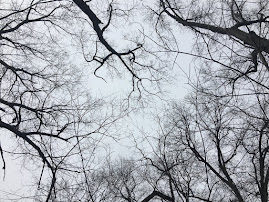
It feels like we’ve been buried under snow and ice for a year or more.  Finally Cincinnati got a break in harsh winter temperatures last week, and the polar vortex ice cap melted away, at least for the time being.  Our yard is sort of rinky-dink, probably a fiftieth of the size of the river property lawn my siblings and I grew up with.  However, thanks to Mother Nature and plantings by our gardener Jean Ann, it's full of interesting patterns and colors.  I walk one or the other sheepdog to the front lawn 8 or 9 times a day, and so I have lots of time to contemplate the vegetation.  Because seeing something other than a blanket of white has been such a visual treat, I thought I'd pass along a few of the images.
Love,
Dave


G-mail Comments
-Donna D (3-3): Beautiful.  

Thursday, February 27, 2014

Archive: Vic's Photos #6


My siblings Steve, Vicki, and Peter on the frozen Menominee River (circa 1957)

Dear George,
My dad, Vic L., was a talented photographer, and he chronicled our family life from the late 1930’s to the mid-60’s and beyond.  Starting in 2001, my brother Peter began creating postcards from Vic’s negatives and mailing them to family members.  Peter’s multi-year project, along with images taken from family albums, are the sources of the photos shown here.  I’ve been posting these once a week in the righthand column of my blog, but, because those individual items get deleted every week, I’ve been saving batches of them in this series of archives.  This is the sixth of the series.  The previous five can be accessed by going to the righthand column, scrolling down to “Labels”, and then clicking on “Archives.  The photos are nearly all taken at various locations in and about Menominee, Michigan, many at our family home on the Menominee River.
Love,
Dave


This family Xmas card looks to me like a professional photograph that was probably taken at Conant Studios in Marinette.  From the left, my brother Steve, myself, my dad Vic, and my mother Doris.  I would guess it’s about 1946 when Steve was 5 and I was 9.  Usually Vic did his own Xmas cards, but this seems to be a special edition. 


Steve and I are with our mom on Xmas morning after opening presents.  Probably 1943 or 1944.  Xmas was the most exciting day of the year in our family.  Santa brought presents, and so did our parents.  We were thrilled to get new toys and games and played with them for days and weeks on end. 


Here’s my brother Steve, around age 3, manipulating one of the floodlights that my dad used in his photography.  Vic enlisted our participation in his photo projects, most notably by having us help develop pictures in his darkroom space.  I’m going to guess that this was taken in our house on Sheridan Road during the war.


This is my parents and myself, probably in 1938 when I was about one year old.  It’s nice to see my parents when they were so young   Vic would have been 30; Doris, 28.  It was the midst of the Great Depression, a hugely difficult time for couples and families, but they look happy nonetheless.  


Carnivals and traveling circuses visited Menominee every summer, and they were highlights of the year.  The merry-go-round was exciting, if somewhat scary, for little kids, as were the pony rides and, later, the bumper cars.  This is me, toughing it out, around 1940.  


My dad is reading to me (left) and my brother Steven.  Steve joked about this photo, saying that Vic had never read a book to us in our entire childhood, except for the purposes of taking this picture which chronicles an imaginary family scene.  That might well be correct.  The photo does look quite idyllic, though, and that’s how we like to remember things. 


My Mom and I are checking out what’s probably a photo album.  More idyllic family life.  I look a little younger then than our five-year-old kindergarten grandchildren,V and L, are right now.  That’s mysterious.  


Here’s my dad and myself, circa 1940.  It’s sort of an unnerving image – e.g., two generations facing an uncertain and potentially harrowing future.   My dad’s looking quite formal in his suit and tie.  It’s a fitting father-son image from the depression/pre-war era.


Here’s my dad at the helm of a sailboat, probably Bob Hood’s, somewhere on Green Bay or Lake Michigan.  Menominee, of course, was and is an important Great Lakes port in the U.P., a destination for boaters from Milwaukee and Chicago as well as the home base for local boaters.  My parents regularly went on watery expeditions with friends to the Mackinac races, to Door County, and elsewhere.


Family friend Dooley Worth sent this photo to me.  It was taken at her parents’ hunting camp at Cedar River.  My dad, Vic, is in the middle.  I think the man at the left may be Judge William Hupy, a U.P. friend and lawyer colleague.  Margaret Worth is at the right.   The men are pretty solemn-looking.  I think they were having some fun by putting on faces.  


This is a view of the Menominee River looking west from our front lawn.  The sunsets were often spectacular there.  We made swimming rafts out of dried out logs from Pig Island across the river.  Then, when we were teens and thanks to the construction skills of my friend Bob A., we started having real rafts made with oil barrels and planks. 


This is myself, my brother Peter, and my brother Steven at YMCA camp somewhere near Green Bay, Wisc.  I was about 13, Steve 9, Peter 5.  My parents sent me off to YMCA camp for two weeks every summer.  I hated going, and it put me in a state of deep despair for weeks beforehand.  Once I got there, it wasn’t quite as bad as I feared.  However, when families came to visit on the middle Sunday, I still prayed they would take me home.  But they never did.  


This photo was also taken at YMCA camp, probably a year or two before the preceding one.  My brother Peter is in the tires, Steve is at the right (with big pants cuffs), and family friend Tom Caley is at the left.  I think Steve was the YMCA camper the year that this picture was taken.  He was more comfortable about going away to camp than I was, though none of us were thrilled about it. 


These are such representative facial expressions from my sister Vicki (left), her chum Kevin (Kiera), and our brother Peter.  Peter looks very impish, which in fact he was as a child.  I don’t remember the hand puppets, though they look like fun for the young people.  


This scene is at my eleventh or twelfth birthday party.  Participants from the left are my brother Steven, Frank S., Skipper B., Jim J., Bill C., and Sam W.  Birthdays at this age were a mixed blessing, since you got a lot of presents but you also underwent a lot of hazing, e.g., running the gauntlet while others spanked you.  I do look happy enough here.  


This is my mom and Circuit Court Judge Ernie Brown who lived in Iron Mountain.  Peter sent us this photo as a postcard and wrote of Ernie:  “He would make me sit on his lap while he sang ‘Bye low my baby.’  He loved me and threatened to kidnap me on every visit which filled me with terror.”  


Peter was the sole high school football player in our family.  He was on the junior varsity at Menominee High, and he might have progressed to the varsity as well.  Steve was a high school basketball player and golfer, I played #2 singles on the tennis team, and Vicki was a junior high cheerleader (cheerleading being the only athletic option available for girls in the early sixties).  


The Chicago Northwestern Railroad ran north from Chicago through Marinette and Menominee, and each of the twin cities had its own depot.  In the late 1950’s I’d take the C&NW railroad train from Marinette to Chicago and then transfer to another line to Springfield, Ohio, in order to get to college.


Our family’s social circle would enjoy frequent gatherings at people’s houses, cottages, and hunting camps.  These are some of the regulars of the group.  Standing, from the left, are Jean O’Hara, my brother Steve, Muriel Sawyer, my mom Doris, Bill Caley, and my dad’s law partner, Dick Sawyer.  Kneeling from the left are Michael Dennis O’Hara, Mike O’Hara, Florence Caley, and Tom Caley.  This was taken in the early 1960’s.  Our lives were all so intertwined that a photo like this brings back many memories. 


G-Mail Comments
-Linda C (2-28): What a wonderful set of pictures, I met Vic when he was old, but love the dapper look on him when young.
-Phyllis S-S (2-27):  Dave,  Loved the photos of your family - I can see your current face in your child's face…  Phyllis