Monday, April 27, 2020

Deathly Musings: Four Poems


Dear George, 
Love and death.  My teacher said these are poets’ two favorite topics.  I’ve tried writing about love, but it’s too sticky and I’ve been more enthusiastic about death.   Now with the pandemic raging, my obsession seems even more pertinent.  I actually don’t expect to fall prey to the coronavirus, but I will probably expire from something or other in the not-distant-enough future.  Some think that death is an unnerving matter, but, looking these poems over, I find it’s not as bad as they say.    
Love,
Dave 

Death on the Front Lawn 

I happened upon death when I was just four
Lying flat on our lawn, a dead crow
My sitter informed me I too would be dead
Much more than a small kid should know

Then I was eight and in the third grade
Mr. Elmquist, our crossing guard, died
We stared at his corpse at the funeral home
Couldn’t wake him as hard as we tried

I asked my dad, “What happens when we die?”
He explained that they don’t know for sure
Skipper told me I’d get eaten by worms
And then I’d turn into manure

Frankie said no, you’ll float up to Heaven
Dead ancestors will wait there to greet you
That could be exciting, it could be bad
I did have this aunt who’d mistreat you

I never believed in an afterlife
We’re like bugs, we just die and that’s that
Though my mother imagined us all together
Four kids, her husband, her cat

Death, in my mind, is not like a party
Nor is it a trip to Cancun
It’s probably more like an empty black hole
Or an unending Philip Glass tune

My demise gets more ominous the older I get
Some days it seems right around the corner
The funeral is actually what bothers me most
Embarrassing when I don’t have a mourner

And it’s not even death by itself that’s so bad
It’s the dying that’s the real bummer
Sometimes it’s quick and sometimes it’s slow
My advice, don’t take the whole summer

In truth, you get perks for being dead
You are done with the shots and the pills
No chance you’ll get stuck in a traffic jam
And Visa stops sending their bills

A whole lot more could be said about death
Like pandemics and nuclear war
But I think I will look on the bright side
Make a list of life’s pleasures galore


* * *

Touring the Hereafter 

Our Triple-A branch, I was pleased to learn,
Offers tours of Heaven and Hell
Since one day soon I’ll be ashes in an urn
I thought I’d see which rings my bell

Heaven throughout is a pristine place
Cozy cottages with white picket fences
Adults wear gowns that are trimmed in fine lace
Best of all, there’s no charge for expenses

The first day in Heaven one is given their harp
Lawrence Welk composed all of the tunes
Cous-cous and kale at six p.m. sharp
For breakfast, poached eggs and dried prunes 

All the radios in Heaven play NPR
People meditate and then do Tai Chi
Ambrosial melodies float from afar
Tiny toddlers take naps on your knee  

I wrapped up my tour, Hell was soon my next stop  
The dwellings, less comfy, I’d say
Residents eat Big Macs, drink sugary pop
Then torture newcomers all day

Most inmates of Hell play poker at night
And do other stuff we’d call risky
Write poems that usually are boring or trite
While besot with too much Irish whiskey
           
All the TVs in Hell are set to play porn
Strangers dance the Charleston while nude 
I didn’t see a demon who looked forlorn
It’s hard to be glum when you’re lewd

Now I’m having trouble making up my mind
Of course Heaven can be seamlessly nice 
But Hell, I found out, is unfairly maligned
It’s hard to pass by such fine vice 


* * *

The Pearly Gates

I dreamt I was standing at the Pearly Gates
So many in line, the longest wait
Tens of thousands arrive every hour
Such a chore to decide each one’s fate

I wasn’t quite sure of procedures
But from everything I could tell
St. Peter inspects you and he decides
If you’re headed for Heaven or Hell

When I got to the gate I pressed the buzzer  
Beaming angels welcomed me in
They gave me a ten-page form on which 
To list all my good deeds and sin

I ran into trouble with the Good Deeds part
Even though I scanned all of my life
I take out the garbage on Monday nights
But the big stuff I leave to my wife

I had more success when I got to Part Two
A list of my sins filled twelve pages
I teased and tortured my brother for years
And told naughty lies at all ages

St. Peter arrived as I finished page twelve 
I would say that he stands six feet two
With a long white beard, a halo, a robe
And a frilly bedraggled hairdo

I watched St. Peter as he scoured my list
Each page led to more of a frown
He looked toward the sky and he shook his head
My heart stopped as he pointed straight down

Your score, said St. Peter, is a minus ten
But for Heaven you need a plus six
He led me to an elevator next to the door
Pressed the button for the River Styx

As the elevator dropped, I woke from my dream
Relieved that I still have some time
I’ll start my good deeds in a week or two
And be sure to record each in rhyme


* * *

Crossing the Styx

The moment my funeral came to its end
I awoke on the bank of the underground river
Bleary-eyed, disoriented, I knew immediately
the River Styx, the notorious river of hate
The passageway from Earth to the Underworld
A journey I always knew I would pursue one day

Charon, the ancient boatman, stretched out his gnarled hand
Yellowed skin, brown-stained teeth, an unkempt beard
An emaciated man, filthy, with blazing dark eyes
The very image of Death himself
Repelled though I was, I handed the boatman the silver coin
that my spouse had carefully tucked in my vest
Charon nodded, beckoned me to join my fellow travelers
Three old men, a young mother, a newborn babe
Strangers all but comrades on our final journey

The Styx was black as coal, bitterly cold
Putrid odors seeped from its surface
A toxic mix that singed my nostrils
My eyes were drawn to the river’s flotsam
Bloated corpses of vengeful sinners
bobbing along, limbs akimbo
grotesque grins etched into their faces
Along the riverbank we spotted hundreds of Wraiths
wretched spirits who couldn’t afford Charon’s fee
destined to wander for a hundred years
I felt sympathy for the lost souls but also relief

We heard Cerberus before we could see him
Thunderous roars echoing throughout the valley 
His form slowly emerged from the mist
and a shudder ran down my spine
A gigantic three-headed dog
snakes bristling around his neck
eels bulging from his torso
Razor-like claws, matted fur, the tail of a dragon
Snarling, prowling, circling, growling
Guarding the river’s edge, barring the dead
from any hope of return to Earth

Charon’s boat bumped against the shore
The fog so thick, my eyes were squinting
Small fires flickered here and there, a bitter smoke smell
Undulating screams and cries from all directions
Naked adults roamed aimlessly
Children curled into fetal positions
sobbing and wailing for lost mothers
Milling about in the meadow
the Gorgons, the Centaurs, the Harpies
No scene in my past life on earth had been this compelling
I stepped ashore from the boat, my curiosity peaking
A tinge of excitement in anticipation of this new world


Sunday, April 19, 2020

An Epidemiological Journey

Milton Werrin at his 20th St. veterinary practice


by Katja Lundgren
(excerpt from a paper presented to the Cincinnati Contemporary Club, March 2, 2020)

My veterinarian father, Milton Werrin, joined the Department of Public Health in Philadelphia in 1948.  The Department’s task was a complex one.  Philadelphia has always been a multi-ethnic, diverse city of approximately two million people.  And it has always been a city of immigrants.  Each community has its own churches, mosques, temples, synagogues, as well as restaurants, schools, foods, and manner of food preparation.  Professionals in the Department of Public Health have to know all about each community if they are to save lives or prevent illness. 
            Public Health doctors and veterinarians were informed of the occurrence of puzzling or unusual maladies by doctors or hospitals around the city.  An incident that was barely mentioned in the newspapers of the time but affected at least twelve families in a tragic way took place at Christmas time.  My father was the principal investigator during that week.  He started receiving  reports from various hospitals throughout the city noting that patients were exhibiting severe stomach cramps, paralysis, respiratory distress, and blurred vision  The patients lived all over the city but the one thing that they had in common was that they had all celebrated Christmas Eve dinner with friends and family members, as they did every year, at a single home in Little Italy. 
            My father visited  the home of the hostess.  She was horrified to think that her cooking may have caused such widespread havoc, and she willingly answered all questions and showed him her well stocked pantry.  She was asked what she had served; where she had purchased her ingredients; whether she had used anything different than in past years, whether her food preparation was different than in the past.  She answered all of the questions honestly and without qualms.  She even volunteered, with much pride, that this year she had used her very own home grown tomatoes that she had picked and canned from her Victory Garden.  She explained that she was planning to expand her repertoire to other vegetables, and her husband had already prepared a large patch of ground for next Fall’s crop. 
            The canned goods were taken back to the lab at City Hall for testing as were the leftover ravioli and other Italian delicacies that had been served Christmas Eve.  The shocking discovery revealed that the home canned tomatoes and tomato sauce in her pantry all tested positive for botulism.  The canning process she had used was defective.  Tragically, five people died, and the others had lingering, debilitating symptoms. 
Other public health problems continued to be tackled.  In Philadelphia there has always been a pigeon problem around City Hall.  Just to set the scene, City Hall is a huge, gray, Baroque building with turrets and tunnels topped by a wonderful, life-like sculpture of William Penn, the Quaker founder of the city.  The law used to forbid any building to be built taller than William Penn’s head but I’m sure that law has been changed by now. 
The plaza surrounding City Hall has always been filled with bustling human traffic and hundreds of pigeons.  They walked among the pedestrians, they flew around the turrets, they roosted on poor William Penn’s head, and they pooped everywhere and on everyone in their path.  It was a nightmare for anyone who had business in City Hall, and, of course, it was unsightly and unhealthy. 
The Department of Public Health started compiling statistics that indicated people within a certain radius of City Hall were developing Psittacosis — a rare flu-like disease also known as Parrot Fever.  There is a treatment for it today but in the 1950’s none existed.
Attempts at getting rid of the pigeons were tried, and my father used to come home at night and let us know the progress they were making (or not making) for the eradication of the pigeons.  As children we used to think his efforts were hysterically funny. The eradication of pigeons did not appear to be a serious  endeavor to the three of us. However, when we became older and were permitted to go downtown alone and walk around City Hall, we saw the damage and mess caused by the pigeons with our own eyes.
  Here are a few of the attempts used to rid the City Hall area of its pigeons:
(1) The city hired sportsmen snipers to shoot the pigeons at night when there were few pedestrians around.  Many died but they returned in droves.
(2) Poison was spread in crumb form all over City Hall Plaza for the pigeons.  Back they came.  Also, it was very unpleasant and unhealthy to have a plaza littered with dead pigeons.
(3) The city installed huge horns around William Penn’s head and randomly blasted the birds.  Unfortunately, the pigeons appeared to either ignore the noise or were deaf to the blasts.
(4) To my best recollection, the problem was partially solved in the 1960’s when the crumbs or food left for the pigeons contained birth control or sterilization medication.  The pigeon population diminished to a tolerable level.
The City of Philadelphia installed an enormous LOVE sculpture by Robert Indiana.  It seems to have remained clean and sparkling to this day.  The pigeons returned in fewer numbers, and even the returnees did not poop on the sculpture.  Make of this victory what you may.  Perhaps pigeons are art lovers.  
While the Public Health department concerned itself with pigeons, other investigations of even greater importance took place during the 1950’s and 60’s.  The discovery of the effect of lead in paint on Philadelphia children’s mental and physical development brought about the abolition of all paint containing lead, nationwide.  In addition, the Department of Public Health became increasingly involved in the detection of industrial hazards and the intersection of machinery, food preparation, and illness.
            My father would tell us about outbreaks of anthrax that occurred in particular tanneries and sheep farms.  Respiratory anthrax was not the form showing up among weavers or leather workers.  It was primarily the skin form with boils and rashes and terrible joint pain.  He became more and more convinced that the barrier between human and animal, viral and microbial, was becoming more transparent, and the need for public vigilance was becoming greater.
The whole field of public health was expanding at this time, and the field of Epidemiology was changing the understanding of how society and large urban populations became sick or stayed healthy.  The changing political climate under the aegis of the Charterite progressive party encouraged an increased professionalism among those who ran and worked in the public health field.  Epidemiology as an area of study and as the backbone of modern public health departments became the route by which my father’s life was to change, once again.
            In 1956, upon the urging of his very progressive boss, my father applied for and won a fellowship to the Harvard School of Public Health — considered the most prestigious school of public health at that time.  Its curriculum focussed  on human and veterinary epidemiology.  He went off to school the same year that his oldest child left for Antioch College.  It was a huge decision to make as he left behind my mother and two children under eleven.  It was also a decision he made with the enthusiasm and hope of expanding his professional and personal life at the age of forty-eight.   It proved to be the turning point of his life, and he embraced the new science of epidemiology wholeheartedly.           
            Harvard was the meeting ground for students from all over the globe.  Many of the graduates went back to their homes and became leaders and administrators of newly formed countries.  My father would write to me at Antioch, enthusiastically describing Friday night suppers with a colleague from Ethiopia.  Since there were no Ethiopian restaurants in Cambridge at that time, dinners were prepared at the student’s apartment.  “He cooked up a goat and we ate with our hands,” exclaimed Dad.
            When Dad returned home he was promoted to a new position — Head of the Veterinary Division of the Department of Public Health and Epidemiology.  During Lent of that year reports started to come in indicating that over a hundred Philadelphians had become ill from chemical and food poisoning.  Doctors and hospitals specifically named nitrite and fish as being the problem.  The number one Catholic tradition of eating fish during Lent meant that many hundreds of additional citizens were at risk of becoming ill.  This was the perfect case for the new Department of Epidemiology and Veterinary Medicine.
            My father and his colleagues went down to the wharves  and tested  the stalls of every fishmonger for excessive nitrite levels. They searched for any spoiled fish on the premises.  No evidence was found, and they began to think the fish might have come from out of state with the evidence long gone.  However, my father noticed that next to every fish stand there was a drain — necessary for the workers to clean up their day’s products.  As he described it, he got down on his knees and took samples from every drain.  Eureka — one drain in particular had excessive residues of nitrites and spoiled flounder.  Upon questioning, the vendor admitted that his flounder had gone bad, and rather than throw it out, he had packed it in large quantities of nitrites to give it the appearance of fresh fish.  The nitrite also removed the smell of  spoiled fish.   
The man was brought to trial, and, since there were five fatalities among the many very ill citizens, he went to prison.  The evidence was undeniable, and so was his confession.
            During the late 1950’s American taste in furniture changed from an interest in heavily upholstered sofas and chairs to cleaner lines, less stuffing, bare wooden or metal unadorned pieces that came primarily from Scandinavia or Asia.  Scandinavian furniture was usually made of light, streamlined teak, rosewood, walnut and leather.  Furniture coming from Asia (Hong Kong, China, Japan, the Philippines) was characterized by straight, unadorned lines and beautifully carved, black exposed wood with an occasional silk pillow for decoration or comfort.
            In 1961, several families in the Philadelphia Chinese-American community ordered several shiploads of very expensive and very beautiful furniture from Hong Kong and Singapore.  It arrived in time to celebrate the Chinese New Year. Reports started coming into the Board of  Health describing a virulent outbreak of  poison sumac that seemed to be targeting members of the Chinese-American community.            
             Since it was winter time and the Chinatown area was in the very urban downtown area of Philadelphia, it was unlikely that these patients were getting this rash from picnics in the park or from raking leaves and autumn foliage.  The Chinese New Year took place in January — not exactly a pastoral time of year.
            Investigating this outbreak revealed that these patients shared a common thread.  The  purchase of lovely black carved furniture from Hong Kong.  Remembering conversations he had had with Asian colleagues at Harvard regarding manufacturing techniques used in the furniture export business, my dad asked one of the homeowners if he could borrow one of the chairs to be examined in the Health Department laboratory.
            Chinese furniture manufacturers usually apply a lacquer to their furniture giving it a distinctive, shiny black look. The furniture that was tested revealed the presence of poison sumac in the black lacquer. Anyone who sat on this furniture, which was not covered in any manner, contracted the poison sumac rash on arms, legs, face, and scalp.  The furniture constituted a whole shipload from a specific factory in Hong Kong.  The rash spread throughout the Asian community as they visited family and friends during the Chinese New Year season.  My father had implemented the techniques and protocols which he had learned during his year at Harvard, and another award was earned by the Philadelphia Department of Epidemiology. 
            My father lived a professionally satisfying career.  From his struggling veterinary practice on 20th street, he managed to embrace and become part of a larger world.  He and my mother travelled extensively throughout the world after retirement. We received postcards and letters from India, China, the Middle East, Spain, Portugal, Italy, Greece, France, and Russia. My father would alway comment on the health conditions in every country visited.  However, in my mind’s eye, I still see a young girl, sitting on the windowsill of his veterinary hospital, doing her homework, and anxiously awaiting her father’s return so that they could begin the really exciting part of their life together.


Sunday, April 12, 2020

Iko and Li'l Paws


Dear George,
Iko and Li'l Paws are very good sleepers.  Back home in New Orleans they normally get up about 7 a.m., but we retirees have a much more relaxed schedule.  When the dogs first arrived I set the alarm for 9, but soon I discovered that they are content to sleep in till 10 a.m. or later.  Li'l Paws, though the smaller of the two, gets into our bed at night by first jumping up on the cedar chest.  Iko doesn’t try that, and he initially decided to sleep in my closet next to my smelly gym bag.  Then I started lifting him into our bed, and he’s slept there ever since.  He is fascinated with the odor of human breath, and some mornings he climb onto my chest, stretches out so his nose is near my mouth, and naps for another thirty minutes or so.  

Our daughter-in-law K’s sister lives in Northern California, and K and J decided to ride out the coronavirus pandemic there, a wise decision since New Orleans has become one of the nation’s hotspots.  K and the kids flew out in mid-March, and J drove up to Cincinnati to leave the dogs in our care.  This has worked out well.  Though it’s been several years since our sheepdogs died, we still miss them a lot, and Iko and Li'l Paws make “sheltering in place” much more tolerable.  Lots of walks, rough-housing for me, loyal companions, and more laughter around the house.  Among other benefits, my blood pressure dropped from 140/90 to 120/70 shortly after the dogs arrived.  


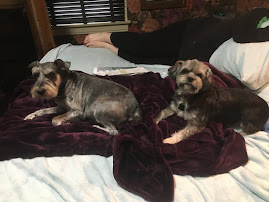
Iko is a miniature Schnauzer with a sweet personality.  If I remember correctly, I think he was a street dog before he joined J and K’s family.  Compared to our sheepdogs, he’s a little guy.  Twenty inches from nose to butt, 17 inches high at the shoulder, 20 pounds.  I would describe Iko as friendly and mellow.  He bonded with us immediately, likes to growl and play fight, rolling on his back and kicking his legs in the air, and stands with his front paws on my desk chair arm to let me know that I’m spending too much time on the computer.  


Li'l Paws is more feisty even though he’s a pipsqueak compared to Iko — 17 inches long, 12 inches high, 13 pounds.  He’s a Yorkie/Chin mix.  Despite being a tiny little dog, he’s very boisterous, and seems to have a Napoleon complex.  Whenever Iko comes over for some affection, Li'l Paws jumps in front of him and hogs the limelight.  Li'l Paws is also pretty noisy on the street, barking ferociously at all the big dogs and letting them know he is a force to be reckoned with.  He’s always in the lead as we walk, tugging at the leash and pulling me along.  For a thirteen-pounder, Li'l Paws is remarkably powerful.  I think if he were my size he would probably be capable of pulling a freight train.  He also has a thing for ladies underwear, depleting Katja’s wardrobe day by day.  One evening he raced past me in the bedroom and seemed to disappear.  I finally found him underneath our king-sized bed.  He’d absconded with a pair of undies.   I reached in to get them, and Li'l Paws let out a vicious growl and bit my hand, drawing blood.  Remembering that dogs have a wild side, I let him keep his ill-begotten  treasure.


The dogs are very attached to humans.  Katja sleeps in most mornings, and I go down the street to get a loaf of salt rye bread and a cinnamon twist at Graeters.  Iko and Lil Paws station themselves at the kitchen door when I leave, and they are still standing there in the exact same position fifteen minutes later when I return.  When we watch TV, Lil Paws jumps up on the couch between us, and Iko stretches out on the floor at our feet.  If anybody leaves the room, the dogs follow faithfully right behind them.       

Last week when I picked up Graeters pastries Katja was still asleep so I arranged them on paper  plates on our solarium table.  When she woke up, I told her that her cinnamon twist was waiting downstairs.  She went to get it but it wasn’t there.  I discovered that I’d left a chair too close to the table.   A little scoundrel (or maybe two) had gotten up and enjoyed a feast of sweets.  I’m sure that those pastries were bigger than either dog’s stomach, but there wasn’t even a crumb left.


The dogs’ eating habits are strange, to say the least.  With our sheepdogs, we were accustomed to one meal at breakfast time and a second at supper, with the dogs gobbling up their bowls in a minute or two.  Iko and Li'l Paws, though, are on a different regimen.  They share one bowl which is kept full 24 hours a day, and they just take turns eating whenever they feel like it.  Katja refills the bowl every two or three days when it gets low, and, when she puts it down, the dogs give a quick sniff but otherwise show little interest.  Later Li'l Paws might pick up a couple of pellets with his teeth and take them to the next room to chew them up.  Iko eats a bit from the bowl, but rarely more than a mouthful or two.  Despite a never-ending supply of food, the dogs are very casual about eating, and the bowl stays pretty full all day long.  Very mysterious.     


I take the dogs out 4 times a day: 10 a.m., 2 p.m., 6-ish, and 10 p.m.  When I pick up the leashes to get ready to go Iko jumps up and down and barks, and Li'l Paws runs around in tiny   circles.  Li'l Paws always leads the way on the walk, while Iko is more leisurely, stopping to sniff every spot that another dog has been at.  I kept count on a recent walk, and Li'l Paws peed 3 times on our 8-block trip while Iko left his mark 22 times.  Li'l Paws would like to go out more if he could.  Our friend Jennifer stopped by last week, and I let the dogs out on the patio to greet her.  Li'l Paws promptly managed to nudge the patio door open with his nose and took off like a flash.  Jennifer went running after him, and I followed behind, but Li'l Paws was a lot faster than either of us.  He ran behind our garage, up our neighbor’s driveway, down the sidewalk next to busy Ludlow Avenue, then back up the east side of our house.  Lucky for us, he  stopped momentarily in our driveway, and Jennifer yelled, “STAY!!!”  Startled by her authoritative voice, Li'l Paws froze in place and started trembling.  Jennifer scooped him up, and we avoided catastrophe.


J had originally planned to return and pick up the dogs in a week or two, but now it’s hard to tell what the future will bring.  We are happy that our family is in a safer place, and we are having a fine time with our canine visitors.  No one really knows what the next step will be.  We’ll just go with the flow.  So far Iko and Li'l Paws are disinterested in the pandemic.    
Love,
Dave


Sunday, April 5, 2020

Insects of River House


Dear George,
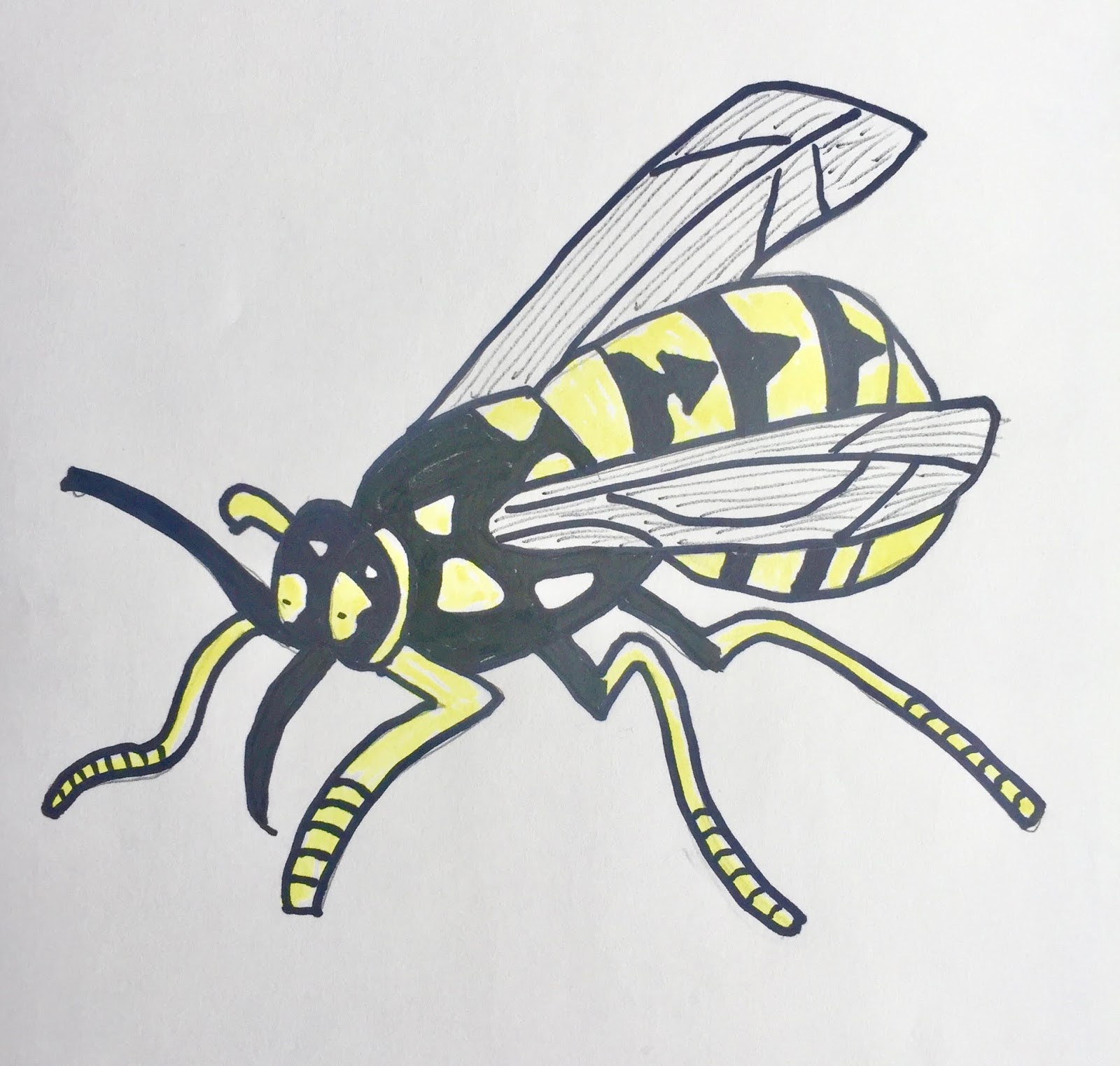
Growing up in the country, we were much closer to nature than I’ve been in my adult life.  My mother taught us the names of all the birds, and my father got us observe the many animals on our property.  But, most of all, I’d say, our world was populated with a remarkable variety of insects.  They were so ever-present that, in some ways, they were our companions and playmates in our daily lives.  For some time I’ve been writing short poems about the insects at our house on the Menominee River.  Recently, with even more leisure time because of coronavirus “stay at home” orders, I’ve taken to illustrating them with felt pen drawings.  Bugs, I’ve decided, are a perfect topic.  Here is my project so far.
Love,
Dave   


Our lawn held ten thousand mosquitoes
They arrived on the twelfth day of June
They weren’t so busy at noontime
But they thrived by the light of the moon


We’d search for the beetles in the forest
Turn over a log and they’re there
They liked to eat leaves and fungi
But earthworms, their number one fare 


The grasshoppers lived in the birch grove 
Strong legs, they could jump up so high
Grasshoppers weren’t even that hard to catch
I suspect they forgot how to fly


Dragonflies wore their coats of bright colors
They’d visit us out in our boat
Quite content to be with the humans
Since they tickled our ears and our throat


The ticks found our dogs in the forest 
They’d burrow right under their skin
As soon as a tick was ballooning with blood
We’d pop him, much to his chagrin


Cicadas are most mysterious bugs
The nymphs grow up deep in the earth
They tunnel to the surface and shed their skins
Their skeletons gave us kids mirth


The ants built huge colonies in the earth
Then we’d poke a tree branch in their hill
This drove the fierce ants to a frenzy
They rushed to find bad kids to kill


Millions of fireflies came with the sunset
We’d catch them in a big Mason jar
They never stopped switching their lights on and off
Each buglet, a glorious star


Thousands of wasps had their home in our field
This we remembered when we stepped on their nest
So angry, they attacked like a Prussian army
The sharpest of stings from this barbarous pest


The Junebugs came out at twilight
Their prime time, of course, was mid-June
They made a huge racket on the window screens
Busy mating by the light of the moon


Crickets remind me of grasshoppers
Except they can sing like a lark
It turns out that only the males chirp
Each one hits his high notes come dark 


Big horseflies harassed us young swimmers
These monsters had the nastiest bite
We thought them the ugliest bugs of all 
And screamed when we saw them in flight


The spiders spun webs on our eaves
To capture mosquitoes and flies  
I watched these artists as they built their traps  
Hard workers, so patient, so wise 


Monday, March 30, 2020

True Romance


Dear George, 
I went to the freshman mixer on the first day and joined a cluster of eight or nine new classmates who were chatting about politics.  I couldn’t believe how knowledgeable and sophisticated they were.  I think I was the only U.P. kid to ever attend Antioch College.  While standing there I spotted a girl in a white dress across the lawn.  A thin, pretty brunette.  She was very animated, flitting about, chatting with this person and that, and had a beautiful smile — bursting with enthusiasm and joy.  I was smitten on the spot and decided that this was the girl that I hoped to marry someday.  Weeks later I learned that her name was Katja Werrin.  While I saw her around campus now and then, I was much too shy to introduce myself, and my first year went by without my having a date with her or anyone else.  
  Our school had a coop system in which all students did jobs off campus, starting in their second year.  My first coop job was at a biological laboratory in Madison, Wisconsin.  I was very lonely in Madison and decided to take a weekend trip to Milwaukee where two of my freshmen hallmates were working at a private mental hospital.  Much to my amazement, Katja Werrin, the girl I’d admired from afar at the mixer, was also there, living a block away from my friends and hanging out with them.  Though I’d never had the courage to speak to her, now chance circumstances had brought us together.  After a second visit I invited Katja to come to Madison to see the University of Wisconsin.  She did so, staying in a dorm with one of my high school friends.  So exciting.  On the first night we went to a campus bar, and I told Katja about wanting to marry her the first time I saw her.   She got very angry and said that was the worst line she had ever heard.  When I dropped her at the dorm we did kiss good night.  It was our first kiss,  Years later Katja told me it was that kiss that sealed the deal.  
  In ensuing weeks my mind was constantly in that agitated state that we know as mad love.  The end of the quarter arrived, and Katja accepted my invitation to come to my family’s home in  Menominee for spring break.  My father and my brother Steve picked us up by car in Madison.  We stopped for a Whitehouse sandwich for lunch, and it was so rich that it required rest room stops all the way home.   When we arrived at our house, Katja went immediately into the ladies room.  My mother, unable to contain her excitement, burst through the unlocked bathroom door to tell Katja that she was the first girl that I had ever brought home.  Katja was mortified, and I’m sure her first impression was that U.P. people were a strange lot.  The rest of our vacation went better.  We walked out on the river ice and saw a mud-puppy on the river bottom, then hiked on snowshoes to Brewery Park. Many of my parents’ friends came over, and Katja thought they were quite wonderful. 
  We returned to Antioch by streamliner and hung out together much of every day.  Katja was a pre-med major, and we took chemistry and physics together.  We were lab partners, but neither of us had much aptitude.  Katja was much more casual about precision in our experiments, while I was  much more rigid.  When we weren’t doing classes or homework, we went to the Little Art Theater to see Ingmar Bergmann or Fellini movies or drank 3.2 beer and chatted with proprietess Goldie at Com’s Tavern on High Street.  By the end of the year Katja had switched from the Pre-Med to French, and I had replaced Engineering with Literature.
  My coop job in my third year was at Popular Science magazine in New York City while Katja was living with her family in Philadelphia, working at Philadelphia Psychiatric.  We’d get together every couple of weeks, either in Philadelphia or New York.  One of my Antioch friends, Steve Schwerner, was a knowledgeable jazz buff, and Katja and I joined the outings that he organized to jazz clubs in and around Greenwich Village.  Thelonious Monk was our group’s  favorite.  One night at the Five Spot Cafe I was nodding to the music, tapping on the table with my knuckles, and I looked up to see Monk at his piano, watching me with a big grin on his face. 
My visits to Katja’s home in Philadelphia were less successful.  First of all, I was silent most of the time.  Second, Katja’s family was Jewish, and there was very strong pressure in the 1950’s for sons and daughters to find Jewish mates.  The final straw came when Katja’s parents offered me a glass of whiskey and I not only accepted it but helped myself to a second glass.  Before I knew what had happened, I was being driven to the bus station, banned for eternity.  Later I took the bus back to Philly and we met downtown, but it was freezing, and we were unhappy puppies wandering about in the cold.    
In our fourth year Katja did a year abroad, first in Besancon, France, and then in Vienna.  She was conscientious about corresponding about her continental adventures, but I was abysmal.  Katja returned to Philadelphia from Europe prior to our fifth and final year, and, deciding from my non-correspondence that I was no longer interested in her, she wrote me a Dear John letter, explaining that she had moved on.  Things weren’t any better when we met on campus.  I would say that the ensuing months were the most painful time of my life and probably hers as well.  Through some miracle too complicated to describe, we did finally manage to get back together.  We scheduled our wedding for August 28th, 1960, at the Quaker chapel on our college campus.  Our minister’s name was Howard Johnson.    
Katja’s parents had been more than dubious about our relationship.  However, they did drive to Yellow Springs from Philadelphia with Katja’s siblings, Ami and David, and they begrudgingly gave Katja fifty dollars for our wedding expenses, enough to rent the upstairs room in the student union for two hours and to buy a bouquet of flowers, a small cake, and one bottle of champagne for twenty guests.  We had purchased our wedding rings for nineteen dollars apiece, including the engraving, from a sidewalk vendor in nearby Dayton.  
My parents, my brothers Steven and Peter, and my sister Vicki drove down from the Upper Peninsula.  Katja’s father told my dad the night before the wedding that they opposed our marriage and were sure that we would wind up getting divorced.  My father took us aside that same night and said, in no uncertain terms, that Lundgrens never get divorced.  That was actually a helpful intervention since we never did consider divorce over the years, even in the rockiest times.   We honeymooned for one night in a downtown Dayton hotel that had seen better days and left the next day to begin graduate school in Ann Arbor.  One major phase of our life had come to an end, and a  brand new young married phase was about to begin. 
Love,
Dave  


Wednesday, March 25, 2020

Hunkering Down


Dear George,
It’s a beautiful spring day in Cincinnati.  Sunny, temps in the mid-60s.  I was much too warm wearing my sweatshirt when I went out earlier.  For the most part, our street scene looks normal.  Dog walkers, joggers, families with baby carriages, old folks carrying groceries.  Invisible to the eye, however, is the horrendous threat which confronts our nation and the world at large.  

Like many places, we are under a Stay at Home order in Ohio.  Because Katja and I are retired, this is less disruptive and life-changing than it is for many people.  We enjoy being home and have lots of things to do.  We’ve watched favorite shows on TV; I’ve been doing some felt pen drawing and poetry writing; Katja is cooking up a storm.  Ventures to CVS or our neighborhood grocery store feel more hazardous, and we wash our hands frequently and disinfect our doorknobs.  

J and his family have gone from New Orleans to Northern California where K’s sister lives, and they will be there for some unknown period of time.  J drove up to Cincinnati first with their two doggies, Iko and Li’l Paws, and we enjoy having their company.  The dogs are lying at my side as I type this, apparently content to be in our household.      

I have no idea whether or not Katja and I will come down with this infection, nor, if we do, how serious it will be.  The same goes for our nation, our community, our loved ones.  There’s just so much uncertainty, and I have no idea whether our lives will return to normal.   We are simply going to do the best we can.  I do plan to stay busy with my blog.  Our thoughts are with all our family and friends.
Love,
Dave 


Thursday, March 12, 2020

Signs of Hope


Dear George, 
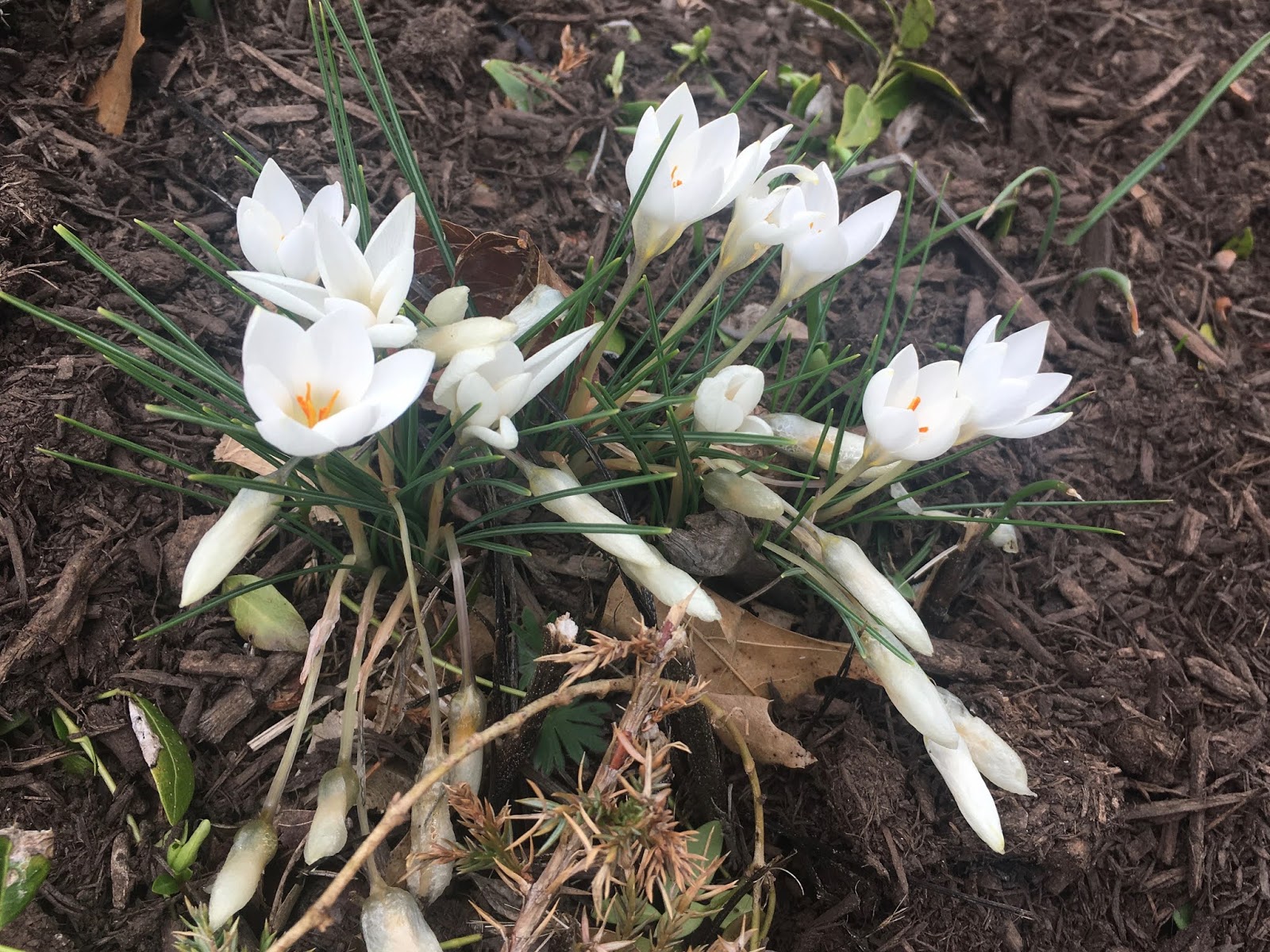
Today our governor banned all gatherings of 100 or more people in the state of Ohio.  Our OLLI classes have been cancelled for the spring quarter  and won’t resume until September.  All the local universities have cancelled in-person classes, and Ohio schools will start a mandatory three-week spring break on Monday.  We’re advised not to fly commercially, not to eat out, not to go to the gym, to buy two weeks worth of canned goods, and to stay home.  A very cloistered life.  Our world, like most of the nation, has pretty much shut down.  I read on CNBC that the attending physician to Congress and the Supreme Court estimates that up to 150 million Americans will eventually become infected with the coronavirus.   Katja and I will adjust our everyday routines, but we are nervous about being in an age group with an estimated 15% mortality rate.  Not wanting to feel imprisoned, the best I could do was take a walk around our block and look for signs of hope.  Spring, it turns out, is breaking forth this week.  Here are some of the sweetie-pies that announce that life is still up and running.  
Love,
Dave