Thursday, September 15, 2011

Drug Store World

My Grandfather, V.A.L. Sr. (circa 1950)


Dear George,

In 1893 at age 18 my grandfather, V.A. Sr., emigrated from Sweden to Menominee with his parents. At first he worked in the logging camps. Then he got his pharmacy degree in 1903 from Ferris Institute in the Lower Peninsula and soon opened drug stores in Menominee and Marinette. By the time I was a teenager, my grandfather was in his mid-70’s and had pretty much retired from a successful business career. He gave his Menominee store to my Uncle Kent, who operated it as the head pharmacist, and he gave the Marinette store to our father Vic Jr., for whom it was a side business to his law practice. As the oldest grandchild, I became the first kid to work at the family drugstore at age 14, as did each of my siblings in the years to follow. My starting salary was 25 cents an hour, and I was excited each year when I got a raise of one nickel.


V.A. had built the brick Rexall drugstore building on the corner of Wells and Main St. at the southern edge of Marinette’s business district. Conant’s photo studio, where we got our high school yearbook pictures taken, was next door. Nylund’s Gift Shop, owned by the O’Hara’s next door neighbors on Green Bay, was two doors down. Tiny’s Bar, where my parents bought Jim Beam Whiskey at a discount price, was around the corner on Wells St. A local blacksmith shop was on the opposite side of Wells from Main St. The Boren Clinic, the Twin Cities’ largest medical establishment, was a half block down on Main. I’d be sent there sometimes to pick up prescriptions or deliver medications.


The Marinette Drugstore, Main and Wells (circa 1972)


The drugstore’s two main personnel were Clarence N. and my Uncle Ralph. They were both good bosses, but they were differed in personality and style. Clarence was the main pharmacist, older, with jet white hair, wire-rimmed spectacles, and a serious Midwestern demeanor. He used a mortal, pestle, and copper weights to mix prescriptions and was painstakingly careful. My uncle Ralph was a large and more affable man, full of laughs and amusing stories. He sang in a barber shop quartet which competed around the state. Ralph enjoyed chitchatting with the customers, and various neighborhood shopkeepers would come in during off-hours to shoot the breeze with Ralph about the day’s events. Highway 41 ran through Marinette into the U.P., and Ralph advised tourists about their vacation routes and itineraries. He encouraged visitors to check out the waterfront business district in downtown Menominee, then see the buffalo herd in Henes Park. He’d tell northbound travellers that Highway 41’s inland route through Menominee County to Escanaba was fastest if they were in a hurry, but M-35 along the Green Bay shore was a much more scenic and pleasant route.


My Uncle Ralph and Aunt Martha


My primary duties were to help customers find merchandise and to ring up their sales. I was good at math and preferred to add up all the purchases in my head rather than ring them up individually on the cash register. On one occasion when I totaled and rang up about 15 items, the customer questioned my mental calculations. Even though I proved to be correct to the penny, Ralph told me I would have to add up items on the cash register from then on. Rexall Aspirin and Hadacol were our medical best sellers. I learned later that Hadacol’s widespread appeal was due to its 12% alcohol content. I was put in charge of the ice cream counter at the front of the store. The neighborhood kids would beg me to make the scoops larger, and I would usually oblige them. Clarence watched over my shoulder one day, and he put the kibosh on that, showing me how to measure out a uniform (measly) scoop. To this day, I believe our ice cream sales declined as a consequence.


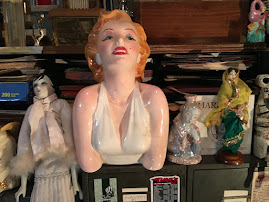
Evenings were slow, and I’d stand at the front tobacco counter reading a comic book or movie magazine till somebody came in. An elderly, unshaven neighborhood geezer stopped by every week to check the new magazines. He was completely infatuated with Marilyn Monroe. He wrote daily love letters to her, and he was convinced Marilyn that loved him in return and would soon be coming to Marinette to visit him. I loved Marilyn too, but I was less carried away in my fantasies.


We closed at nine, and it was my nightly job to sweep the floor throughout the store. I also checked the shelves before closing time and replaced any missing items from the stockroom in the back. Once a season we did a complete inventory, and we had to list on lined tablets the exact quantities of every item that the store carried. That boring task seemed to go on for weeks. In the winter I was responsible for shoveling the sidewalk, and my dad arranged for me to paint murals, e.g., Santa or the Easter Bunny, on the store’s front windows at holiday seasons. I made deliveries in the neighborhood on my bike, and sometimes I’d go to a competing drugstore over on Hall Ave. to pick up some medication that we needed for a customer but didn’t have in stock.
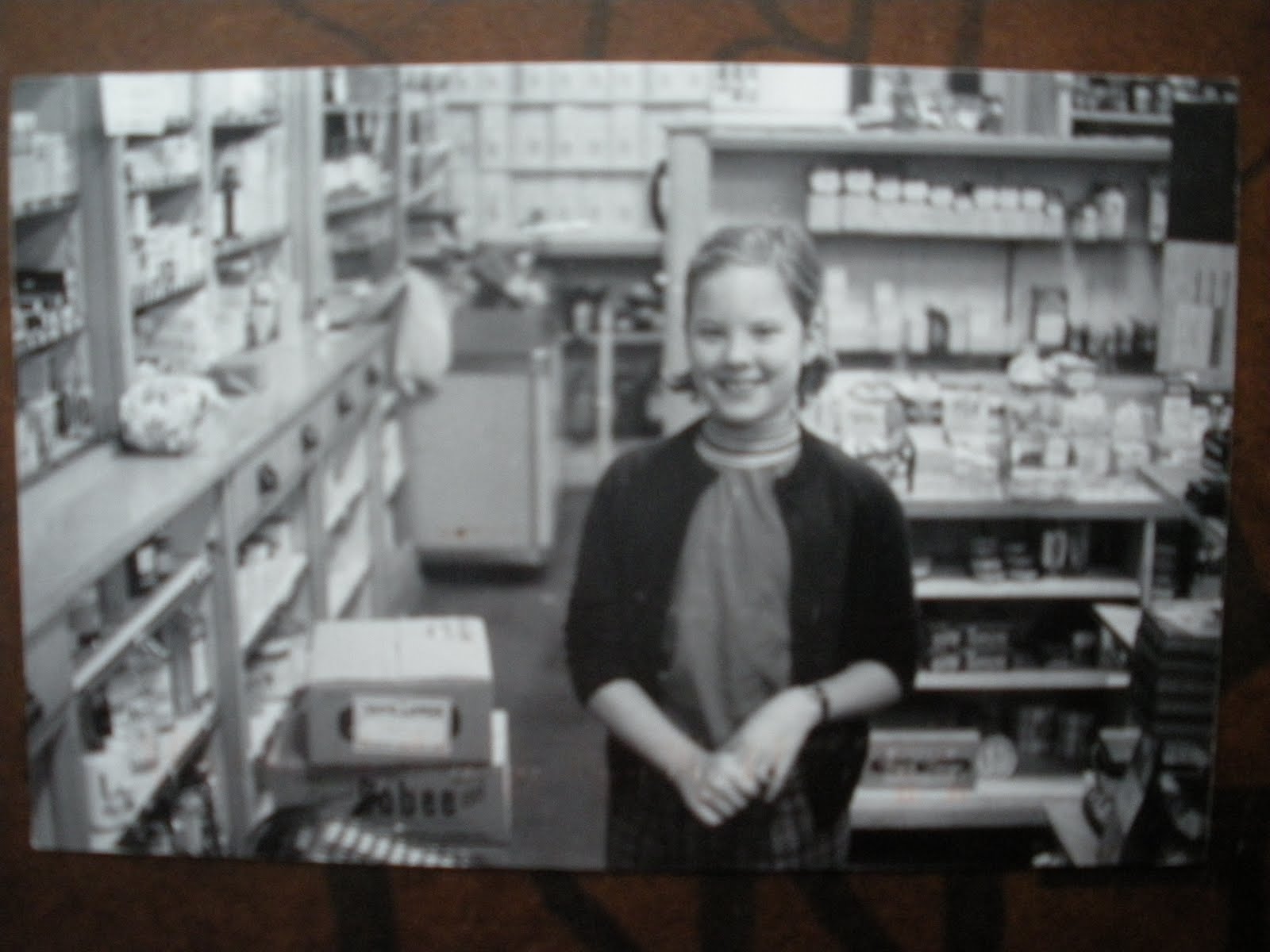


My Sister Vicki in Her Job at the Family Drugstore (circa 1960)


The most high pressure part of my job was taking a money bag filled with the previous day’s receipts a block and a half down the street to the First National Bank. I undertook the task with utter seriousness, concealing the money bag in a innocent-looking paper sack and watching for masked robbers who might try to waylay me along the way. After I’d made it successfully to the bank (which I always did), I’d continue down Main St. to get a frozen malt cone at Lauerman’s Department Store. The frozen malt machine was right up at the front counter. It was the best cone I’ve ever tasted. Though I’ve kept an eye out ever since, I’ve never run across another frozen malt vendor anywhere. After my malt cone I’d go down to Lauerman’s basement and check for any new additions to the camping gear in the Boy Scout department.


My father was attuned to health issues, and he became increasingly convinced that operating a drugstore, whose very aim was to foster well-being in the community, was incompatible with selling cigarettes and cigars. He decided to remove the tobacco counter. Uncle Ralph responded with total alarm, arguing that we got half of our customers from the personal contact that occurred when people stopped in to buy a pack of cigarettes. My dad and Ralph argued back and forth for a year or more -- the two of them taking heated, polarized positions. Eventually Ralph’s pragmatism won out, though Vic never really accepted the idea.


My Dad, V.A.L. Jr.


One day a young girl came in and spoke to Ralph at the back of the store. She was perhaps 13. I saw her hand him a note, and he shook his head after reading it. After she’d left, he told me that the note was supposedly from her mother, asking the pharmacist to sell her daughter a box of condoms that her daughter would bring home to her parents. Ralph said that he got that all the time from young girls. He felt bad about refusing contraceptives to sexually active young teens. At the same time, he was sure there would be a serious uproar if he did that and it became a matter of common knowledge in the community.


The condom drawer was in the back room where prescriptions were prepared. I was always curious and liked to look over its contents when nobody else was around. Several years later, when my brother Steven was working at the store, he thought it would be a funny practical joke if he stole a box of condoms to give away as the prize at a poker party he was hosting for his teenage male friends. He’d just put a box of Trojans in his pocket when our mother came in to the store and started talking with him and Clarence. Somehow Steve, fiddling around, managed to drop the condoms onto the floor between the three of them. My mother didn’t see it, but Clarence did, and he rapidly pushed the box behind him with his foot. Steve grabbed the box up as soon as he had a chance. Neither he nor Clarence ever spoke a word about it.


In addition to Clarence, Ralph, and I, the drug store staff included a black-haired woman named Gertie. Gertie was very outgoing, full of jokes and laughter. Her specialty was the cosmetics counter, and she was an excellent saleswoman. She and her husband owned and operated a tavern on Hall Ave., Ed and Gert’s, and she’d shift to her evening hours as a barmaid after her daytime stint at the drugstore. One day Ralph was out of town on vacation and Clarence became ill after lunch. Despite state regulations requiring that a registered pharmacist be on the premises at all times, Clarence went home, leaving Gertie in charge. Around mid-afternoon Gertie called me to the back of the store, looking pale and in a state of panic. She said that the State Inspector had just come in for his annual visit. Gertie gave me her car keys and said I should get out to Pine Beach as quickly as possible and bring back my grandfather so we would have a pharmacist in the store. She said she would stall the inspector in the meantime. Pine Beach was a couple of miles away, and I drove through town at fifty miles an hours, rushed my grandfather V.A. Sr. into the car, and raced back to the store. My grandfather, as you might imagine, was totally upset about possible sanctions from the authorities. Gertie was waiting for us at the back door, looking sheepish. The State Inspector had already finished his job and left. It turned out he wasn’t the pharmacy inspector at all – he was the plumbing inspector. So much for that dire crisis.


V.A. Sr. and I at the Drugstore (circa 1953)


Years later, when Katja and I were married, my dad would tell us that we could go over to the drugstore and pick out anything we wanted for free. We’d stock up on household supplies for the year: bandaids, mercurachrome, shoelaces, shampoo, aspirin, Tums, shaving cream, combs, everything we could think of. Katja especially loved to spend time behind the cosmetics counter, and she fully replenished her beauty supplies on each of our trips. After several years of this Ralph explained to us that it wasn’t really free, but, rather, our bill was put on my father’s tab. Even though we’d discovered it wasn’t free, that didn’t slow us down much on subsequent trips.


One summer in the early 1960’s when we came home we learned that Uncle Ralph was gravely ill. We went to visit him at his family’s Pine Beach home, and he was as cordial and welcoming as always, though he’d lost a lot of weight and his face was very pale. I vividly remember him saying that if he could have only one wish in the world it would be to go back for a day’s work at the drugstore. We said we prayed that that would happen, but we knew in our hearts it wasn’t likely. Ralph, in his forties with two teenage children, died a couple weeks later. Some time after that, Clarence retired and my dad sold the drug store to a pharmacist named Jerry. My dad didn’t lose sleep about disposing of the store since most years he’d lost money from the business. However, we were saddened by the end of a family tradition.

Love,

Dave


G-mail Comments

-Vicki L (9-16): Hi D, I really loved this piece about the drug store- maybe I'm touched not only be the memories but by how much richness lies within simple, ordinary daily living. Thanks, V

PS Where did the picture from Vic come ? - a rare find!

Sunday, September 11, 2011

Mundane Photograpy: 1. Walls


Dear George,

Recently I’ve been taking lots of photos of walls. This came about by accident. I was driving across the Harrison Avenue Viaduct and noticed the railroad yards down below. They struck me as very photogenic, so the next day I came back, parked my car up the hill on McMicken Ave., and walked down to the viaduct. The first section of the viaduct was topped with a high fence designed to prevent wayward teens from throwing rocks on the cars passing below. After the fence, however, the viaduct walkway turns into a narrow sidewalk with speeding cars on one side and a waist-high wall next to a hundred-foot drop on the other side. I walked no more than six steps before I started feeling queasy. Rapidly retreating, I decided that that was it for my railyard project. As I disappointedly walked back to the car, I passed by several walls in various states of deterioration. To prevent my outing from being a total loss, I took a few pictures. Back home, I found them visually interesting and decided that walls, though lacking the intrinsic power of railroad yards, were a worthy subject matter in their own right.


Usually, I think that the most meaningful photos one takes are of people, particularly friends and family members. They have the richest emotional connotations and often capture memories of particular occasions that people have enjoyed together. I also like photos I’ve taken on trips to Santa Cruz or New York City since they provide a visual record of places and experiences. All have a lot of personal relevance and meaning.


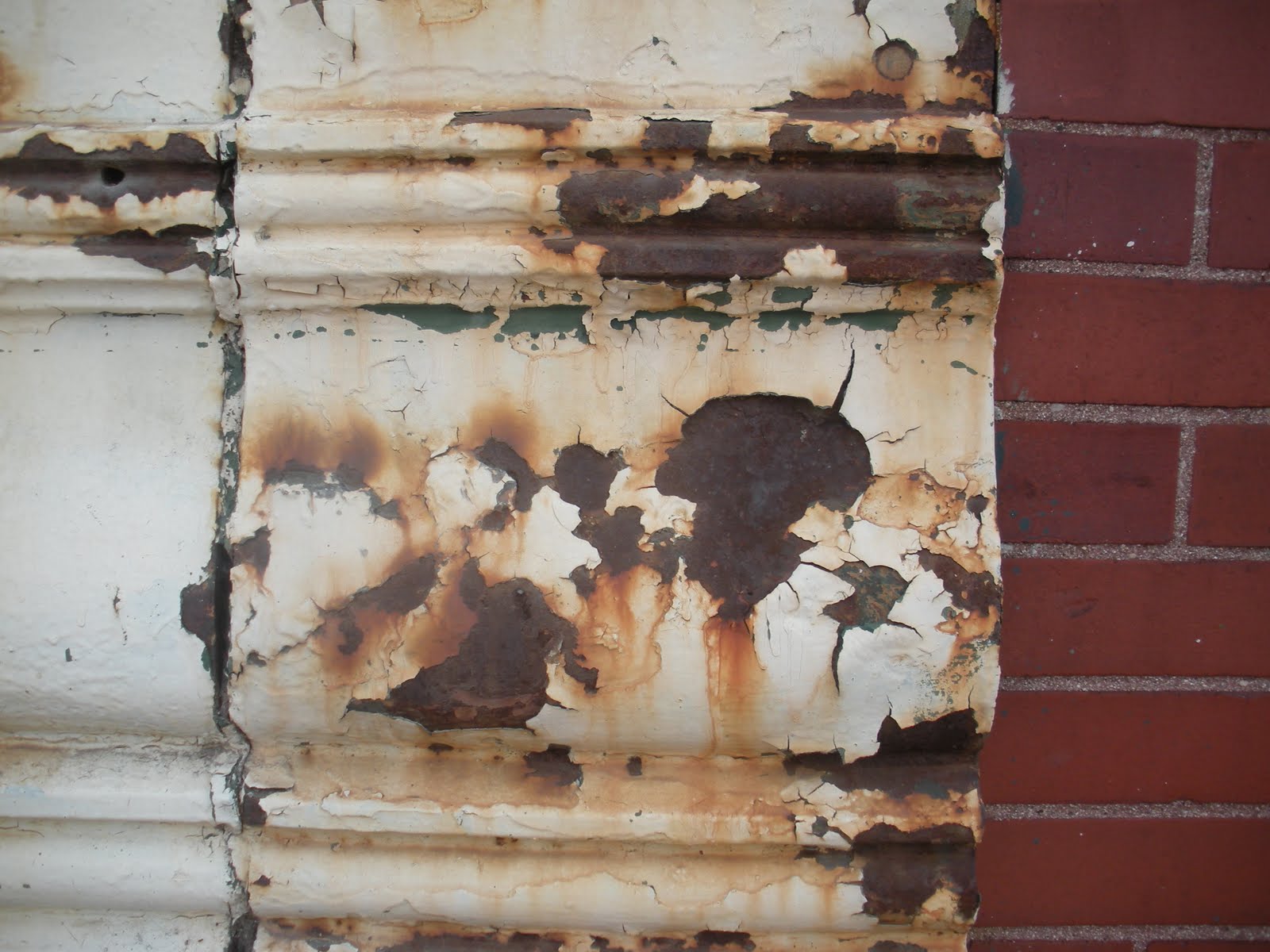
Walls are at the opposite end of the spectrum. Rather than special, they are mundane, even potentially boring. With photos of people or places, we usually have a rich history of interaction with the “object” of interest, and the photo arouses a host of memories and emotions. Railroad yards, for example, activate a host of meanings: commerce, transport, speed, power, workers, goods, wealth, etc. Walls, in contrast, are ever-present and entirely familiar, but we usually pay them minimal attention and we’re unlikely to feel much sense of personal connection or associative meanings if we do. Consequently photos of walls presents the challenge of selecting a stimulus configuration that will be aesthetically pleasing in and of itself, rather than via what it means personally or in terms of past history. It’s the immediate configuration of shapes, colors, and forms that provides the photo’s sensory impact. Here are some of the wall images that I like. See what you think.

Love,

Dave


G-mail Comments

-Donna D (9-13): oh my god, david...these are really beautiful!!! donna

-Vicki L (9-11): Hi Dvd, Wall Art! I say. I think you should continue your project, get over your vertigo and get Greg to have a gallery showing. My friend Virginia (also my supervisor back when I was an intern) has really taken to photography since her retirement and has put on several shows. She's having a lot of fun. I think you have always had artistic sensibility and talent - glad you're sharing. Maybe even more people can see it. The other thought I had is you might select a few of your favorites, frame them and install them at Farm next summer. You're an inspiration. Love, Vicki (PS I've only been making bouquets....).

Thursday, September 8, 2011

A Birthday Letter for Our Grandchildren

My family in 1949: Steve, Dave, Vic with Vicki, Doris, Peter


Dear V and L,

Here it is, September again, the time for your third birthdays. That’s so great. You’ve both grown so much in the past year, and you are becoming such good talkers. Your grandma Katja and I are very eager to see you. We are sad that we can’t be in New Orleans this week, but we plan to visit you soon. In the meantime I am going to celebrate your birthdays by writing you this letter. In it, I will tell you something about my family history, because, of course, now it’s part of your family history too.


V.A. and Olga (seated) at their wedding, June 1, 1904


This picture is of my grandparents, V.A. Sr. and Olga, at their wedding on June 1, 1904, in Marinette, Wisconsin. These are your father’s great-grandparents, and so they are your great-great-grandparents. My grandfather V.A. Sr. was born in 1875 in Ostersund, Sweden, and he came to this country in 1893 with his parents, Carl and Martha. Olga had been born in Landskrona, Sweden. She had moved with her parents to Marquette, Michigan, when she met my grandfather. V.A. Sr. first worked in the logging camps. Then he went to school at Ferris Institute and became a pharmacist. He opened a number of drug stores in our home towns of Menominee, Michigan, and Marinette, Wisconsin, and was a very successful businessman. V.A. was a very kind, gentle man who was a loving grandfather to my brothers, my sister, myself, and his other grandchildren. I didn’t know my grandmother Olga as well because she didn’t live as long, but my parents always described her as a very strong woman who was a leader in politics in the state of Wisconsin. My dad Vic was V.A.’s and Olga’s first and oldest child, and then they adopted twin boys, Kent and Karl (my uncles), and their daughter, Martha (my aunt).


My parents Vic and Doris (about 1940)


These are my parents, Vic and Doris. They are also your dad’s grandparents and your paternal great grandparents. Vic was born and grew up in Marinette, Wisconsin, and he met Doris while at the University of Wisconsin. She was from Omaha, Nebraska, and was an honors student in school. Vic became a lawyer and then a judge and prosecuting attorney in Menominee. Doris worked in my dad’s office, then became a homemaker and our mom. She raised four children and created a beautiful home. They had many dear friends and led a very enjoyable, interesting life in our home town. My parents always emphasized doing well in school and striving to be excellent in whatever one chooses to do. They also believed it was important to have lots of fun and enjoy life. They took us many places and exposed us to art, music, books, museums, plays, and many different experiences. They always encouraged us to do the right thing, make good decisions, and keep on the right track. They were proud of their children and their grandchildren (including your Dad).


My brothers, sister, and myself on the river in Menominee (about 1950)


These are our parents Vic and Doris’ four children: my brother Peter (born in 1945), myself (born in 1937), my sister Vicki (born in 1947), and my brother Steven (born in 1941). I was the oldest, Vicki was the youngest, and Steven and Peter were in between. In this picture we are out on the Menominee River at our house on Riverside Boulevard. You can tell that we were happy children who loved one another. We spent a lot of time swimming in the river, playing in the forests, and going on hikes with our Irish Setter dogs. Peter grew up to become a financial executive in New Jersey with two kids of his own. Steven became a lawyer in Seattle, with three children. Vicki became a family and marriage therapist in Santa Cruz, California, with three children. I was a college professor in Cincinnati, and we had one child, your Dad. For many years we all had family reunions together at Vic and Doris’ Farm in Birch Creek, Michigan. Being with my brothers and sister were some of the best times of my life.


Katja and I at our wedding (1968)


I met your Grandma Katja in 1957 when we were students together at Antioch College in Yellow Springs, Ohio. I wanted to marry her the first time I saw her, and we did get married in 1960. First we went to graduate school at the University of Michigan, and, after that, we moved to Cincinnati where we’ve lived for 45 years. You’ve come to visit us in Cincinnati several times already. (Remember our sheepdogs, Mike and Duffy?) I taught Social Psychology and Katja taught French at the University of Cincinnati. Then Katja became a Social Worker who helped blind people have better lives. Now we have both retired from our jobs.


Katja and your Dad when he was two years old at Mt. Airy Forest


Your Dad was born in 1969. Having a child became the most exciting thing that ever happened to Katja and me. We gave him lots of love and attention, and he turned out to be a great kid. He could stand on his head longer than anybody in the neighborhood, was an expert at skateboarding and hacky-sack, and was a champion tennis player. We were very sad when he left home to go to college, but we were also proud and happy for him.


Your Mom and Dad


Your Dad met your Mom when they were in college at Columbia and Barnard Universities in New York City, and it was the best thing that ever could have happened. They fell in love right away and have been together ever since. When they graduated from college and went to New Orleans, they decided to become doctors, which required a lot of hard work for year and years. Then it was time for them to start a family of their own. Who do you suppose that could be?


Two darling children on the first day of school


You children are the most wonderful thing that has ever happened for your Dad and Mom. You are lucky to have such great parents, and they are lucky to have you. Your Mom and Dad are patient, loving, and fun. They are thrilled with what you say and do, and it’s wonderful to see all the fun that you all have together. Already you have been to more places and done more things than practically any children we’ve ever known.


So now it’s your turn, with your parents’ help, to grow up and carry on these family traditions. There are many wonderful people on both your Mom’s and your Dad’s sides of your family, and we are thrilled that you will be such an important part of that. We are excited about being with you many times in the coming years. Happy Happy Birthdays!

Lots of Love,

Grandpa Dave


G-mail Comments

-Vicki L (9-9): Hi David, What lucky little grandchildren you have. It would've been so meaningful to me had Vick and Doris delineated our family history with pictures and anecdotes. You've given Vida and Leo a tremendous gift (as well as myself). Hope things are well at home. Love, Vicki

-JML (9-8): Hey dad, such a nice letter! Thank you

-Jennifer M (9-8): This is so sweet. It brought tears to my eyes. A wonderful gift to your grandchildren.

Monday, September 5, 2011

Peshtigo Tidbits and Postcards

Catholic Church, Peshtigo (now the Fire Museum)


Dear George,

It’s a truism to say that our lives and character are shaped by the various communities in which we live and spend time. My early experiences were mostly in Menominee and Marinette, but other places were significant too. Many of our forest outings occurred at Cedar River. Green Bay (pop. 50,000), an hour away, was our closest metro destination for shopping and orthodontics, and family trips to Milwaukee and Chicago provided the year’s other-worldly cultural highlights. Peshtigo (pop. 3,400) was our closest neighbor, seven miles south of Marinette on Highway 41. Though we only visited occasionally, Peshtigo turned out to be the site of some of the more thrilling and scarier experiences of my childhood.


Like Menominee and Marinette, Peshtigo was a logging boom town. French fur traders had explored the area in the late eighteenth century, and a man named J. H. Levenworth built Peshtigo’s first sawmill in 1838. The lumber industry thrived over subsequent decades, with millions of feet of lumber transported down the Peshtigo River to mills on the shores of Green Bay. The town is best known for the Great Peshtigo Fire of 1871, the largest forest fire in American history which destroyed 1.5 million acres of woodlands and killed at least 1300 people. Like many towns in the area, Peshtigo’s name is an Indian word, translated as “wild goose”. Today Peshtigo’s economy is centered around the Badger Paper Mills, a grandchild of the logging era.


Sorting logs on the Peshtigo River


For Katja and I, Peshtigo has always been a landmark on our trips home for family reunions. Driving in, we’d take note of the city limit sign and the Peshtigo River because they signaled that we had just a few more miles to Marinette and Menominee. I’ve always procrastinated on journeys home, so we’d normally stop in Peshtigo to delay our arrival time, typically by having a Hot Fudge sundae at the town’s Dairy Queen. If it were close to supper time, we’d go to Anderson’s Family Restaurant and have a Butterburger (a remarkably delicious, sinful burger that I’ve seen only in the twin city area). For years there was a raggedy junk store on Highway 41 near the middle of town where we’d search for old postcards, antique dishware, and other castoff treasures. Then the world’s greatest flea market was just a couple of miles further up the road, an absolutely essential stop.


In our childhood, Peshtigo was the destination for the year’s single most exciting trip. That’s because it was the nearest place that one could buy fireworks for the Fourth of July. Each year on the morning of the Fourth two or three dads would put their oldest kids in somebody’s station wagon and drive over to Peshtigo to buy an array of skyrockets to shoot off that evening at Northwood Cove. The older we got, the more say we had in selecting which fireworks to purchase, and then we’d be allowed to set them off ourselves that night. There were tons of fireworks at the roadside stand, and the young debated endlessly about which ones to choose. It’s hard to describe our level of eager anticipation. When we were teenagers, we’d go back to Peshtigo with our dads a few months later because it had one of the area’s best hunting stores. With the approach of deer season, we’d stock up on ammunition for a November trip to hunting camp in Cedar River. While not as amazing as fireworks, boxes of rifle bullets had their own emotional aura.


The Marinette County Insane Asylum at Peshtigo


Peshtigo was also the source of deep childhood anxieties. The area’s single most frightening place, the Marinette County Insane Asylum, was located on the north edge of town, set in a grove of pine trees about 150 yards off the road. We children would stare intently at it as we passed by and share fantasies about crazed people locked in chains or bashing their heads against the walls of their padded cells. Our stereotypes came from old Hollywood movies like “The Snake Pit.” All of us, we believed, were at risk of losing our minds, and now and then we would hear a rumor about somebody being shipped off to the Asylum. After many such trips, I spent the next few decades worrying about being locked away. It’s probably a good sign that I haven’t thought about that for a long time, but maybe that’s just because I don’t travel through Peshtigo these days.


I’ve collected a big collection of Menominee and Marinette postcards over the years, and I always keep an eye out for Peshtigo too. Here are some images from the early 1900’s to the 1960’s which give a feeling for the history of our next door neighbor.

Love,

Dave


Downtown Peshtigo


Peshtigo's first auto


Employees of the Wisconsin and Michigan Railroad, Peshtigo


Train Depot, Peshtigo


Peshtigo High School, ca. 1910


Peshtigo Gun Club (1909)


Thompson Boat Company, Peshtigo


Badger Paper Mills, Peshtigo


Peshtigo Fire Cemetery


Peshtigo River


G-mail Comments

-Gayle C-L (9-6): David. Great story with great pictures. ;))).

Lots of love.

Thursday, September 1, 2011

Heikki Lunta

Kenny Svenson of Traprock Valley as Heikki Lunta, Heikinpäivä Festival, Hancock, MI, ca. 2001 (www.csumc.wisc.edu)


Dear George,

If people aren’t from the U.P., they've probably never heard of Heikki Lunta. In fact, if you're not from certain counties in the northeastern U.P., you still might never have heard of Heikki Lunta. As it turns out, the U.P. is the only place in the country where a number of counties have a concentration of people of Finnish ancestry. Houghton County, with 47% Finnish-Americans, is one of those places. And that's where the modern legend of Heikki Lunta, the Finnish Snow God, was born.


There's a little town called Atlantic Mine about five miles away from Houghton where they hold an annual snowmobile race every winter. In 1970 the race was at risk of being cancelled because there wasn’t any snow. The race was sponsored by radio station WMPL in nearby Hancock. With no snow in sight, one of the station’s salesmen, David Riutta, composed a song called the "Heikki Lunta Snowdance Song." It took him about twenty minutes to invent the lyrics. "Heikki Lunta," it turns out, means “Henry Snow” in Finnish, and Riutta chose the name because his favorite musician was country western singer Hank Snow. Heikki Lunta was said to live in the back woods of a Finnish farming community south of Houghton, and he reportedly had the ability to do a dance which would cause snow to fall from the skies. Riutta’s song asked "Heikki Lunta" to do his dance to make it snow in time for the snowmobile race. They started playing the song on WMLP, it immediately became a local hit, and, lo and behold, it soon began snowing. According to local lore, it snowed and snowed for days. So much so that they had to cancel the snowmobile race.


Carl Pellonpaa, Finnish-language TV host, as Hankooki Heikki (2004)


Quite a few townspeople believed that Heikki’s snow dance song had caused the excessive snowfall, and there was a lot of public outcry. Riutta was chagrined when a huge lumberjack, infuriated by the amount of snow, threatened to “clean Heikki’s clock.” In an interview one of Riutta’s radio station co-workers said, “It was getting dangerous for Heikki and Dave…people started throwing rocks at them…well, not really rocks, but snowballs filled with rocks.” In response to the uproar, Riutta recorded a new song, "Heikki Lunta Go Away," and it became the flip side of the record. The song apologized for the big mess, and Heikki promised to quit dancing unless he was called upon again. Here’s the first half of the original Heikki Lunta Snowdance Song (1970):


Now I’ll sing my song


To make the snow come down


And I’ll do my snow dance


Whoops! I almost lost my pants


I’ll holler and yell,


And really give it---

It’s Heikki’s snow dance song, 
Heikki’s snow dance song

We gotta have some snow by the 4th of December


“Heikki Lunta, make it snow!” say all the Range Club members


The races are only three weeks away


And if I don’t make it snow, I’ll go back to making hay

It’s Heikki Lunta’s snow dance song,


Heikki Lunta’s snow dance song.

Snow, snow, snow!


Melvin Kangas, Finlandia U. Prof., as Hankooki Heikki (2010)


Heikki Lunta’s fame spread, and the snow dance song was circulated to radio stations around the country. Heikki Lunta’s story was aired on “The Today Show” and The Tonight Show,” and David Riutta was invited to events as far away as California to sing his magical song. Heikki became the focus of many festivals and events throughout the Upper Peninsula, especially in Finnish-American communities, and he’s still around as an important local presence. We’re going to keep an eye out for him on our next trip to the U.P.

Love,

Dave


Sources:

“Not Just Talking About the Weather: Tradition, Social Change and Heikki Lunta”, Hilary Virtanen, www.csumc.wisc.edu/exhibit/HeikkiLunta/index.htm

“Heikki Lunta – A Modern Copper Country Folk Hero,” Jim Kurtti, www.pasty.com/heikki/heikkilunta.html

“Heikki Lunta”, www.wikipedia.org

Photos: Google Images