Showing posts with label history. Show all posts

Tuesday, September 17, 2024

THE BEAT POETS


Dear George, 
Katja and I went to college in the late 1950’s, and, like most of our contemporaries, we were caught up in all sorts of new and exciting ideas. Existentialism, psychoanalysis, Zen buddhism, etc. The most powerful of all was the Beat Generation movement. Rebellion, hedonism, the search for meaning fit our life stage and circumstances, and “On the Road” became our bible. Katja took to wearing all black and scrapping makeup, while I let my hair grow long and tried (unsuccessfully) to grow a scraggly beard. When we went to co-op jobs in New York City, we hung out in Greenwich Village coffee houses and jazz clubs, hoping to catch a glimpse of Jack Kerouac. Now, some 65 years later, I’ve become immersed in reading and writing poetry, and I find myself going back to revisit the beat poets. Here’s a quick review. 

“Beat Generation” refers to a literary and cultural movement that initially formed in New York City in the late 1940’s and became influential nationally and worldwide in the 1950’s and early 1960’s. The initial core group of Beat Generation authors — Jack Kerouac, Allen Ginsberg, William Burroughs, Herbert Huncke, and Lucien Carr — met in 1944 in and around the Columbia University campus. Many of their ideas were formed in response to Columbia professors like Lionel Trilling and Mark Van Doren. Kerouac introduced the phrase “Beat Generation” in 1948. The term “Beat” is believed to have originated from the jazz term “beatnik” which referred to a group of artists and musicians who embraced a countercultural lifestyle. “Beat” was slang for “beaten down” or “downtrodden”. The Beat Generation authors often challenged societal norms and explored themes of alienation and disillusionment. In the mid-1950’s Kerouac, Ginsberg, and others moved to San Francisco’s North Beach neighborhood, drawn by the burgeoning literary scene there. 

Beat Generation poets had a major impact on American literature and society, challenging traditional values and exploring unconventional themes. The Beat poets pioneered a new literary style that emphasized spontaneity, improvisation, and personal experience, and that rejected traditional poetic forms, e.g., rhyme and meter. Often addressing social and political issues, the Beat poets explored a wide range of unconventional themes, including spirituality, free love and sexual liberation, drug use, and the search for meaning. Their emphasis on individuality, freedom, and self-expression inspired a generation of young people to question traditional values and to embrace more unconventional life styles. Major Beat poets included Jack Kerouac, Allen Ginsberg, Lawrence Ferlinghetti, William S. Burroughs, and Gregory Corso. 


Jack Kerouac. Kerouac was born into a French-Canadian family in Lowell, Massachusetts, in 1922, and he grow up in a family shaped by his father’s death and his mother’s struggle with alcoholism. He received a football scholarship to Columbia University where he met 17-year-old Allen Ginsberg and William Burroughs and became involved in the emerging Beat Generation scene. Serving in the U.S. Navy during World War II, he was honorably discharged on psychiatric grounds with a diagnosis of “schizoid personality”. Kerouac is best-known for his novel, “On the Road”, based on his cross-country road trips with his friend Neal Cassady. Kerouac’s poetry explored many of the same themes as his prose, the allure of the road, the search for meaning, and the spiritual quest. He employed a stream-of-consciousness style, and his poems often reflected the rhythms and spontaneity of jazz, creating a sense of musicality. Kerouac published three poetry collections: “Mexico City Blues” (1959), “Book of Dreams” (1962), and “Scattered Poems”, published posthumously. Despite his literary success, Kerouac struggled with alcoholism, drug addiction, and financial instability, never fully achieving the fame and fortune that he sought. He died in 1969 at age 47 from internal bleeding caused by alcoholism. 


Allen Ginsberg. Ginsburg was born in Newark, New Jersey, in 1926, growing up in a family with a history of mental illness. His mother’s struggle with schizophrenia deeply influenced his personal life and his work. Ginsberg attended Columbia University in the 1940’s where he formed a close-knit community with fellow poets like Kerouac and William Burroughs, the group striving to break free from societal constraints and to explore unconventional themes. Ginsberg’s early career involved struggles with drug addiction, mental health issues, and financial instability. His breakthrough came with the publication of “Howl” in 1956, a poem that explored alienation, conformity, and sexual liberation, and that immediately led to Ginsburg’s fame. Throughout the 1960’s and 1970’s Ginsberg was actively involved in the civil rights and anti-war movements, his poetry addressing issues such as police brutality, racism, and the Vietnam War. His main influences were William Blake and John Keats. Ginsberg won the National Book Award in 1993. He died in 1997 of liver cancer, leaving behind a legacy of poetry, activism, and cultural influence. 
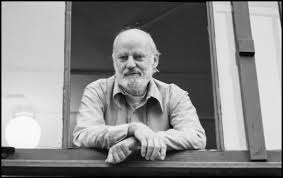


Lawrence Ferlinghetti.  Ferlinghetti was born in Yonkers in 1919. His father died when he was 6 months old, and his mother was committed to an a mental institution shortly afterward. Ferlinghetti spent time with an aunt in France, an orphanage, and the mansion of a wealthy family. After serving in the U.S. Army during World War II, he earned a B.A. at North Carolina, an M.A. from Columbia, and a Ph.D. in comparative literature from the University of Paris. He moved to San Francisco in 1951, and in 1953 he and a partner opened the City Lights Bookstore, publishing the works of Kerouac, Ginsberg, and other Beat poets and becoming a West Coast hub for the beat Generation. Ferlinghetti’s poems often addressed social and political issues, criticizing conformity, materialism, and the Vietnam War. His most famous work is a collection of poems published in 1958, “A Coney island of the Mind.” He was a committed activist as well, engaging in civil rights, anti-war, and environmental protests. Ferlinghetti died peacefully at home in 2021 at the age of 101. 


William Burroughs.  Born in 1914 in St. Louis, Missouri, Burroughs attended Harvard where he studied anthropology and served in the U.S. Army during World War II. He formed a close friendship with Ginsberg and Kerouac in the 1950’s. Burroughs was a heavy drug user, and his exploration of altered states of consciousness had a profound impact on his writings. Burroughs developed a unique literary technique known as the “cut-up” in both poetry and prose which involved taking fragments of text, rearranging them randomly, and creating new, often nonsensical, narratives. Though primarily known for his prose works, Burroughs published several collections of poetry, including “The Cities of the Red Night” (1981) (a series of prose poems exploring sexuality, violence, and the occult) and “Queer” (1991) (exploring gender, sexuality, and identity). Burroughs died of a heart attack in 1997 at the age of 83. 


Gregory Corso.  The youngest of the original Beat group, Gregory Corso was born in New York City in 1930. In his early years, he spent time in foster homes and orphanages, was homeless for a period, and was imprisoned multiple times. Despite this background, Corso discovered a passion for poetry in prison and then became friends with Ginserg and Kerouac in Greenwich Village. His poetry was characterized by its simplicity, directness, themes of rebellion and spirituality, and often humorous tone. “Bomb”, one of his most famous poems whose text was shaped like a mushroom cloud, is a scathing critique of war and the destructiveness of human society. Corso was known for his unconventional lifestyle, struggled with alcohol and drugs, traveled extensively, and lived in various parts of the world. He died of prostate cancer in 2001. His ashes were deposited at the foot of Percy Bysshe Shelley’s grave. 

The beats had major influences on the culture, paving the way for the counterculture movement of the sixties. Among other bits of trivia, the Beatles spelled their name with an “a” as a reference to the Beat Generation. Other notable figures who have acknowledged the Beat’s influence on their work include Bob Dylan, David Bowie, Andy Warhol, Ken Kesey, Timothy Leary, Tom Wolfe, Quentin Tarantino, and Francis Ford Coppola. In 1982 Ginsberg published a summary of the effects of the Beat Generation. His list included: spiritual liberation, gay liberation, liberation from censorship, decriminalization of marijuana and other drugs, ecological consciousness, opposition to the military-industrial machine, and respect for land and indigenous peoples. 

When my spouse walked by and asked what I was doing the other day, I told her, “I’m writing about the Beat Generation. It takes me back to when we were Beatniks.” She laughed. “Or trying to be,” she replied. “That’s more like it.” I guess she’s right. 

Love, 
Dave 

APPENDIX: Brief excerpts from poems by Beat authors to illustrate their styles. 

How to Meditate 
by Jack Kerouac 

-lights out- 
fall, hands a-clasped, into instantaneous 

ecstasy like a shot of heroin or morphine, 

the gland inside of my brain discharging 

the good glad fluid (Holy Fluid) as 

i hap-down and hold all my body parts 

down to a deadstop trance-Healing 

all my sicknesses-erasing all-not 

even the shred of a 'I-hope-you' or a 

Loony Balloon left in it, but the mind 

blank, serene, thoughtless… 

 Howl 
by Allen Ginsberg 

I saw the best minds of my generation destroyed by madness, starving hysterical 
naked, 
dragging themselves through the negro streets at dawn looking for an angry fix, 
angelheaded hipsters burning for the ancient heavenly connection to the starry 
dynamo in the machinery of night, 
who poverty and tatters and hollow-eyed and high sat up smoking in the 
supernatural darkness of cold-water flats floating across the tops of cities 
contemplating jazz, 
who bared their brains to Heaven under the El and saw Mohammedan angels 
staggering on tenement roofs illuminated… 

The World is a Beautiful Place 
by Lawrence Ferlinghetti 

The world is a beautiful place 

to be born into 

if you don't mind happiness 

not always being 

so very much fun 

if you don't mind a touch of hell 

now and then 

just when everything is fine 

because even in heaven 

they don't sing 

all the time... 
 

Where Flesh Circulates 
by William S. Burroughs 

Its so hard to remember in the world - - Weren't you there? Dead so you 
think of ports - - Couldn't reach flesh - - Might have to reach flesh from 

anybody - - 

And i will depart under the Red Masters 

for strange dawn words of color exalting their 

falling on my face impending attack satellite in a 

Gold and perfumes of light city red stone 

shadows brick terminal time wet dream flesh creakily 
the 
the last feeble faces fountains play stale 

spit from crumpled cloth Weimar youths on my face 

bodies where flesh circulates Masters of color 

exalting their dogs impending attack of light… 
 

Bomb 
by Gregory Corso 

Budger of history Brake of time You Bomb 

Toy of universe Grandest of all snatched sky I cannot hate you 

Do I hate the mischievous thunderbolt the jawbone of an ass 

The bumpy club of One Million B.C. the mace the flail the axe 

Catapult Da Vinci tomahawk Cochise flintlock Kidd dagger Rathbone 

Ah and the sad desperate gun of Verlaine Pushkin Dillinger Bogart 

And hath not St. Michael a burning sword St. George a lance David a sling…

Wednesday, March 20, 2024

REVISITING THE ATOMIC AGE


Dear George,

Oppenheimer won Best Picture at the Academy Awards so we finally got around to watching it.  It covered arguably the most significant events of our lifetimes: Hiroshima and Nagasaki, the Cold War with Russia, the nuclear arms race, the threat of annihilation -- an era of great tension and fear.  And lots of personal memories. 

I was just about to enter fourth grade when the U.S. dropped its atomic bombs on Japan in August, 1945. At school our Weekly Reader contained regular articles on the peacetime benefits of atomic energy, but we children were more concerned that humankind now possessed the capacity to destroy all life on the planet. A difficult prospect for young minds to digest. We had regular classroom rehearsals in preparation for nuclear war. This consisted mainly of bending over and putting our heads under our wooden desks. 

Russia exploded its first atomic bomb in August 1949. The Cold War was in full sway, and the possibility of nuclear war seemed increasingly real. The hysteria gripping the nation spread as well to my home town of Menominee in Michigan’s Upper Peninsula. Menominee was located 150 miles east of the Soo Locks, the latter likely to be a prime target of Russian bombers because of their economic importance to the nation. Local prognosticators reasoned that if enemy bombers drifted off course by as little as a single degree they would pass directly over Menominee. Our town, with its location on the Menominee River and its adjoining port, factories, and warehouses could easily be mistaken for the Soo, resulting in the accidental delivery of atomic bombs. Local anxiety about a possible atomic attack remained at a fever pitch throughout my teenage years. 

Whether or not my father, my uncle Ralph, and my grandfather, V.A. Sr., believed in the Soo Locks theory, they decided that it would be prudent to build an atomic bomb shelter in the basement of my grandfather’s drugstore. V.A. enjoyed carpentry projects of various sorts and took charge of construction, recruiting me as his assistant. The bomb shelter was in a room the size of a small bedroom along the south wall of the drugstore basement, a cramped space for the eleven members of our two families. I forget the exact materials, but we lined the walls with some sort of insulation to protect us from radioactive fallout. Then we stocked the room with bottles of water, candles, canned food items, toilet paper, fresh underwear, and other essentials. The adults had an ongoing debate about whether to stock the bomb shelter with guns in case neighbors tried to break in. We settled for multiple interior locks on the door. 

I left for college in 1955 and my second coop job was in New York City two years later. New Yorkers assumed, probably correctly, that their city would be the number one target for a nuclear attack by the Russians, and I was nervous about moving there. By this time the U.S. and Russia had both developed hydrogen bombs, each about 700 times more powerful than the Hiroshima bomb. I vividly remember attending the Barnum & Bailey Circus in Madison Square Garden one Saturday afternoon. Suddenly the entire interior of the arena went black, search lights began flashing on and off, and sirens wailed at full blast. I nearly collapsed from anxiety, fully convinced with the rest of the audience that the end had arrived. Then a bevy of clowns came charging out, tooting their horns, and we breathed a sigh of relief. Just another amusing circus joke. 

In 1960 my brand new bride Katja and I moved to Ann Arbor for graduate school, and we voted for JFK in our first presidential election. Two years later President Kennedy delivered a TV address to the nation, announcing that the Soviet Union had built nuclear missile bases in Cuba and was delivering nuclear warheads by sea. Kennedy had ordered U.S. naval ships to blockade Cuba. Khrushchev responded that the blockade was “an act of aggression propelling humankind into the abyss of a world nuclear-missile war.” A military confrontation seemed imminent. Katja and I met on campus to decide what to do. Detroit, one of the nation’s most important industrial centers, was a mere 40 miles away, and Ann Arbor seemed a likely candidate for deadly radioactive fallout. We thought about leaving immediately for my parents’ Upper Peninsula home, a 400-mile trip. However, Soo Lock fears were still fresh in my mind. and we had the terrible feeling that no place was safe. Fortunately the crisis finally ended thirteen days later. Historians today agree that the world was actually on the brink. That was my last personal nuclear crisis, even though, in fact, the potential for nuclear disaster has probably increased with rogue states like Pakistan and North Korea possessing the bomb. But we have survived for almost 80 years, and I think we’ve become desensitized. Oppenheimer did bring it all up again. 

Love, 
Dave

Monday, January 31, 2022

WHAT'S ALL THIS FUSS ABOUT THE FILIBUSTER?


 Dear George, 
I’m by no means a political junkie, but I try to keep abreast of the news as best I can. Recently I’ve been confused about all the controversy regarding use of the ilibuster in the Senate. The Democrats are pressing for reform but can’t get consensus in their own ranks. Joe Biden has changed his opinion in recent months. What’s been most confusing to me is how the filibuster is connected to 60 votes being necessary to pass legislation in the 100-member Senate. After some reading I did manage to figure that out. Here’s what I learned about that and other matters. 
Love, 
Dave 

 What is the definition of “filibuster”? The U.S. Senate defines “filibuster” as “the tactic of using long speeches to delay action on legislation.” (11) 

 Where does the word “filibuster” come from? The word derives from the Spanish “filibustero” (“freebooting”), a reference to 16th century pirates who plundered ships and colonies. Its first use in a political sense occurred in the late 1800s when it was an insult directed toward lawmakers who held up legislation by effectively “raiding” the Senate like pirates. (4) 

 When did the filibuster begin in the Senate? The filibuster is not part of the Constitution, nor was it recognized in original Senate rules. The original rules specified that cutting off debate of a motion required a simple majority. The filibuster was accidentally created in 1806 when Vice President Aaron Burr argued that the rarely used majority rule was redundant, and the Senate eliminated it as a housekeeping matter. Though not their intent, the change gave senators the right to unlimited debate, meaning that they could indefinitely delay a bill without ever getting to a vote. The filibuster wasn’t used regularly until the mid-1800s when Southern senators employed the tactic to block debate over abolishing slavery. In order to support the American war effort in World War I, the Senate in 1917 passed the cloture rule which made it possible to end a filibuster with a two-thirds majority. Because a two-thirds majority proved difficult to obtain, the Senate in 1975 reduced this requirement to 60 votes. While a final vote to pass legislation in the Senate requires a simple majority of 51 votes, a supermajority of 60 votes is needed to start or end debate on the bill. Consequently 60 votes has become the minimum needed for most bills to advance to a vote. In a highly partisan, polarized Senate with a 50-50 split between parties, obtaining 60 votes to end a filibuster is often impossible. (1, 3, 16) 

 What’s the difference between “talking” vs.“silent” filibusters? Originally, filibusters involved long speeches in which a senator attempted to block a vote from proceeding by refusing to yield the floor. The longest filibuster ever recorded was by South Carolina Senator Strom Thurmond, whose speech opposing the Civil Rights Act of 1957 lasted for over 24 hours. Since the early 1970s, however, senators have been able to use a “silent” filibuster. Any time a group of 41 or more senators threatens a filibuster, the Senate majority leader, knowing the legislation lacks sufficient support, can refuse to call a vote and instead moves on to other matters. Use of the filibuster escalated dramatically with the availability of the silent filibuster. Of the more than 2000 filibusters in the last century, over half have occurred in the Obama, Trump, and Biden administrations. (3) 

 Are there exceptions to the filibuster rule? Yes, in 2012 Democrats changed Senate rules to enable confirmation of executive branch positions (e.g., Obama’s cabinet) and non-Supreme Court judicial nominees by a simple majority vote. In 2017 Senate Republicans expanded this change to include Supreme Court appointments, enabling President Trump to fill three Supreme Court vacancies over the course of his term. Both changes involve what is known as the “nuclear option”, i.e., changing a Senate rule to pass legislation with a simple majority and overcome obstruction by the minority. (“Nuclear” because both parties saw it as an unthinkable final recourse, much like nuclear war.) “Budget reconciliation” is one such way to get around the filibuster. That is, a bill may be passed with a simple majority if all of its provisions relate to the federal budget. This process was used to pass the Democrats’ $1 trillion spending package to help people struggling during the pandemic (the American Rescue Plan). In addition, the Senate has also exempted certain other types of legislation from the 60-vote requirement, e.g,, certain trade agreements, military base closures, arms sales. (2, 9, 10) 

 What are pros and cons of the filibuster? Pros include the argument that the filibuster makes the Senate more deliberative and prevents hasty legislation from being pushed through without adequate debate. It’s also argued that the filibuster encourages bipartisan compromise, forcing the majority to negotiate a version more acceptable to the minority, thus protecting rights of the minority party. Without the filibuster, the majority party would be able to pass anything for which it could get a simple majority. The major con is that the filibuster has made accomplishing anything in Congress extremely difficult. In effect, it’s argued that the filibuster gives the Senate minority too much power. Additionally use of the filibuster prevents other critical issues from being addressed. In the current congress Republicans have used the filibuster to successfully block legislation on police reform, immigration reform, voting rights, and a host of other measures. Finally, no other part of the government requires a super-majority to pass a law. (7, 15) 

 What are options to reform the filibuster? Six options are evident. First, eliminate the filibuster altogether. (However, ending debate on changing the Senate’s standing rules requires a two-thirds majority, making this change extremely unlikely.) Second, use the nuclear option in which the Senate majority leader would use a nondebatable motion to bring a bill to a simple majority vote. Third, go back to the talking filibuster and require that objectors to a bill be present with one of them speaking at all times. Fourth, shift the burden onto the filibustering Senators to muster the required number of 41 votes to maintain the filibuster (instead of requiring votes from 60 who wish to proceed). Fifth, get rid of the 60-vote hurdle to start debate on a bill but keep it in place for ending debate. Sixth, do not eliminate the procedure altogether, but make an exemption for voting rights legislation and other pro-democracy measures (similar to the existing procedure for budget reconciliation). (3, 5, 14) 

 What is likely to happen with the filibuster? The future is uncertain. Many Democrats see the 60-vote rule as a stranglehold on their agenda, and the pressure to pass at least some party priorities is pushing Democratic leaders to call for filibuster changes. Last week the Democrats brought to the floor a proposal to change Senate rules to force GOP senators to use a talking filibuster in their opposition to voting rights legislation. However Kyrsten Sinema (D-Ariz.) and Joe Manchin (D-W.Va.) opposed the proposed rule change, resulting in its defeat. Nonetheless, there is near-unanimous support for filibuster reform among Democrats, and if they are able to hold the House and add a few Senate seats in 2022, experts suggest that change is likely in the near future. In 2022 the late Senate Majority Leader Harry Reid predicted: “The filibuster is on its way out, It’s not a question of if but when. It may not be tomorrow or six months from now, but the filibuster is doomed for failure. You can’t have a democracy that requires 60 percent of the vote on everything.”  (6, 7, 13) 

 SOURCES: (1) abcnews.go.com, “What is the Senate filibuster?; (2) ballotopedia.org, “Filibuster and reconciliation in the United States Congress”; (3) brennancenter.org, “The Filibuster, Explained”; (4) britannicacom, “filibuster: parliamentary tactic”; (5) brookings.edu, “Filibuster reform is coming — here’s how”; (6) brookings.edu, “What is the senate filibuster, and what would it take to eliminate it?”; (7) cnn.com, “Why Democrats want to change the Senate’s filibuster rules”; (8) filibusterreform.com, “What is a Filibuster and Why Reform is Good”; (9) nbcnews.com, “The Nuclear Option: What It Is and Why It Matters”; (10) nor.org, “Senate Democrats plan a vote to change the filibuster. So what is it?”; (11) senate.gov, “About Filibusters and Cloture: Historical Overview”; (12) theblaze.com, “2 pros and 3 cons of ending the filibuster”; (13) thehill.com, “Democrats say change to filibuster just a matter of time”; (14) thehill.com, “Manchin: ‘Heavy lift’ to change the filibuster through nuclear option”; (15) thinkehevote.com, “Should the Senate Reform the Filibuster?”; (16) usatoday.com, “What is the filibuster?”

Wednesday, May 19, 2021

1960

DEAR GEORGE, 1960 was a momentous year. The Cold War was in full sway; France tested its first atomic bomb; Fidel Castro declared allegiance to communist Russia, nationalizing American oil and sugar companies; the Soviet Union downed a U-2 reconnaissance plane and imprisoned American pilot Francis Gary Powers. In my Upper Peninsula home town rumors circulated that Menominee could be mistaken for the Soo Locks from the air and become the target of a nuclear attack by Russian bombers. My father and my uncle Ralph converted a room in the basement of our family drugstore to an atom bomb shelter, stocking it with canned goods, barrels of water, a radio, magazines, and a portable toilet.
Katja and I were busy finishing our fifth and final year at Antioch College in Yellow Springs. She was the T.A. for Romance Languages, and I had the same job in the Psychology Department. My friend John N. and I both put off our year-long senior year projects till the last night and nearly flunked out. The entire campus was overjoyed when President Eisenhower signed the Civil Rights Act of 1960 to prevent voter disenfranchisement in the South. Antioch students had carried out one of the nation’s first sit-ins to protest discrimination at a local segregated barber shop. Because Katja’s parents were unhappy about our pending marriage, we held our wedding at the Quaker chapel on the Antioch campus in August. My future father-in-law told my father he was certain we would be divorced within a year, and my dad took us aside the night before the ceremony and told us in no uncertain terms that Lundgrens never get divorced. We’re sure it’s one of the reasons that we stuck together for the next sixty years.
On September 1st we moved to Ann Arbor for graduate school, Katja in French and me in Social Psychology. We found a second-floor apartment at Mrs. Quackenbush’s house on Brookwood St., a five-minute walk from campus. Having come from a small liberal arts college, we were very skeptical (and snooty) about going to a huge public university. However, we immediately discovered that the U. of M. was amazing and Ann Arbor was a wonderful college town. Much to our surprise, we started going to all of Michigan’s home football games (we lost to Ohio State in 1960, 7-0). Katja bought a German Shepherd puppy who we named Heather, and she got a job at Faber’s Fabrics to help keep us a step ahead of poverty. We opened our first checking account and were called in by the bank and told not to cash a separate check for every $2.00 purchase that we made. The FDA had approved the pill as an oral contraceptive in the summer of 1960, and the Ann Arbor Planned Parenthood was made one of the first distribution sites. Katja signed up on the first day, and we fantasized that she might have been the first woman in America to be on the pill.
The war in Viet Nam was growing, and, with 900 military advisers already in South Viet Nam, President Eisenhower announced that the U.S. would be sending an additional 3,500 troops. Michigan, along with Berkeley and Columbia, was soon to become the site of massive anti-war protests. Home on vacation, I visited my local draft board which assured me that my graduate school enrollment would prevent my being drafted in the near future. John F. Kennedy and Richard Nixon were running for president, squaring off in the first televised presidential debates, and, along with millions in our generation, we became fervent Kennedy supporters. In October JFK came to Ann Arbor for a major speech (in which he introduced his idea for the Peace Corps), and Katja and I joined the huge crowd in front of the Michigan Student Union. Kennedy was several hours late, and around ten o’clock, when somebody accidentally stepped on our puppy Heather’s front foot, we decided not to stay for the historic address.
We voted in our first presidential election, and Kennedy won by a narrow margin of 112 thousand votes out of 68 million cast. Kennedy carried Menominee County, 5,857 to 5,064. On the home front, we went to the movies most Saturday nights at the Michigan or the State Theater: Ben-Hur, Psycho, The Apartment, Exodus, La Dolce Vita, Spartacus, etc. Charlton Heston and Simone Signoret won the best acting Oscars. Many other notable things happened in 1960. Elvis came back from his two years of military service in Germany, and Chubby Checker introduced The Twist on the Dick Clark Show. “Its Bitsy Teenie Weenie Yellow Polkadot Bikini” reached #1 on the Billboard charts. The Anne Frank House opened in Amsterdam. The Flintstones premiered on ABC. Wilt Chamberlain set an NBA playoff record, scoring 53 points against the Syracuse Nationals. Lew Burdette of the Milwaukee Braves pitched a perfect game against the Phillies (just 27 pitches). Hugh Hefner opened the first Playboy Club in Chicago. Adolph Eichmann was captured by the Israelis in Argentina and later hanged for his role in the Holocaust. The Surgeon General reported the initial findings that smoking causes lung cancer (launching my twenty-year struggle to quit). The Philadelphia Eagles beat Vince Lombardi’s Packers, 17-13, in the NFL championship game. Ted Williams hit his 500th home run, Cassius Clay (a.k.a. Muhammad Ali) won his first professional fight against Tunney Hunsaker, and the U.S. hosted the Winter Olympics in Squaw Valley, California. Grandma Moses turned 100. The Beatles had their first public gig in Hamburg, Germany. All in all, a year to remember. LOVE, DAVE

Saturday, May 8, 2021

What I've Learned From The Pandemic

DEAR GEORGE, Our lives have been significantly altered for over a year because of the coronavirus pandemic. With growing hope that we might return to normal in the foreseeable future, I find myself trying to figure out what it has all meant to me. Here are my thoughts so far. LOVE, DAVE.
(1) The pandemic is like prison. The pandemic means different things to different people. One of my acquaintances loves working at home and dreads returning to the office. Another is mourning the loss of both of his parents to the virus. For Katja and myself it’s been mostly a matter of home imprisonment — confined to the house, cut off from contact with friends, most of our normal world inaccessible. Life’s pleasures typically involve going places and doing things, and fourteen months of restrictiveness have resulted in a felt loss of control and bouts of boredom and hopelessness. (2) My wife is a pretty good cell-mate. Despite divorce filings rising 34% during the pandemic, I’d say that we fellow prisoners have actually been more mutually supportive than we normally are. Together in the same boat, we’ve managed to share a few laughs every day. (3) The pandemic is a major test. In the most dire circumstances the pandemic has meant coping with the death of loved ones, job losses, business failures, neighborhood decay. In my own case it’s been more a question of resourcefulness — how to restructure my life in meaningful ways, given the loss of so many options. (4) My grade is a C-. A year ago I made a list of things I could do more of. Start a new home exercise program, read more books, do an art project, study Spanish, write more poetry. As with my New Year’s resolutions, I failed at all of these. Personal change is difficult to bring about. My only significant adjustment has been to watch more TV. That’s o.k. — I enjoy watching TV and it’s entertaining. But it’s also lazy and nonproductive. (5) Others are alien beings (and so are we). Out on the street most of us wear masks, concealing our faces, smiles, and nonverbal expressions. When passing on the sidewalk people move as far apart as possible, sometimes stepping into the gutter or onto an adjacent lawn. We now live in a world where everyone else is a potential threat to one’s well-being (and we ourselves are threats to others). How alienated can the populace be? (6) The pandemic is politicized. One might think the pandemic to be a public health matter, but, thanks to an unnamed former president, it’s a political monstrosity as well. Half the country (the other half) is the enemy. I feel angry when I see people in indoor spaces who refuse to wear masks; resent the millions who choose not to be vaccinated; and, with the exception of Gov. Dewine, am generally disgusted with the actions of red-state governors. It’s amazing that we can’t find more common ground since everyone faces the same global disaster. (7) Social isolation isn’t all bad. Some people have prospered during the pandemic. The takeout restaurant down the street is doing a whopping business. For myself I find that my faulty hearing has been largely “cured” during the pandemic (thanks to TV closed captions and lack of conversations). I also suffer much less from social anxiety (given minimal social contact). Much of the time I feel more at peace than I did before the pandemic. (8) One solution is a sense of mission. After months of stagnation, I rediscovered a major task that I’d put off for years and years. We have an upstairs room that I regard as my “junk room”. It’s filled with stuff that I’ve accumulated over forty plus years — treasures from yard sales, antique stores, flea markets, etc. The piles of stuff grew out of control a decade or two ago, and I’ve long been thinking about cleaning it up. With so much new free time, it seemed like my chance had come. The job took about a month, but I was totally engrossed and managed to create order out of chaos. This was my most satisfying accomplishment during the past year. (9) Family is the bulwark. We would have had a much harder time, were it not for the support of our sweet family in New Orleans. J, K, and the kids flew up last month, and, with all of the adults vaccinated, we did a lot of activities that we’d foregone for a year: the zoo, out to eat at a fancy restaurant, multiple thrift shops, Findlay Market and Jungle Jim’s, three-ways at Skyline Chili. They gave us concrete hope that our lives were changing for the better. (10) Dogs help too. Dogs don’t worry at all about the pandemic. If anything, they appreciate getting petted and walked more. My son J. drove up from New Orleans in March 2020 on his way to California and left their miniature schnauzer, Iko, with us. Having this furry bundle of energy in the house has made our lives much more lively and enjoyable. (11) Returning to “normal” is a challenge. With the exception of our recent family visit, Katja and I continue to pretty much shelter in place. Keeping isolated seems to have become our fixed pattern, and sometimes I worry it will go on forever. We need to take some more baby steps to break free.

Wednesday, March 24, 2021

The Turning Point?

DEAR GEORGE, In the grand scheme of things, this is a significant time. One year ago the nation went into a pandemic lockdown, and our lives changed drastically, becoming much more constricted. With more and more vaccinations given every day, we may be seeing the light at the end of the tunnel. In the midst of this medical crisis, we’ve also just ended the worst four-year presidency in American history, and we’re seeing a gradual restoration of democracy. 2021 looks more hopeful by the day.
Katja and I got our second Moderna vaccination last month, and, paradoxically, I seem to have gotten more depressed as a consequence. While you’d think this would be exhilarating, virtually nothing in our life has changed. I’m choosing not to do online OLLI classes or to go out to restaurants or other public places. No travelling, no gatherings with friends. My doctor has advised me not to return to the fitness center for a couple of months. In part because of my own lack of creativity, the last twelve months have been a loss of priceless time.
On the up side, there are signs of spring everywhere in our neighborhood — yellow flowers, the first white flowering tree blooming outside the bank, green buds on the shrubs and trees. I counted fifteen dandelions on our morning dog walk. Patrons are starting to return to our Ludlow Avenue restaurants, and the art museum resumed its normal hours last week. Perhaps we’ll soon start normalizing too.
One significant event in our household is that the repair technician came last week to restore our Hammond Chord organ that has been languishing for decades in my upstairs junk room. My parents bought the chord organ in the early 1950’s so that we children would have the opportunity to play music. Though not the most complex or sophisticated instrument, Vicki and I were serious aficionados. When Vic and Doris sold our house on the river in the early 1970’s, Katja and I rented a U-Haul trailer and brought the chord organ to Cincinnati. The last time it was played was about 1990 when J crooned love songs to K, his college sweetheart. I’ve been playing it for about an hour a day for the last week. The pages of music have turned yellow, but the books are full of great classics (e.g., Old Buttermilk Sky; Five Foot Two, Eyes of Blue; I’m Getting Sentimental Over You), and I’m amazed at how quickly playing the chord organ comes back.
We do have other exciting times coming up. J and family are coming to Cincinnati in April for a weeklong visit, and Katja and I will go to California in July for her niece’s wedding. I plan to return to the fitness center by early summer, I hope that my writers’ group will start meeting by then, and I expect that OLLI will resume in-person classes in the fall. Time to break out of my funk and start enjoying life again. LOVE, DAVE

Saturday, August 4, 2018

Ancient Warriors from the Afterworld Visit Cincinnati


The First Emperor’s burial tomb mound 

Dear George, 
The terracotta soldiers on display at our art museum through Aug. 12 are one of the most amazing exhibits I’ve ever seen.  Over 2200 years old, their construction was ordered by the First Emperor of China, King Ying Zheng of Qin.  In his lifetime the Emperor had enormous impact on China’s development, initiating construction of the Great Wall, a nationwide network of canals and roads, the country’s first centralized government, and the standardization of currency, measurement, and writing.  Zheng was born in 259 BCE in Handan in the Zhao state of northwest China.  He ascended to the throne at age 13 and promptly ordered the construction of his mausoleum at the base of Mount Li.  The mausoleum took 38 years to complete and covered 38 square miles (over three times the size of Menominee and Marinette combined).  Archeologists estimate that over 700,000 workers were used in its construction.  The mausoleum includes a palace, armory, entertainment area, stables, and three pits containing nearly 8,000 life-size terra-cotta warriors.  The terracotta figures include infantrymen, archers, officers, charioteers, and horses.  They average 6 feet 3 inches in height.   Each individual figure is unique, and some hypothesize that the sculptures are replicas of actual soldiers from the Emperor’s army.  Though faded to a gray color today, they were originally painted in bright colors — scarlet, green, purple, yellow, and black.  Their purpose was to accompany and guard the First Emperor and his court in the afterlife.  The terracotta warriors were discovered in 1974 by farmers digging a well, and much of the site remains unexcavated.  The discovery was praised as the Eighth Wonder of the World.  The sculptures are exquisite, and, even in our wildest fantasies, it would be hard to envision a creation of this scope.  It’s also astonishing that they have survived for more than two millennia.  Here are a few of the robust warriors who made their way to Cincinnati.
Love,
Dave  


Wednesday, July 4, 2018

July Four


Dear George, 
I don’t remember being this glum on the Fourth of July before.  This is, of course, the most patriotic holiday of the year, but there doesn’t seem to be much in current national life to celebrate.  I’m not going to blame it all on the President.  The forces that put him in office — racism, sexism, xenophobia, extreme inequality — have been disrupting American political life for decades.  And we have, of course, lived through equally bad or worse times as a society — World War II, McCarthyism, the Vietnam War era, assassinations, 9/11, etc.  In my more optimistic moments, I find myself imagining that politics have bottomed out, the Republican Party has pretty much destroyed itself, and that we’ll see a revolution of sorts beginning in 2018 and 2020.  We’ll see.  In the meantime, here are few quirky facts to help brighten up the Fourth of July:  

  • Jefferson changed the word in the Declaration of Independence from “Life, liberty, and the pursuit of property” to “Life, liberty, and the pursuit of happiness.” 
  • 200 copies of the Declaration of Independence were made, but the whereabouts of only 27 are known today.  One was found in the back of a picture frame at a yard sale.   
  • The names of the Declaration signers were kept secret for six months since they would have been executed if independence from Britain hadn’t been achieved.   
  • Three U.S. presidents died on the Fourth of July (all in a row): John Adams, Thomas Jefferson, James Monroe.  
  • The song “Yankee Doodle” was written by British army officers to make fun of colonial, buckskin-wearing “Yankees”. 
  • Miners in Swan, Colorado, blew up the post office in 1884 because they didn’t receive fireworks to celebrate the holiday.  
  • Before the advent of cars, the Fourth of July was the worst day of the year for horses because of the noise and of children throwing firecrackers at them.  (Now it’s worst for dogs.)   
  • After the attack on Pearl Harbor in 1941, the Declaration of Independence was moved by train to Fort Knox, Kentucky.  It was returned to DC in 1944.   
  • July 4th is Americans’ top beer-drinking holiday, accounting for about $340 million in beer sales. 
  • Joey Chestnut of San Jose, California, holds the world record for eating 73.5 hot dogs in 10 minutes at Nathan’s Coney Island Fourth of July contest.    
  • There is a 42% decrease in air quality on July 4th because of fireworks.
  • Malia Obama was born on July 4, as were President Calvin Coolidge, Neil Simon, and Kiera O’Hara.    
  • The modern 50-star U.S. flag was created as a class project by Lancaster Ohio high school student Robert G. Heft.  When his teacher gave him a B-, Heft sent his flag to President Eisenhower who chose it for official adoption.  (The teacher changed Robert’s grade to an A.)  
  • The vast majority of imported U.S. flags are made in China.  
Love,
Dave

SOURCES: 
www.acei-global.blog, “20 fun facts about the 4th of July/Independence Day” 
www.businessinsider.com, “10 unusual facts you probably didn’t know about the Fourth of July” 
www.cbsnews.com, “Independence Day: Fun facts you may not know about July 4” 
www.cnn.com, “Independence Day Fast Facts”  
www.huffpost.com, “Fourth of July Facts” 
www.ibtimes.com, “4th of July Trivia Facts 2015”
www.list25.com, “25 4th of July Fun Faces That Will Make You Want To Celebrate”
www.purpletrail.com, “Independence Day — 4th of July Trivia & History” 
www.theodysseyonline.com, “15 Fourth of July Fun Face and Trivia”


Sunday, May 27, 2018

Memorial Day 2018


Dear George,
In my youth (and I’m sure it’s the case now) my hometown of Menominee celebrated Memorial Day with the year’s largest parade, heading north on Sheridan Road and then west on Ogden Avenue.  Our boy scout troop marched in the parade, and we prepared for months beforehand.  This was shortly after the end of World War II, and the war had had a life-altering impact on everyone.  My dad was in the navy, stationed in the Pacific, and my uncles Kent and Karl were in the army, fighting in Europe.  Many family friends served in the Army, Navy, and Marines. 

Memorial Day has a long history.  First known as Decoration Day, it originated shortly after the Civil War, with observances in numerous towns and cities.  Waterloo, NY, has been designated the official birthplace of Memorial Day.  Businesses were closed, and residents decorated the graves of Union soldiers.  In 1868 General John A. Logan called for a nationwide day of remembrance on May 30 for soldiers who died in the Civil War, calling it Decoration Day.   With major U.S. losses in World War I, the newly named Memorial Day evolved to commemorate American military deaths in all wars.  In 1968 Congress established Memorial Day as the last Monday in May in order to create a three-day weekend for federal employees. (4)       

Below are the estimated numbers of American military deaths in major wars and percentages of military deaths per total U.S. population. (8)  I’ve also added a list of Menominee County Vietnam war dead (my and my siblings’ generation) (10) and miscellaneous facts about World War II, many horrendous, some quirky.
Love,
Dave

Table: Military deaths and deaths as a percent of the U.S. population.  

Civil War (1861-65) 655,000 (2.4%)
World War II (1941-45) 405,399 (0.3%)
World War I (1917-18) 116,516 (0.1%)
Vietnam War (1955-75)          58,209 (0.03%)
Korean War (1950-53)           54,246 (0.04%)
Revolutionary War (1775-83) 25,000 (1.0%)
War of 1812 (1812-15)          15,000 (0.2%)
Mexican-Amer. War (1846-48)       13,283 (0.06%)
Iraq War (2003-11)             4,497 (0.002%)
Philippine-Amer. War(1899-1902)    4,196 (0.006%)
Spanish-American War (1898)      2,246 (—)
War in Afghanistan (2001-pres.)    2,216 (—)

Vietnam War Dead (Menominee County) 
William Richard Alfredson, Army
Wayne Richard Bebo, Army
Wayne David Johnson, Army
David John Klippel, Army 
Michael Conrad Larsen, Army
William Benedict Nolde, Army* 
Ronald Joseph Phelps, Marines
Jon William Rich, Army
Dennis Lawrence Stiglitz, Army
Albert James Van Horn, Marines
*Colonel William Benedicdt Nolde, a professor of military science at Central Michigan University before joining the army, was the last official combat casualty of the Vietnam War, dying just 11 hours before the beginning of the cease fire on 1-27-73.  Serving in both the Korean War and the Vietnam War, he was awarded the Purple Heart, Bronze Star, Legion of Merit, Vietnam Service Medal, Air Medal, and Vietnam Campaign Medal.  (8)

Miscellaneous World War II Facts
  • There were between 50 million and 70 million casualties in World War II.  80% came from four countries: Russian, China, Germany, and Poland.  Over 50% of casualties were civilians, a majority of them women and children.  (1) 
  • 80% of males born in the Soviet Union in 1923 died during the war.  (1) 
  • At the beginning of WW II, the U.S. army was smaller than the army of Portugal.  (3) 
  • The Gulf War cost America $306 per person; the Korean War, $2,266 per person; and World War II, $20,388 per person.   (3)  
  • The Battle of the Bulge was the deadliest battle for U.S. troops, with over 80,000 American casualties.  (2) 
  • The Nazis murdered approximately 12 million people during the war, nearly 6 million being Jews killed in the Holocaust.  (2) 
  • To avoid using the German-sounding name “hamburger” during the war, Americans used the name “Liberty Steak”.  (1) 
  • A well established Nazi party operated in the U.S. until 1940, Henry Ford being one of the major financial backers.  (5)  
  • The Nazis stole the Harvard “fight song” to compose their “Sieg Heil” March.  (2) 
  • Dachau, the first Nazi concentration camp, opened 6 years before WW II.  (3) 
  • London zookeepers killed all their venomous animals in case the zoo was bombed and the animals were to escape.  (3) 
  • The invasion of Okinawa (40,000 U.S. troops) was larger than the D-Day invasion (24,000 U.S., British, and Canadian troops).  (5) 
  • A Polish Army bear named Wojtek carried boxes of shells to the frontline and was taught to salute.  (3) 
  • A serviceman in the U.S. Air Corps had a 71% chance of dying during World War II.  (7) 
  • The American 8th Air Force brought down one enemy fighter for every 12,700 shots fired.  (7) 
  • WW II American pilot Nicholas Alkemade survived a fall from 18,000 feet without a parachute, crashing through a glass roof and suffering only a sprained leg.  (3) 
  • The Mosque of Paris helped Jews escape the Nazis by giving them Muslim ID’s.  (3) 
  • During WW II Japan bombed China with fleas infected with bubonic plague.  (3) 
  • 21% of U.S. casualties in WW II occurred through friendly fire.  (3) 
  • At Buckingham Palace Queen Elizabeth taught herself to shoot in case a German parachutist attacked.  (3) 
  • The atomic bomb dropped on Hiroshima destroyed 90% of the city and killed 80,000 people.  (9) 
  • The intended target of America’s second atomic bomb was Kokura (pop. 130,000), but it was shrouded in fog and planes were rerouted to Nagasaki.  (6) 
SOURCES:
(1) businesinsider.com; (2) factretriever.com; (3) fact slides.com;  (4) history.com; (5) knowledgeglue.com;  (6) secondworldwar.co.uk;  (7) warhistoryonline.com;  (8) wikipedia.org; (9)  www2.bc.edu; (10) honorstates.org