Wednesday, August 5, 2009

Why You Shouldn't Count 100% on Mind-Reading

Dear George,


As I grow older I find that I’m more prone to just do what I want to do, even though this can have negative effects.  An example occurred several weeks ago when one of  Katja’s friends invited us to a big party.  Katja was excited about it, but I only knew her friend a little bit, and I didn’t think I would know most of the other party-goers at all.  This, of course, made me excessively nervous. We talked back and forth, I remained stubborn, and finally Katja gave up and said she would go by herself.   


The next day I reminded Katja that I wouldn’t be going to the party, and we talked about it some more.  She said we could dance together, and it would be lots of fun. I succeeded in saying every wrong thing imaginable, and, by the end of the conversation, Katja wound up hollering at me, saying she didn’t even want me to go, that I should just stay home, and I could pack my suitcase and go and live somewhere else.  I knew she didn’t mean it, so I didn’t get perturbed.  Instead I thought to myself, that’s what I should do.  I should just pack my suitcase and move into my office.  But I knew I didn’t really mean that either.


The day of the party I chatted with a couple of friends. They encouraged me to go, giving lots of good reasons, not the least of which was that it would be supportive of Katja.  I thought about it.  We haven’t gone dancing for a long time, and that would be fun.  Plus I could write on my blog about going to the party.  That was the selling point.  I changed my mind and decided to go.


I came home, put on some nicer clothes, and started practicing dance steps in my head.  Katja arrived a bit later and did stuff downstairs while I worked upstairs on the computer. At 8:00 she called up and said goodbye.  Goodbye?  I went downstairs, and Katja said she’d be home around 10.  “Oh,” I said, “I told everybody that I would probably be going to the party with you.  We could do some dancing.”  “Oh,” Katja said matter-of-factly, “you would be too uncomfortable.  I’ll just go ahead by myself.”  And off she went.  I felt sort of mopy.  It was one of those prototypical marital exchanges where we started off at opposite poles and each of us shifted to the other’s position, passing one other in the middle, but not even knowing it.  I must admit I hadn’t actually said anything to Katja about my change of heart.  I sort of count on her to be a mind-reader.  She usually is, but it doesn’t always work perfectly.  I went to Skyline and had a five-way, then stopped at Graeters for some dark chocolate peanut clusters.  I was sound asleep when Katja got home.  She’d had a very good time.  She said the food was wonderful, and she’d enjoyed meeting her friend’s visiting family members.  I was happy it went well and didn’t say anything else.  I privately thought that maybe our marital communication has gotten too subtle and needs a little fine-tuning.  If I can remember, I intend to try harder next time.


Love,

Dave

Tuesday, August 4, 2009

Local Characters: Leonard Franklin Slye

Dear George,


My childhood understandings of the world, dreams, and fantasies were powerfully shaped by Saturday afternoon matinees, first at the Lloyd Theater on Sheridan Road and later when they opened the Menominee theater in the old Opera House.  Kids’ tickets cost a dime, and the standard fare included a double feature, the news reel, a short (often the Three Stooges), and two or three animated cartoons by Disney, MGM, or Warner Brothers.  Laurel and Hardy, the Marx Brothers, and Abbott and Costello were at their peak, as were Charlie Chan, Dick Tracy, and Superman.  Nothing was as awe-inspiring, though, as the Westerns: Gene Autry, Roy Rogers, Hopalong Cassidy, the Lone Ranger and Tonto, and many others.  Roy Rogers, with his palomino horse, Trigger, and his German Shepherd, Bullet, was the king.  He was handsome and always had a twinkle in his eye, but, when confronted with injustice, he could battle six men with his fists or shoot the weapon out of the hand of a gunslinger with a single bullet.  We never cared a lot for Roy’s singing or kissing, though he wooed and won an asexual Dale Evans week after week.  Roy and Gabby Hayes taught us that the world was divided into the good guys and the bad guys, and, though usually outnumbered by muscular, mustachioed villains in black hats, the good guys through their courage, strength, intelligence, and virtue would always prevail.


As a kid, I implicitly assumed that Roy had grown up in Texas.  Or perhaps Colorado or Montana.  You can imagine my shock when, shortly after moving here, we learned that Roy Rogers was a Cincinnati native who grew up in Southern Ohio.  And that he wasn’t a cowboy.  And that his name wasn’t really Roy Rogers.  He was born Leonard Franklin Slye on November 5, 1911, to Andy and Mattie Slye who lived in a tenement building on Second Street, now the site of Riverfront Stadium.  His dad and his uncle Will, disliking their jobs and city life, built a houseboat in 1912, floating down the Ohio to the river town of Portsmouth. The Slyes purchased a nearby farm, but its income was meager, and Andy Slye took a job at a shoe factory in Portsmouth.  He bought an old  racehorse, Babe, for his son with part of his earnings, and Leonard learned horseback riding on Babe.  Leonard quit school at 17 to work at the shoe factory and never did finish high school.  On Saturday nights the neighbors came over for a square dance, and Leonard sang, played the mandolin, and eventually called the square dances (a skill that he later employed in his movies).


Both Leonard and his father hated their shoe factory jobs and quit in 1929 to visit a relative in California, then moved there in 1930.  They got jobs as truckdrivers, but the Great Depression had set in and their jobs disappeared almost immediately.  They worked as migrant farmworkers, traveling from farm to farm picking fruit and living in worker campsites.  At night Leonard played his guitar and sang at the campsite fires.  Eventually he told his dad that he was going to seek a career in music.  He and his cousin Stanley Slye moved to L.A., seeking gigs as the Slye Brothers.  They had little or no success.  After four years Leonard formed a western cowboy group in 1934 called the Pioneer Trio, though a manager changed them to Sons of the Pioneers, judging the boys too young to have been Pioneers themselves.  This group did hit it big with songs like “Cool Water” and “Tumbling Tumbleweeds” (the words of which still come readily to my mind). 


Beginning in 1935 Leonard began appearing in support roles as a singer and guitar player in western movies, usually as one of the Sons of the Pioneers.  Their early work included Bing Crosby’s and Martha Raye’s Rhythm on the Range, where they joined Bing in singing “I’m an Old Cowhand (From The Rio Grande)” and Gene Autry’s film, “The Big Show.”  When Autry temporarily walked out on his contract in 1938, Leonard Slye became “Roy Rogers”, the name of his childhood dentist in Portsmouth, and took over the lead in Under Western Stars. With that film Roy Rogers leaped to stardom and became a competitor with Gene Autry for the title of the nation’s favorite singing cowboy.  Roy went on to make over a hundred movies, many of which we wound up seeing.  The Roy Rogers Show ran on radio for nine years, then on TV from 1951-1957.  Trigger lived for thirty-three years, and Roy rode him in every one of his movies and TV shows.  Dale Evans was cast in a movie with Roy in 1945, they fell in love, and they married on New Year’s Eve in 1947.  Dale authored their well-known theme song, “Happy Trails to you, until we meet again…”  They adopted several children and were active in numerous charities.  Roy died in 1998, and Dale followed in 2001.  Roy had commented, “When I die, just skin me out and put me up on old Trigger and I’ll be happy.”


We didn’t reflect on it at the time, but our childhood views of the moral order and the contents of our gender identities were substantially influenced by identification with cultural role models like Roy Rogers and Dale Evans. As kids, we spent endless hours playing good guys against the bad guys with our western capguns, lariats, and cowboy hats.  It was a lot of fun, and it affected who we were to become. We learned some positive values, as well as lessons compatible with a capitalistic and militaristic society.  But you can’t go too far wrong if Roy Rogers is your ideal.


Love,

Dave


Sources: Wikipedia, www.royrogers.com, www.imbd.com


Monday, August 3, 2009

Canines and Homo Sapiens: Virtual Cousins?

Dear George,


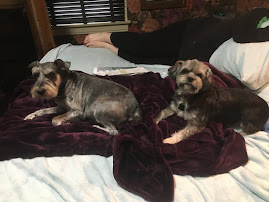
Dogs have at least six basic biological needs:  breathing, sleeping, eating, drinking, peeing, and pooping.  Mike and Duffy take care of the first two pretty much on their own.  Katja organizes eating and drinking.  I oversee the pooping and peeing, mostly by taking the dogs outside four or five times a day and cleaning up their more tangible products.  Duffy ordinarily does his business within 30 seconds of leaving the back stoop, eager to get back in the security of the house.  Mike, on the other hand, waits until he’s at least a couple of houses down the block.  He seeks out an appropriate spot, the criteria for which are unclear to me, and then starts turning in circles.  Four turn-arounds are Mike’s minimum.  Fifteen or twenty aren’t uncommon.  On their first morning outing, Duffy reliably poops at least once; Mike often chooses not to go at all.


We humans, of course, have the same biological needs to take care of, though our routines, artifacts, and rules are more complicated.  When we had the upstairs bathroom replaced a few years ago, Katja picked out a state-of-the-art toilet fixture by Kohler, whose exotic ads you’ve doubtless seen in home and garden magazines.  It’s very stylish, and it’s designed to be eco-friendly, meaning that it uses a minimum quantity of water.  While aesthetically appealing, it does have the drawback that, because of its minimal water pressure, it gets stuffed up pretty easily.  I’ve found this sufficiently irritating that I generally patronize our downstairs bathroom with its decades-old toilet that I regard as more truly American.  However, I do forget my policy from time to time, and the seemingly sentient and wicked Kohler machine seems eager to take advantage of my mistakes.


Katja, rarely a complainer, called me the other night to say that she had been plunging the toilet without success and could I try.  I went in and plunged and plunged until my hands started developing blisters.  Finally I gave up and told Katja I would try again in the morning.  I got up when the alarm went off and started plunging some more.  After five minutes, Katja said she was going to call the plumber.  I said, “No, no, not yet.”  I said the plumber would automatically charge a hundred dollars, and, since we now have a new hardware store down the street, I would go there and buy something to solve the problem.  What that something was I didn’t know, but I was certain the hardware store could handle this better (i.e., cheaper) than the plumber.  Katja said the plumber only charges sixty-five dollars.  When I came down for breakfast, she said that the plumber already was on his way.


Katja left for work, and the plumber did arrive shortly.  I showed him to the upstairs bathroom and went back down to finish my Sudoku.  I heard some grinding noises as he worked, and he called me ten minutes later.  He’d been successful.  He showed me some large strings or threads wound onto the gizmo that he had put down the toilet pipe.  He said they looked like mop strings, and he speculated that somebody had poured a mop bucket down the toilet bowl.  I said that the cleaning lady had been here recently.  He expressed relief at having been able to fix it.  If the gunk had been pushed further into the wall, he said, we would have had to call Roto Rooter to have the toilet removed and the wall dismantled.  Big bucks.  I silently patted myself on the back for not going to the hardware store and trying to fix it myself.  Later I phoned Katja at work and told her the plumber did charge $100, but I was glad we’d decided to call him.


The cleaning lady returned a few days later.  Katja left her a note, saying that the plumber told us that the toilet was stopped up by mop strings plus when I’d come home the last time she’d been there the back door was open and the dogs were running free on the patio.  The cleaning lady wrote a terse rebuttal, saying that she always pours the mop bucket outdoors and that I was out walking the dogs when she left our house last time.  I didn’t believe her story on either account, but I didn’t have the psychic fortitude to challenge her.


What lessons (if any) might be learned from this primal story?  Well, the first thing is that dogs and humans share fundamental communalities as living organisms, and we should appreciate this mutuality.   I conclude that we are far more alike than we are different. The second thing is that dog life is a lot more simple and straightforward than the human world.  The dog goes on the lawn, the owner picks it up with a plastic bag, and that’s it.  We humans face far more complicated challenges, and we could learn a lot from our dog friends if we paid better attention.  I guess I’m in favor of having an environmentally proper Kohler toilet, but it’s not all peaches and cream.


Love,

Dave


Saturday, August 1, 2009

How I Wound Up at Antioch

Dear George,


I was a pretty maladjusted high school student.  I was shy to begin with, but when my orthodontist decided in my senior year that he should reinsert my braces which he had removed in seventh grade, I became totally self-conscious and vowed to be a hermit, abandoning all social contact in favor of solitude and devotion to my studies.  I spent a lot of time in my bedroom that year, reading the six volumes of Scientific American paperbacks that my father had given me, along with Thoreau’s Walden and the collected works of Mark Twain, Charles Dickens, and George Bernard Shaw.


Perhaps because of my anti-social behavior, Ferdie Davis, Menominee High’s senior social studies teacher and college advisor, told my parents that he didn’t think I was mature enough for college and should put it off.  Ross Taylor, my geometry teacher, disagreed.  Because I was one of his best math students (just behind Earl Malcolm), he had pegged me as a candidate for an engineering career, and he recommended to my parents that I apply to the Northern Michigan School of Mining and Technology at Houghton.  My mother had read in the Saturday Evening Post that engineers were in scarce supply in America, and Mr. Taylor’s advice struck her as very sound.  My parents then met a newly hired engineer at Ansul Chemical Company in Marinette.  He was a graduate of Antioch College in Yellow Springs, Ohio, one of the more well regarded liberal arts colleges of the day.  He got together with my parents, talked about Antioch’s coop program (“More than books”), President Douglas McGregor (a well-known industrial psychologist who I later studied in graduate school), and Antioch’s reputation as a leader in liberal arts education.  My father was very impressed.  Despite Ferdie Davis’ warning, I applied in December to two colleges, the Northern Michigan School of Mining and Technology and Antioch. I was relieved though still anxious when I learned I’d been accepted to both.


Mr. Taylor thought that I should go to Houghton, and my mother leaned that way too.  My dad was undecided.  My parents talked further with the Antioch alumnus.  My mother wanted to know about the social scene at Antioch and how active fraternities and sororities were on campus.  Antioch, of course, had never allowed any sort of Greek system on campus.  I suspect that my mother so annoyed the Antioch grad that he wound up telling her that everybody on campus belonged to fraternities or sororities.  Morever, he said, every weekend Antioch held formal dress balls at which the girls wore floor-length gowns and the boys dressed in tuxedos.  He was sure I would fit in perfectly.


My mother was thrilled, and both my parents agreed that Antioch was for me.  My mom wanted to take me to Charlie Goldberg’s Men’s Store to get outfitted for a tuxedo, but I couldn’t imagine it.  I asked her to let me go and start school; then, if I definitely needed a tuxedo, I would get one over Xmas vacation.  She was a little reluctant, but she did say o.k.


My Uncle Ralph was driving down to southern Ohio that September, and he took me with him and dropped me off.  Antioch, of course, bore no resemblance whatsoever to the picture that my parents had constructed – in fact, it was the exact antithesis.  The standard attire for guys was jeans, T-shirts, sandals, and beards.  The girls threw out most of the fancy clothes that they had brought from Philadelphia or New York and replaced them with black or purple thrift shop purchases.  The only thing that approximated formal balls was barefoot Jewish folk dancing on Friday nights on the patio outside Main Hall.  My staunchly Republican parents would have been in a state of shock if confronted with Antioch’s leftwing leanings.  Self-professed Democrats were looked down upon as mealy-mouthed, and the more pertinent question was whether one leaned toward socialism or communism.  With my limited Menominee High background, I had never heard of Karl Marx, and (this is literally true) I thought that socialism was a type of venereal disease.  I was the first student to ever enter Antioch from Menominee and probably from the U.P.  My initial roommate, Les Sulzberg, had attended Bronx Science, one of the premier academic high schools in the country.  My first good friend, Bob Phillipoff, had gone to a progressive high school in Greenwich Village.  Many of my hallmates were from New York/New Jersey or other major metropolitan areas, came from liberal families, and were so far more knowledgeable and sophisticated than I that I soon decided I had no chance of ever catching up.  Needless to say, I experienced a major dose of culture shock during that turbulent first year, and I barely survived it.  Ferdie Davis wasn’t too far off base.


Love,

Dave



Thursday, July 30, 2009

Dogs of Our Lives: ARCO

Dear George,


The most remarkable dog of our childhood didn’t even belong to us, but rather to my Uncle Kent.  He was a huge black and brown German Shepherd named ARCO, and he was like a totally famous dog.  (I should note at the outset that the details of this account represent my best effort to retrieve childhood memories and shouldn’t be taken as literal fact.)  My Uncle Kent was a decorated U.S. Army veteran from World War II.  I think that he attained the rank of captain and was a recipient of the Silver Star, one of the highest military honors there is.  As I recall Kent’s account, he was fighting in the trenches of northern France following the Normandy invasion, when suddenly a huge, snarling Nazi war dog appeared at the top of the trench, baring his fangs and poised to attack.  Kent froze, and he and the dog stared at one another, eye to eye, for a long long time.  You have to know my Uncle Kent to appreciate the intensity of this situation.  He was a very tough, military-minded man with piercing eyes and a forceful demeanor.  If anybody in social circle could dominate a confrontation with a trained killer dog, it was Uncle Kent.  In fact, after several minutes the dog finally did capitulate and slowly climbed down to join him in the trench.  Because of his high military rank, Kent was able to arrange to keep the dog.  He named him ARCO, the acronym for the military unit which was responsible for distributing resources to troops in the field and upon whose actions their very survival depended.  ARCO stood for something like Army Replenishment Company (though I’m not sure about the exact wording).  Kent brought ARCO back to Menominee with him at the end of the war.


ARCO, as you might imagine, was the only bona fide Nazi war dog in Menominee, and consequently he got a lot of attention in the neighborhood.  Kent allowed us to bring him up the street to our house on Sheridan Road to play.  Despite being trained to kill, ARCO was gentle, good with kids, and exceedingly bright.  Kent did kinds of complicated stunts with him  What I remember most vividly is that he built a high-jumping apparatus with two high posts and nails at graduated six-inch spaces so that a bamboo pole could be shifted up and down.  ARCO could easily jump over our heads, and, taking a short run, he probably cleared the bar at six feet or more.


One day years later I ran into a neighborhood kid who told me that ARCO had died that morning.  It never occurred to me that this seemingly immortal dog would ever die.  I ran down to Kent’s drugstore at Electric Square.  Tears were streaming down my face as I came in the front door, though I tried to convince myself that I was only crying because I was expected to.  Kent solemnly confirmed the bad news.  It was my first direct experience with death, and it took some time to get over it.  ARCO had taught me what rewarding companions dogs can be.  It was a valuable lesson.


Love,

Dave


Email Comments: 

David, Thank you for kind and wonderful message.  Your stories about Menominee (all of which I have now read) brought back many memories (mostly fond).  To my knowledge the account regarding ARCO is completely correct.. Warm regards, Thor

Tuesday, July 28, 2009

The Great Peshtigo Fire of 1871

Dear George,


On our last drive up to Menominee, we stopped at the Peshtigo Fire Museum.  We’d been there before, but it’s always worth a visit.  Most people have never hear of the Peshtigo fire, mainly because it occurred on the same date as Mrs. O'Leary's great Chicago fire, and the latter got all of the attention at the time and thereafter.  However, loss of life was five times as high in the Peshtigo fire and property damage was far greater than in the Chicago catastrophe.  I was particularly interested this last visit because I looked at a map which detailed the boundaries of the fire, and I discovered, to my surprise, that our family homestead in Birch Creek fell smack within the northern section of the devastation.


The Peshtigo Fire began on the evening of Oct. 8, 1871.  It’s generally regarded as the most horrendous fire in U.S. history, having destroyed 12 communities and 1.2 million acres of timberland in northeastern Wisconsin and upper peninsula Michigan.  Precise estimates are not available because the fire destroyed all records, but between 1200 and 2400 persons died, and tens of thousands were terribly maimed and left homeless.  It’s called the Peshtigo Fire because the most concentrated loss of life occurred in that community, but, in fact, the fire covered an immense range from the very edge of the city of Green Bay, Wisconsin, past Marinette and Menominee which are fifty miles to the north and well into Menominee County, Michigan.  Overall, the fire covered an area of over 2400 square miles (twice the size of Rhode Island).


Causes of the fire included a mix of weather conditions – extreme drought, high temperatures, cyclonic winds – and byproducts of human activities.  Logging operations, sawmills, and factories left piles of dry tinder throughout the area; farmers set fires to clear hardwood growths for their fields; and sparks from railroad steam engines regularly ignited grass and brush.  Numerous fires were burning in woods and around villages for months prior to the conflagration.  Just after 8:30 p.m. on Oct. 8 Peshtigo residents were startled by a dull roar.  Flames from the scattered forest fires had been whipped into an inferno by the intense winds.  Within minutes the entire town was burning, and everything except one structure newly built from green wood had been reduced to ashes by 10 p.m.  The rains finally arrived the next day.


The Peshtigo fire has been described by experts as a firestorm. Temperatures reached as high as 2,000 degrees at its core and created tornadoes and hurricane force winds which propelled the fire across the land at speeds of up to ninety miles per hour.  Witnesses reported that the fire winds threw railway cars and houses through the air.  A minority of people in Peshtigo survived by immersing themselves in the Peshtigo River, wells, or other bodies of water, though many who tried to do so drowned or were boiled alive.  Years later U.S. and British military experts studied the Peshtigo fire in an effort to recreate firestorm conditions in their bombing campaigns against Germany and Japan. 


The loss of life was magnified because, during the period of extended drought, traveling preachers in the area had prophesied the end of the world through hellfire and damnation.  When the great fire did erupt, many believers concluded that the prophesies had come true and declined to seek refuge.  Others died in the flames as they tried unsuccessfully to rescue their recalcitrant family members or friends.  


As the fires raged, the flames moved northward and threatened Marinette and Menominee.  Most of the women and children in Menominee boarded three steamers that had been docked in the harbor and escaped out into Green Bay.  Remaining citizens dug trenches, hauled water, and wetted down roofs.  The towns appeared to be doomed, but a sudden shift in wind direction and deflection of the flames by a long range of sandhills south of Marinette led the fire to shift to the west of the cities.  The Catholic Church, a sawmill, and a planing mill were destroyed, but residential areas were largely spared.  The fire lept over the Menominee River and sped northward into Menominee County.  A painted sign that had become airborne in Peshtigo was discovered 15 miles away in Birch Creek.  That small settlement was totally destroyed, and as many as 40 people died there.


Our family, of course, were not Birch Creek-ites back then.  It would be three decades or so before my paternal grandparents emigrated from Sweden and nearly a century before my parents bought their Birch Creek Farm.  It is interesting, though, to contemplate this bit of history of which our family property is a tiny part.  We’ll keep an eye out for Peshtigo artifacts on our next trip.


Love,

Dave


Sources: 

wikipedia.com

www.peshtigofire.info

www.rootsweb.ancestry.com/~wioconto/Fire.htm

www.essortment.com/all/peshtigofire_rixl.htm

Saturday, July 25, 2009

How the Wolf Dog and I Got J into Med School

Dear George,


It broke our hearts when J left for his freshman year at Columbia.  With only one kid, we were an overly child-centered family, and I pal’d around with J a lot.  Nonetheless, we were proud and happy about his new life venture.  We heard hardly only occasionally from him the first year (e.g., every few months) which was disconcerting.  In his second year J said he was thinking about majoring in religion, and I couldn’t imagine what he would do with that.  Eventually, he wound up in Sociology, perhaps in part because of his lifetime connection with my congenial department at UC.  He did his senior thesis with Herbert Gans, former president of the American Sociological Association, and I was happy that he was on a productive track.


J graduated in 1991, and I think his college experience was rewarding, though perhaps more socially and personally rewarding than academically.  He didn’t end up with a clear life direction.  I thought that newspaper journalism would be a good choice, since J was an excellent writer and had done some student journalism at Walnut Hills, but he didn’t like the thought of daily deadlines.  He decided to go to San Francisco for the summer and get whatever job he could find.


I read later in the newspaper that 86,000 students went to San Francisco that summer to look for jobs.  Like most, J had no luck, though he did like the city.  He visited a casual friend’s apartment one day, and the person had a large, powerful dog which was half huskie and half wolf.  It was the Fourth of July, and the dog was agitated because of all the fireworks in the neighborhood.  J tried to calm him down, but, when he reached out to pat his head, the dog lunged at his face and slashed his right eyelid in two.  Blood was gushing out all over the place.  His friend rushed him to the emergency room, and, after a lengthy wait, an intern sewed him up.  The guy was brand new, working on the very first day of his career, though fortunately he had been an assistant in a plastic surgeon’s office and knew what he was doing.  The intern said J was lucky that the cut came from a part-wolf.  The animal’s incisors were sharp as razor blades and made a perfect cut which was simple to stitch up and wouldn’t leave scars.


When he came back to Cincinnati, J told us about the wolf-dog episode.  He said that he was so impressed by his emergency room experience that he had decided to go to med school and become a doctor.  I went ballistic.  I told him that that was an unrealistic, even preposterous plan.  Except for “Physics for Poets,” J had never taken a science course.  His grades were o.k., but they weren’t competitive enough for med school.  Plus, I claimed, he’d never shown any interest in the field before, and it would probably be a lousy fit.  J asked if I thought there was any reason I thought he would be a good doctor.  I said, begrudgingly, that he would have an excellent bedside manner.  J said, “Good, I’ll take it,” and he applied to the University of Cincinnati a couple of days later to begin pre-med coursework in the Autumn.


I didn’t change my attitude for a long time.  I was disturbed that J was beginning a new program of  undergraduate coursework after his graduation.  Despite my protests, though,J was busy mastering chemistry, biology, math, etc.  Aside from going to classes, he did virtually nothing but study behind his closed bedroom door for days and weeks on end.  His mom was enthusiastic and supportive, but I watched with complete skepticism.  His autumn grades came in – straight A’s.  Then the same for winter and spring.


K came back from a year in Russia.  At first they sublet an apartment in a building known locally as the Roach Hotel, but the bugs drove them out and they moved in with us.  At the end of sumer the two of them went to New Orleans, finished up pre-med requirements, established residency in Louisiana, and J was accepted by the LSU School of Medicine.  He received his M.D. degree from LSU in 1999 (as did K from Tulane).  We went to graduation at LS¨, and  we were proud and thrilled.  J and I chatted about his med school experiences.  He said he was so angry at my disbelief and discouragement that he was determined to prove that I was wrong.  And so he did. Well, what is the conclusion of this?  J certainly deserves a lot of the credit for his success.  Let’s say at least fifty percent.  But, in my mind, the wolf dog should get twenty percent (without him, this would never have happened), and then I should get the remaining thirty percent.  If I hadn’t made J that angry and determined, he probably wouldn’t have been as strongly motivated as he was.  Sometimes parents do really dumb things, but good outcomes can happen anyway.  Life is not that orderly or predictable.


Love,

Dave


Thursday, July 23, 2009

The Menominee River (Part Two)


Menominee River from River House (photo by VAL)

Dear George,

I wrote a while back about our childhood on the Menominee River.  The river continued as an important part of our lives as we grew into our teenage years and beyond.  Each summer Steve and I retrieved dried out logs from the channel and Pig Island, lugged them home behind our rowboat, and strapped them together to construct primitive rafts to use for swimming.  In my high school years, my friend Bob Anderson replaced our flimsy log raft with one built from oil drums, two by fours, and a full wooden cover, and our group of teenage friends began to frequent the riverbank.  Soon it became the primary summer hangout for my high school group, as it did later for Steven, Peter, and Vicki.  Steve and his chums added a cloth cover to the raft, and they swam and sunned in luxury.


As preteens we were allowed to swim across the river, but only with the accompaniment of an adult and lifejackets in the rowboat.  Later we swam the half mile down to the logging cabin in the middle of the river.  The dam was just a little bit beyond the logging cabin, and the current became swifter in that area.  When boating or swimming there, we always got nervous about being caught up and swept over the dam.  I was amazed when Peter reminisced a few years ago that he and his teenage pals used to go swimming there, propelling themselves over the dam’s top and sliding down the its face headfirst into the splashing white water below.


As a teenager, I would occasionally pile my gear into the rowboat and go camping by myself on a small island in the channel behind Pig Island.  It was the most mosquito-ridden place I’ve ever been, but it was also a secret and private world, psychologically separated from home and family.  I’d daydream that if the Russians invaded the U.S. and occupied Menominee, I would hide out in my tent in the channel and make nighttime commando raids on the town.


A mile to the west, beyond Indian Island, a tributary called Little River branched off to the right and ran through Mason Park, a minimally developed county park which was Steven’s and my favorite tent camping location.  Little River was a beautiful winding waterway, bordered on both sides by evergreen and birch trees.  Sometimes we would park our rowboat at Mason Park and follow a foot trail a quarter mile up to a swimming hole, which had a tire strung up by rope from a tall tree, allowing one to swing out and catapult oneself into the pool.


Summer was a paradise on the river, but winter had its own delights.  The ice would freeze to a thickness of two or more feet, and, once solid, we could walk from our house to Pig Island.  On Katja’s first visit to Menominee, we walked across and came upon the sight through the clear ice of a mud puppy lying on the river’s bottom.  It looked like a prehistoric creature, and Katja thought she had happened upon a new world. Before heavy snows arrived each year, we would keep a patch of

river ice cleared off to use as a skating rink, and we built an inclined snow ramp so that we could get a running start on our lawn, belly flop onto a sled, and slide forty yards out on the river ice.  When enough snow had accumulated and gotten soft from the sun, we built snow forts on the river and had snowball fights.  In the spring, Chinese Bells Day, named by my parents because of the tinkling of the ice as it broke up and began flowing down the river, was such a significant family event that my father carved the date each year on the wooden archway between our living and dining rooms.  One spring a deer tried to cross the river from Pig Island, but fell through the melting ice.  My dad, Mike O’Hara, and one or two others pushed our rowboat out on the ice to rescue it, but the deer vanished below the water’s surface before they could reach it.  It was common to see people’s docks, canoes, trashcans, lawn chairs, buckets, and miscellaneous other objects floating down the river in the midst of the ice floes, and we would try to retrieve these treasures from the shore with long bamboo fishing poles.  Once the ice had fully cleared out we would have a polar bear contest to see who was brave enough to jump into the frigid water.  Peter and Vicki were the youngest and most fearless, but nobody lasted more than a few seconds.


One year before the river froze over several of my high school friends and I took the boat across the river to Pig Island to get evergreen boughs to decorate one of the girls’ family home for the holidays.  Rather than damage a lot of trees by cutting off their limbs, we decided it would be better to chop down a single large tree.  It took an hour of effort, but we did so, then sawed off all the branches and ferried them back across the river in three or four trips.  The house decorations were impressive -- the pride of Sheridan Road.  Two years later an executive from the local chemical company, Bob H., bought Pig Island.  He and my parents were good friends, and a few weeks after his purchase he contacted my father to complain that vandals had chopped down a valuable pine tree on his property.  He asked my dad, who was prosecuting attorney at the time, to take whatever steps were necessary to locate and arrest the trespassers.  Since the site of the crime was directly across the river from our house and since we were the only youth in the area, it probably was not difficult to identify possible suspects.  Instead of turning us over to the authorities, my dad took me for a long walk out on the road and wound up saying he would try to stall on his friend’s request.


When we were high school juniors, Grant Berggren, Earl Malcolm, and I decided to take a major camping trip up the river in our one horsepower boat.  We wanted to go all the way to Iron Mountain if we could do it.  We loaded up with provisions and set off early one morning. When we were a couple of miles beyond Indian Island, the river channel became surprisingly shallow, and our propeller blades hit a rock and snapped the engine’s cotter pin.  We had a couple of spare cotter pins, but within a short distance we had broken all of them.  We got out of the boat and pushed it for a mile or two along the shore, but we eventually gave up and found an open space in the forest to pitch our tent.  When we rowed home the next day, we all started itching along the way.  It turns out we had camped next to a grove of poison ivy. Grant had the worst poison ivy problem, and he wound up being hospitalized for two weeks with an infection that spread into his lungs.  He vowed never to go camping again.

In the 1970’s my parents began renovating an old farm in Birch Creek, eight miles north of the city.  For a while they maintained two residences, but they became sufficiently enamored with their new project that they decided to sell the river house.  They offered it for free to any of their children who would live there, but there were no takers.  A local dentist bought the property.  After several years he decided to rebuild, and he gave the house away to an acquaintance who cut it in half and moved it to the shores of Green Bay. River house is still sitting there now – such an irony, since we had always claimed that the river was a far superior place to be than the bay.  Vicki still owns a parcel of the family property on the river, and we visit it each time that we’re in Menominee.  On our last trip we made a family excursion to the river to cast cremated ashes into the water from the dock.  A sudden gust of wind came up as I tossed Peter’s ashes into the air, and they blew all over my sister-in-law Faith.  Peter would undoubtedly have been amused.  All in all, the river is the site of great adventures and the source of rich memories.  It was a place for play and friendship, as well as experiences of solitude and testing oneself.  It would be an exaggeration to say that the river made us who we are today, but it would be a mistake to not recognize its significant impact on our childhood and adolescence.  My heart still skips a beat when I run across on old postcard of the Menominee River.  In some ways, we’ll always be River Rats.


Love,

Dave