Thursday, October 6, 2011

Great Cincinnatians: Reverend Fred Shuttlesworth [1922 - 2011]


Dear George,

Yesterday Reverend Fred Shuttlesworth died at age 89 in Birmingham, Alabama. Along with Martin Luther King Jr. and Ralph Abernathy, he is regarded as one of the "big three" of the 1960's civil rights movement in the U.S. and has been an icon and elder statesman of the black freedom struggle to the present day. Shuttlesworth was brought up in rural Jefferson County near Birmingham by his tough-minded mother, Alberta Robinson Shuttlesworth Webb. The young Shuttlesworth was known for having a combative personality which he was to channel into the civil rights arena in adulthood. During World War II he worked as a truck driver at a Mobile air force base, then, following a calling to the ministry, he studied at Cedar Grove Bible College, Selma University, and Alabama State College. He and Ralph Abernathy became friends at Alabama State, exchanging advice about writing sermons. Graduating from Alabama State in 1952, he became the pastor of Selma's First Baptist Church. Reportedly because of personality clashes with deacons, he left that position in 1953 and became pastor of the Bethel Baptist Church in north Birmingham.


Shuttlesworth soon became active in the voter registration efforts of the NAACP in Birmingham and supported the Montgomery bus boycott in 1955. When the state of Alabama used the circuit court to ban the NAACP, Shuttlesworth and Ed Gardner founded the Alabama Christian Movement for Human Rights (ACMHR) which became the major force spearheading civil rights activity in Birmingham for the next 8 years. Following the Montgomery bus boycott, Shuttlesworth attempted to desegregate the Birmingham Transit Company. Segregationists bombed his home, but Shuttlesworth survived despite 16 sticks of dynamite exploding three feet from his bed. The wall and the floor were blown out, but Shuttlesworth was protected by his mattress which flew into the air. A police officer who was also a member of the KKK told him, "If I were you I'd get out of town as quick as I could." However, his survival convinced him and his followers that God had intervened in order that he lead the fight against segregation. The next day Shuttlesworth led 250 people in a protest of segregation on Birmingham buses.


Paradoxically, Shuttleworth's early successes led to the political comeback of extremist segregationist Eugene T. "Bull" Connor who was selected commissioner of public safety in Birmingham. The two were central, polarized figures in a six-year period of "massive resistance" in the Deep South. Shuttleworth was jailed by Connor's police force more than two dozen times. His colleagues found his boldness and willingness to accept risk extraordinary. "We're determined to either kill segregation or be killed by it," Shuttlesworth told a television interviewer. According to the New York Times, Shuttlesworth was known by some of his activist peers as "the Wild Man from Birmingham."


In 1957 King, Abernathy, Shuttlesworth, and Bayard Rustin founded the Southern Christian Leadership Conference which became the most important civil rights organization in the South in the 60s. Shuttlesworth helped coin the SCLC's motto of non-violence: "Not one hair of one head of one person should be harmed.” He served as the organization's secretary for years. King and Abernathy were a sharp contrast. King came from a black middle class family in Atlanta and had a Ph.D. in systematic theology from Boston U. Shuttlesworth was the child of a poor black woman, and his ministerial degree was from an unaccredited black school. Whereas King was polished and conciliatory, Shuttlesworth was temperamental and favored confrontation over words. Few doubted his courage. In 1957 Shuttlesworth was badly beaten with bicycle chains and baseball bats and his wife was stabbed by a white mob when they tried to enroll two of their daughters in an all-white school. Connor used the fire and police departments to keep African Americans away from the ACMHR weekly meetings, and segregationists bombed the Bethel Baptist Church twice.


Beginning in 1958 Shuttlesworth put continual pressure on the more cautious, deliberate King to bring the SCLC to Birmingham to join in protests with the ACMHR. Shuttlesworth participated in sit-ins against segregated lunch counters in 1960 and participated in the Freedom Rides in 1961. One Freedom Ride leader stated, "Fred was practically a legend. I think it was important...for there to be somebody that really represented strength, and that's certainly what Fred did." By early 1963 King did agree to join forces, and the two organizations launched historic demonstrations in Birmingham which resulted in city businesses beginning to desegregate downtown department stores. Two weeks of nationally televised images of Bull Connor using police dogs to attack unarmed demonstrators dramatically affected Americans' view of the civil rights struggle. Shuttlesworth suffered chest injuries from the firehoses turned on him; Bull Connor said, "I'm sorry I missed it…I wish they'd carried him away in a hearse." Biographer Andrew M. Manis wrote that Rev. Shuttlesworth had "no equal in terms of courage and putting his life in the line of fire.” The Birmingham demonstrations were central in pressuring President John F. Kennedy to introduce the legislation in Congress which became the 1964 Civil Rights Act. In introducing the bill, Kennedy said, "But for Birmingham, we would not be here today."


In 1960 Rev. L. Venchael Booth, pastor of the Zion Baptist Church in Cincinnati, invited Rev. Shuttlesworth as a guest preacher. Later he recommended Shuttlesworth to the Revelation Baptist Church in Avondale which was seeking a pastor. In 1961 Shuttlesworth accepted the position at the Revelation Baptist Church and moved to Cincinnati. For the next fifty years Shuttlesworth focused on civil rights issues in Cincinnati and Birmingham, seeking particularly to remove barriers to black's employment opportunities. He joined other black ministers in a campaign to make William Lovelace the first African American Municipal Court judge in Cincinnati. He pressed for greater minority hiring by the police department and changing procedures in city council elections to increase minority council members. In 1966 Shuttlesworth organized the Greater New Light Baptist Church in Cincinnati's Avondale neighborhood, where he continued to seek opportunites to improve living conditions for the poor. In 1967 he tried to calm violent demonstrations in Cincinnati over issues of police brutality. In 1989 he established the Shuttlesworth Housing Foundation which helps low-income families in Cincinnati purchase their first homes. Shuttlesworth served as the interim president of the SCLC in 2003 and 2004. He was an early signer of the Birmingham Pledge in 1998, a grassroots effort to combat racism and prejudice across the country.


The Greater Cincinnati Area Chamber of Commerce named Reverend Shuttlesworth a "Great Living Cincinnatian" in 2000. President Bill Clinton presented Shuttlesworth with the Presidential Citizens Medal in 2001. When honored by leaders of the civil rights movement in 2002, Shuttlesworth said, "I have seen us come so far, but we have so much farther to go." Shuttlesworth gave his last sermon at the Greater New Light Baptist Church on Mar. 19, 2006, following the removal of a non-cancerous brain tumour at age 84. In 2008 the city of Birmingham honored Shuttlesworth with a four-day tribute and renamed the local airport the Birmingham-Shuttlesworth International Airport in his honor.


Shuttlesworth continued his pastoral ministries at the Greater New Light Baptist Church in Cincinnati until 2006. He met Senator Barack Obama In Selma in 2007 at a commemoration of the Selma to Montgomery voting rights marches, and Senator Obama pushed Shuttlesworth's wheelchair across the Edmund Pettus Bridge where demonstrators had been tear-gassed on "Bloody Sunday" in March, 1965. Shuttlesworth moved back to Birmingham in 2008, following a stroke which left him largely unable to speak. Following his death, President Obama remarked, “He was a testament to the strength of the human spirit. And today we stand on his shoulders, and the shoulders of all those who marched and sat and lifted their voices to help perfect our union.” In looking back at all of this I’m struck, as many are, by Shuttlesworth’ great courage and his ability to act on his convictions in the face of overwhelming opposition. It’s rare to find individuals who produce lasting changes in the society as a whole. Fred Shuttlesworth was one of those remarkable figures.

Love,

Dave


SOURCES:

www.cincinnati.com ("Rev. Fred Shuttlesworth dies")

www.encyclopediaofalabama.org ("Fred Lee Shuttlesworth")

www.hosted2.ap.org (“Shuttlesworth, an inspiration to MLK , dead at 89”)

www.library.cincymuseum.org ("Rev. Fred L. Shuttlesworth")

www.local12,com (“Civil rights Activist Fred Shuttlesworth dies”)

www.wikipedia.org ("Fred Shuttlesworth")

Sunday, October 2, 2011

Life and Death: A Photo-Montage


Dear George,

Katja called me at the office to say that a large spider was building a wonderful web on our patio. I got home just as it was finishing its work -- it was a nice-looking insect and a remarkable web. After it finished its last strand, the spider curled up into a ball and pretended to be a corpse, presumably to avoid scaring other naïve insects. Unfortunately we had a huge rainstorm that night, and there was no sign of the web in the morning. When the sun came out, however, the spider was back at work and soon had an entirely new creation in place. Then it rained again and wiped out the second web. Nonetheless, the spider soon replaced it. I haven’t yet seen an insect fly into it though. Here’s our spider in action:


Things I learned from the spider’s travails were:

(a) Life is a never-ending struggle.

(b) You can put in a lot of work and not get much out of it.

(c) When awful things happen, it’s best to pick yourself up and do it over again.


Last week I went to the flea market in Brookville, Indiana, and this led to more contemplation about life and death. The flea market is part of a big complex that includes a livestock auction warehouse. A number of the pens were filled with hogs and cows. Here are some of the hogs, who look to be in their prime. They don’t know it, but they will soon be auctioned off and sent to the slaughterhouse.


Here is what I got out of it:

(a) You might think they are giving you a lot of good stuff for free, but beware -- they’re just fattening you up for the kill.

(b) Don’t waste too much time lying around because you never know what’s right around the corner.

(c) If everybody around you looks like they’re going to be turned into pork chops, you are undoubtedly a candidate yourself.


Back home, in the meantime, I was walking the dogs in the front yard when I noticed a big cluster of mushrooms that had suddenly sprouted up in our garden. I’m sure it hadn’t been there the day before, and it looked like it had come from a faraway galaxy. I took a photo of it, then another the following day, and a couple later in the week. Here is the progress of the giant mushroom:


Tuesday, September 20


Wednesday, September 21


Saturday, September 25


Sunday, September 26


Mushrooms probably don’t have feelings about it, but their life story is quite compelling. I can’t believe how quickly they appeared from nowhere, then collapsed into oblivion. Their fate entails some important lessons:

(a) Life is short; make every day count.

(b) You’re at your best in your youth, but you acquire character as you age.

(c) If you’re a mushroom, you don’t have to worry about dying. You’ll be replaced in the same spot next year anyway.


So life is just sort of rolling merrily along here. But there’s a lot to think about.

Love,

Dave


G-mail Comments

-Phyllis S-S (10-3): Dave, Neat stories - loved the photos of the spider. pss

-Vicki L (10-2): Hi David, I'm so comforted by your philosophical attitude toward nature. I've been fretting about an enormous spider which is draping itself across my front window. The other day, I was walking around the corner of my house with my gardener and ran face first into another of these beasts. I screamed and fell into Freddie's arms - he laughed and swiftly killed the large creature. ..

Two years ago I ended up in the ER having breathing problems - the doctor thought I had a bacterial infection complicated by the bite of a 'brown recluse' spider (can be deadly). The brown recluse has a violin emblem on its thorax. As much as I study this spider which - like yours - continues to rebuild its web across my window - I can't quite tell if it has a 'violin' on its thorax or not. To me, it appears to have a white Christian cross - this could be even scarier. A Tea Party or Ku Klux Klan spider… This morning, participating in my rowing club event, I learned that psilocyban (sp?) mushrooms can increase one's levels of oxytocin (a female hormone secreted during pregnancy/ nursing which enhances one's ability to multi-task). Just keep tracking those mushrooms. Love, Sis

-Jennifer M (10-2): :-)

-Donna D (10-2): david, i just loved this. is your spider still around?

-DCL to Donna (10-2): Thanks, Donna. The spider lost its last web and hasn't returned yet, but I wouldn't be surprised to see it come back soon. Maybe we'll see it tomorrow.

Tuesday, September 27, 2011

Saturday on Ludlow

Mike, Duffy, and Sophie on Ludlow Ave.


Dear George,

Donna went to Nashville last weekend to visit her kids, so we took care of Sophie. I’m always glad when our dogs’ younger sister comes over. Having two sheepdogs in the house is fun, but three is like nirvana. Sophie is such a different personality – peppy, playful, always ready to go – and she perks up her brothers as well. I especially like taking the three dogs for a walk on Ludlow Avenue because they get so many reactions from passersby. Saturday was busy because it was the weekend for Streetscape, the arts festival in which Telford Street is blocked off and artists draw reproductions of famous paintings on the pavement in colored chalk. I put Mike, Duffy, and Sophie on three leashes hooked together, and we went out after lunch. Probably two dozen people told me how beautiful the dogs are, and I said, “Yeah, they’re great” to each one. A man with white hair and goatee took a photo of us with his zoom lens camera as we approached. A two-year-old came up with her mother and father and was utterly fearless in petting the dogs. Then a pair of ten- and eight-year-old boys joined in. We met two large poodles, a weimeraner, a little shaggy white dog, two huskies, an orange mutt, and some others I can’t even remember.


Streetscapes at Ludlow and Telford


When we got to the Roanoke Apartments, a tall woman and a man were having a yard sale on the patch of ground at the corner. It was mostly large items, e.g., a TV, a microwave, exercise equipment, an air conditioner furniture. The item that caught my eye was a Coleman camping stove. I reached over the fence to unlatch and open it up. It was old and had clearly seen better days – rusty, paint scratched off, blackened in spots. I have a camping wish list that I put together for yard sales, but a new stove isn’t on the list. Nonetheless, I’ve spent most of my life with Coleman Stoves and have a certain primal obsession about them. The tall woman said, “We’ll take whatever you offer on the stove.” That was tempting. I thought about offering three dollars. I was pretty sure she would take it. However, I already own two used Coleman stoves that I bought at yard sales, and last year I got rid of my third stove to scale back my inventory. I told the lady I already have two Coleman stoves. She said, “You know, sometimes you just want one more.” I nodded. She was clearly a kindred soul. “I’m going to think about it,” I told her, and I meant it since we’d be coming back that way.


Next-day leftovers from the Roanoke yard sale


As we crossed Ormond Ave. to the public library, I heard a voice behind me ask, “How much would you take for one of those dogs?” I turned, shook my head, and said something like, “No way.” It was a smiling, middle-aged, balding guy on a bicycle. The guy persisted, pushing his bicycle along with his feet. He said he’d give me $800 in cash. Right now. Cash. I shook my head. I did think about it for a second. “My wife would kill me,” I told the man. Then I wondered what Donna would think. I considered calling her in Nashville. For $800, you could buy two brand new sheepdogs. But then I decided she would be offended if I even mentioned such a possibility. The guy followed along behind me for quite a way on his bicycle, asking more questions like where you find a breeder, did I get these dogs around here, how much do Old English Sheepdogs cost, etc. I said $500, and he said that was a terrific deal. I agreed. He did seem genuinely interested in getting a sheepdog, but I couldn’t judge if he really had $800 to spare or not. I started walking a little faster. Finally the guy said goodbye, and that was the end of that potential transaction.


A gray-bearded street artist was set up outside the toy store, and he was busy doing a charcoal portrait of a young brunette woman in her mid to late twenties. The woman was rather pretty. I looked at her face, then at the artist’s depiction. It was a shock. I’d seen this artist many times, and he’s always seemed capable. But this time he was using black charcoal to highlight shadows on the woman’s face, her lips were distorted, and her eyes looked sunken into her head. I couldn’t imagine how the woman was going to react when she saw her unflattering picture. For a moment, I wondered if she had perhaps commissioned a portrait of herself as a ghoul. I wanted to stick around to see what happened when he showed it to her, but when you’re walking three sheepdogs you have certain responsibilities, and so I moved on. [Postcript: The artist was back at the same spot the next day, and he was exhibiting his finished portrait of the young woman. It looked like she didn’t buy it.]


Street artist awaiting his next client


At the fire station on the corner of Clifton and Ludlow I saw a familiar face sitting on the bus stop bench. It was a woman named Miranda who used to work at Kellers and who is a long-time admirer of the sheepdogs. She hadn’t seen the dogs for ages because she moved downtown to the YWCA for financial reasons. She said her I-phone had crashed, and she’s been very upset because she lost her picture of Mike and Duffy. I promised to e-mail her some new ones, and she was relieved and grateful. Afterwards it occurred to me that, since I had my camera in my pocket, I should have just taken a picture of Miranda with the dogs but I was too late.


Jefferson Ave. looking west


We walked up Jefferson along the edge of Burnet Woods park. After a long block, we crossed the street and started heading back. Down the block who did I run into but my nephew Chris who was walking his dog, Calvin. Chris and his wife Karrie moved to Cincinnati from Portland, Oregon, about two weeks ago and found an apartment in Clifton, next to Dewey’s Pizza. We’ve never had any extended family members live close to Cincinnati in all the years we’ve been here, so that’s an exciting prospect. Karrie and Chris had paid their first visit the night before to Skyline Chili, a Cincinnati institution. Chris had had a Cheese Coney, and Karrie had a plain hot dog. They’re sort of slowly working their way up to a Five-Way (chili, spaghetti, cheese, onions, beans). Calvin, who’s a mix of a Dalmatian and an Australian Shepherd, seems like a very sweet dog, and he and the sheepdogs sniffed at one another. It’s the third time in three days that I’ve run into Chris and Calvin on the street, so we will probably have a lot more dog and human encounters in coming months.


Streetscape artists at work


Streetscape was going on just past the Esquire Theater, and the dogs and I stopped by to check out the artists’ progress. Somebody in charge politely asked me to keep the dogs away from the painting area in the street, and I complied, though it was harder to see the art from the sidewalk. The drawings were large and quite splendid. As we were leaving, I noticed a big sign that said “Absolutely No Dogs.” That didn’t seem very Clifton-like. They prohibit drugs and weapons at the Clifton plaza across the street, but they don’t have large signs saying, “Absolutely No Drugs” or “Absolutely No Weapons.” I couldn’t imagine what sort of bad experiences they’d had. I thought that humans were probably a greater hazard to the art than dogs were. I did feel nervous that we had inadvertently violated the no-dog rule, but there’d been a couple of other errant dogs on the sidewalk with us too.


Absolutely No Dogs!


On our way back we passed by the Roanoke again. The yard salers were starting to pack up, but the Coleman Stove was still sitting there. I looked at it again and felt certain that, since they were closing up, they would accept a two dollar offer. As beat up as it was, I figured the stove would probably work. It’s hard to explain how much conflict I felt. I walked away. Then I walked back. Then I walked away, then walked back again. The woman selling the stove didn’t recognize me and didn’t say anything. If she’d said, “Just buy it,” I’m sure I would have. Finally rationality won out over desire, and I used all my mental will power to force my feet to keep moving. I had an unpleasant, constricted feeling in my chest that didn’t subside till we were well down the street.


Near the CVS Pharmacy corner I saw a sign advertising a garage sale on Whitfield Ave. The dogs have been to hundreds of yard and garage sales over the years, so we checked this one out too. Two gray-haired women were selling miscellaneous household objects at reasonable prices. The item that caught my eye was a GM clock radio. Katja likes to listen to NPR when we go camping, and I had added “Radio” to my yard sale camping equipment list after our recent trip. The tag on t he radio said “$5, Works Well.” I turned it on and tested the reception for 91.7, WVXU. It sounded great – clear, loud. crisp. I thought to myself that Katja would probably be more interested in camping if I had a radio like this. I didn’t bother to bargain. For $5, it was already a good deal. I was happy with the outcome -- I would definitely rather have a good radio than a third Coleman stove.


Whitfield Ave. yard sale house


When we got home, Katja was in the kitchen. I plugged in my new radio and turned on WVXU. Katja thought it sounded very good. She didn’t think we needed a new radio just for camping, but I said it was good to have one we could store with our equipment so it would always be available. The dogs were excited from our walk, and they crowded around Katja, probably maneuvering to get a hoped-for treat. I went upstairs to watch the LSU football game. The dogs and I had had a successful walk, and I was already looking forward to our next outing.

Love,

Dave

Friday, September 23, 2011

Cincy TV in the Golden Age

Midwestern Hayride, WLWT


Dear George,

We’ve always been TV addicts of sorts, so, when we moved to Cincinnati in 1966, we soon became fans of local programming. Just the other day the Cincinnati Enquirer featured an article about the early Cincinnati radio and TV hit, The Midwestern Hayride. Not only had we watched the Hayride back in the old days, but we were pleased to discover that the article mentioned Freddie Langdon, our friend Donna’s dad. Freddie Langdon was the world-class fiddler for the Hayride's country music group, The Hometowners. Langdon also appeared on the Arthur Godfrey Show and sang backup for James Brown at King Records in Cincinnati. Dean Richards and then Kenny Price were hosts of the Hayride. Performers who guested or were regulars on the show included Willie Nelson, Dolly Parton, Porter Wagoner, Bonnie Lou, Tex Ritter, Barbara Mandrell, Waylon Jennings, Merle Travis, Homer and Jethro, Johnny Cash, and many other country stars.


The Hometowners: Buddy Ross, accordion; Kenny Price, guitar; Freddie Langdon, fiddle; Joy Near, bass


Cincinnati, primarily via powerhouse station WLWT, was the nation’s largest producer of live television outside of New York City in the 1950’s and 1960’s, broadcasting up to 24 live programs. The most popular show when we arrived was Ruth Lyons' 50/50 Club. It had started on WLW Radio as The 50 Club, so named because 50 women were invited to each broadcast. When the audience was expanded to 100 people, it was renamed the 50/50 Club. Ruth Lyons is credited with having invented the daytime TV talk show, essentially the Oprah Winfrey of her day. She concealed her microphone in a bouquet of flowers, and she and the audience wore white gloves while they sang "The Waving Song" and waved to the viewers at home. Ruth's guests included Arthur Godfrey, Sammy Davis Jr., Pearl Bailey, Bob Hope, Red Skelton, Bill Cosby, and many other celebrities. The show was so popular that there was a three-year waiting period for audience tickets. The Ruth Lyons Christmas Fund, begun in 1939, has raised tens of millions of dollars and still provides toys to hospitalized children in Cincinnati.


Ruth Lyons 50/50 Club (back: Ruby Wright, bandleader Cliff Lash, Bonnie Lou; front: Bob Braun, Ruth Lyons, newscaster Peter Grant)


Ruth Lyons retired because of illness in 1967, and the 50-50 ‘Club was replaced by The Bob Braun Show on WLWT. We saw a lot of Bob Braun over the years. In addition to becoming one of the best-known TV personalities in Cincinnati, Braun enjoyed careers in radio, singing, and acting (e.g., Diehard 2 with Bruce Willis). His daily 90-minute show became the top-rated live TV program in the Midwest and featured regulars Rob Reider, Mary Ellen Tanner, and Nancy James, as well as numerous celebrity guests, e.g., Bob Hope, Lucille Ball, Johnny Carson, Phyllis Diller, and Presidents Ford, Reagan, Carter, and George H. W. Bush. Mayor Roxanne Qualls declared a “Bob Braun in Cincinnati Day” in June of 1997.


Bob Braun Show (Rob Reider, Colleen Sharp, Bob Braun, Nancy James, Gwen Conley)


Katja’s favorite daytime program (and mine too) was the Paul Dixon Show which aired at 9 a.m. weekdays. We always watched it if we were home in the morning. “Paul Baby” Dixon had come to Cincinnati as a newscaster in the late 1940’s, co-hosted a local music show for several years, and, after a stint in New York City, returned to Cincinnati in 1955 to host a new morning TV show on WLWT geared to housewives. Dixon delighted in being completely corny, and his audiences loved him. He’d start each show off as the “Mayor of Kneesville,” with the camera panning in on the short-skirted women seated in the front row. The show’s singers and co-hosts, Bonnie Lou and Colleen Sharp, were major celebrities in their own right -- prominent country music singers and regulars on The Midwestern Hayride. The show’s most famous episode centered on the wedding of two rubber chickens who were longtime props on the show which Dixon used in Kroger advertising (you can see this you YouTube if you search for “Paul Dixon chicken wedding”). Bob Braun was the Best Man, and Bonnie Lou and Colleen were Matrons of Honor. Katja and I watch the Chicken Wedding when it occurred, and I remember the broadcast to this day since it reached the heights of goofiness. The Dixon show aired in Indianapolis among other places, and David Letterman, who grew up there, credits Paul Baby with being the main inspiration for his own comedic style.


The Paul Dixon Show (Paul, Bonnie Lou Okum)


Our son J was born in 1969, and he too soon fell prey to the wonders of local TV. The Uncle Al Show on WCPO, co-hosted by Al Lewis and his wife Wanda (known as Captain Windy), was one of the longest-running kids’ shows in TV history (1950-1985), and we watched it with J in his preschool years. Regulars on the show included Pal the Dog, Lucky the Clown, the Merry Mailman, and Mr. Patches. There would be dance contests, birthday celebrations, and Uncle Al would play his banjo and accordion. Perhaps the peak event of J’s childhood occurred when our good friend Susan G. got tickets for the The Uncle Al Show for J and her daughter Jessica. Susan went to the show with the kids, while Katja and I stayed home and watched as adoring parents.


The Uncle Al Show (Captain Windy, Uncle Al, Patches)


I was still working on my doctoral dissertation when we came to Cincinnati, and I would stay up late at night, analyzing my data while watching the all-night movie show hosted on Channel 9 by local TV personality Bob Shreve. Shreve had been a staple of Cincinnati television since 1950, long before our arrival in the city, and had been a regular on The Midwestern Hayride, The Ruth Lyons Show, The Uncle Al Show, and several programs of his own. He started doing the Schoenling All Night Theater on WCPO in 1963. He’d come on at 11:30 p.m. and show movies till dawn. Like Jackie Gleason’s skits with Frank Fontaine, Shreve would play the part of a bartender, greeting his audience as customers at his bar and serving them Schoenling Beer. Shreve intertwined movie segments with crazy antics that were often more entertaining than the movies themselves. Characters on the show included Chickie, a rubber chicken that Shreve would stretch beyond the breaking point; Garoro, a gross severed head; and Spidel, a large spider that would swing into the picture and knock Shreve’s hat off. Shreve lip-synched songs like Limburger Lover, did some soft-shoe dancing, and sometimes made cameo appearances in the movies he was showing. When WCPO cancelled the show, Shreve moved back to WLWT for a year or two and then to WKRC-TV where the show became known as The Past Prime Playhouse. His many guests included Bill Cosby, Adam West (Batman), and “baseball’s kissing bandit,” stripper Morgana.


Bob Shreve, The Past Prime Playhouse


I have fond memories of all these media characters and shenanigans. I’d lived in New York City for a while during college, and radio and TV there were much more hip (e.g., Jean Shepard). Cincinnati productions had a deliberately Midwestern, small town feel about them – non-pretensious, warm, funny, sometimes off the wall. But, since I’m a product of the heartland myself, I guess I won’t complain.

Love,

Dave


IMAGE SOURCES:

Google Images

www.cincinnativiews.net/wlw_radio_tv_2.htm

Monday, September 19, 2011

Ups and Downs at Hocking Hills

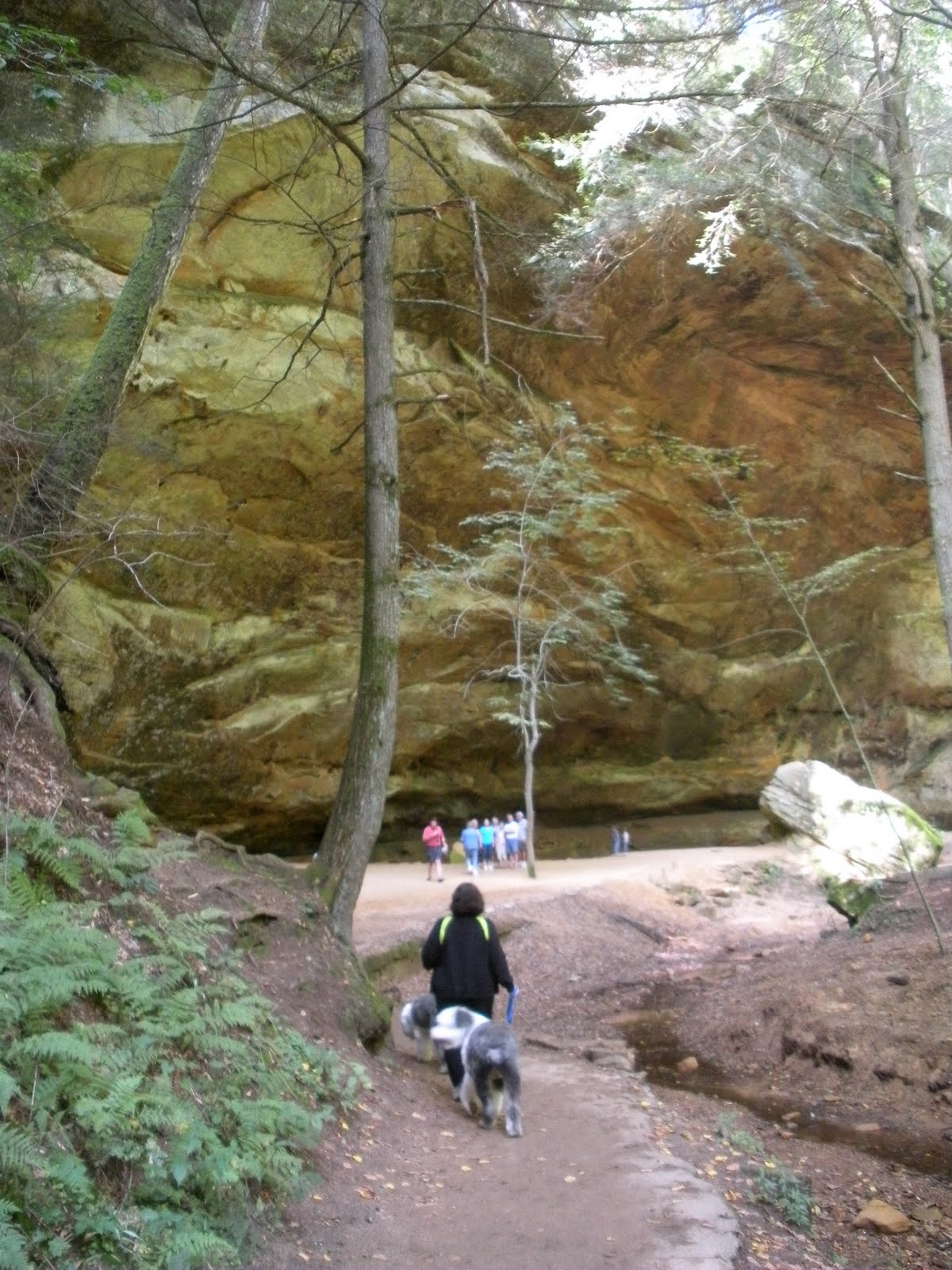
Campers at Ash Cave


Dear George,

Katja and I are recently back from a four-day camping trip to Hocking Hills State Park in southeastern Ohio. The trip had particular significance because Katja, a Philadelphia city girl, is less enthralled about camping than I am, so I’ve been mostly going out by myself with the sheepdogs. Many of our acquaintances don’t realize it, but it’s rumored that Katja is actually the lost daughter of the King and Queen of Romania, and, having been attended to by doting handmaidens throughout her childhood, the idea of roughing it in the wilds of Ohio doesn’t come easily to her. I was able to lure her to Hocking Hills because of the region’s reputation for beauty and splendor. My secret intent was to make this the perfect trip – flawless, comfortable, just like staying in a five-star hotel. However, things turned out more like that old Chevy Chase movie, National Lampoon’s Vacation, in which Clark Griswold takes his wife and kids across the country to visit Wally World. Like the Griswolds, we had lots of excitement, though not all of it was what we planned.


Hocking Hills is located in Ohio’s Appalachian foothills, about two and a half hours east of Cincinnati. We arrived about 1 p.m. on Monday, our SUV packed to the gills. The state parks are quiet on September weekdays, so we got our pick of campsites. Campsite #163 was an obvious pick because there were three deer standing on it as we drove by. Except for the ground being wet and dirty, it was an excellent location. We’d bought a large 9’ by 15’ dome tent for a U.P. trip several years ago, but we hadn’t put it up since then. For some reason, we got entirely befuddled in the process, with tent poles pointing every which way and nothing fitting together properly. After an hour of frustration Katja voiced her concern that we wouldn’t get the tent set up by sunset. I was privately thinking that we would never get it set up and would have to sleep in the car. However, after many missteps, we did finally succeed (by accident). Here’s our put-together campsite with handsome sheepdogs and all.


Hocking Hills is a huge park with a number of scenic destinations. A couple at a nearby Welcome Center suggested we go to Ash Cave first, since it had the most navigable of the hiking trails. Hocking Hills is so attractive because of its deep gorges which are lined by massive Blackhand sandstone walls and filled in with hemlock and beech forests. The bedrock is 350 million years old and was once covered by a warm shallow sea. The cliffs have been eroded by water and weather over millions of years to form natural caves underneath them. Ash Cave, which is 700 feet from end to end, is the largest of these. The cave got its name from an immense pile of ashes believed to have been generated by Native Americans’ campfires over hundreds of years. Here are a few views of Ash Cave and the gorge trail leading to and from it.


Monday night I wasn’t able to get our campfire started (probably because our wood had come from the wet forest floor), so we turned in before 9 p.m. I gave Katja my sturdiest air mattress. Naturally, all the air leaked out in the first few hours, and Katja wound up sleeping fitfully on the cold, hard ground. We did get up for breakfast, which Katja graciously cooked with her eyes half-closed, but then she went back to sleep while I took the dogs out on a forest hike on a trail along the upper rim of the gorge heading toward Old Man’s Cave. The views were pretty, though I was nervous about the dogs falling off the 150-foot vertical cliff and kept a short grip on their leash.


Katja got up after lunchtime, and the four of us set out for Old Man’s Cave. It’s a beautiful hike along the lower part of the gorge, but much more arduous, with a lot of steep up and down climbs. Katja, with a gimpy knee, gritted her teeth and gradually made her way, while I was busy trying to keep control over the sheepdogs who delighted in racing down the stone steps while pulling their master behind them. Old Man’s Cave was as gorgeous as billed. The cave is named after hermit Richard Rowe who made it his home around 1796. His grave is believed to be under the main ledge.


Another trail led off to the Lower Falls. It required a strenuous climb up the gorge, so Katja decided to take a rest with the dogs while I explored it. It was a beautiful view.


As we were leaving Old Man’s Cave, Katja tripped over an upraised rock on the trail and jammed her right leg into her hip bone, causing intense pain. Though she was near tears, there were no options except to hike back a half mile over the hilly terrain. Katja was pretty brave though she was worried that she might have broken something. When we finally got back, she took four Advil, lay back on a reclining lounge chair, and immersed herself in a murder mystery.


Unfortunately, that was the end of Katja’s hiking adventures for the trip, though it did make for lots of rest and relaxation. The next day we took it easy and checked out a nearby town. Katja had seen an advertising brochure that suggested it was a shopper’s paradise, but, aside from a neatly organized Goodwill and a tourist trap antique mall with 1950’s knick knacks there wasn’t too much of interest. Disappointed with that venture, we consoled ourselves by having Dairy Queen sundaes for lunch. Back at the campground, Katja resumed her mystery novel. I did the rest of the hiking stuff, taking the doggies along. Here’s the Old Mans Cave trail that led to the Upper Falls.


Here is Cedar Falls. It’s one of the park’s most stunning waterfalls.


Conkles Hollow didn’t allow pets, but I was glad that I went ahead and did it on my own. It’s one of the deepest gorges in the state with 200-foot cliffs on each side of the trail.


Wednesday night was our most memorable night at the campground. There was a heavy rainstorm, and a large puddle formed on our dome tent roof, then leaked through right on top of my head. I was already chilly because my lightweight summer sleeping bag wasn’t suited for the cold front that had moved in, and all the air had gone out of what was now my air mattress. I slept on and off. By morning, our tent was soaked on the outside, wet on the inside, and the campsite was a sea of mud. Pretty grumpy, we loaded our gear in the car, skipped breakfast, and departed before 9 a.m. We both were happy to have seen Hocking Hills, though we agreed that our trip could have been smoother. Katja, to her credit, said she was willing to try camping again sometime, though “not in the same manner.” She was a little sketchy about what manner she has in mind, but I’m sure we’ll find out. She might mean camping in the manner which they offer at the Best Western.

Love,

Dave


G-mail Comments

Hi David and Katja, I had no idea you had such exquisite natural wonders in your area. Good for you that you took on such an adventure. I've done yearly camping at a site with lovely canoeing and peaceful views but without bathrooms, rocky terrain, uncertain weather (including lightning and thunder storms, wind and smoke from wildfires). I guess that's what makes it all an 'adventure'. But I have to empathize with you, Katja, there does come a time when sleeping on hard ground, having your joints ground together on steep passes or having cold rain pour on your head doesn't really appeal! Recently, I'm more taken with finding a comfortable cabin on a lake with some cooking facilities and doing day hikes (haven't found that yet). I will say that my air mattress is 'deluxe' (about 18" thick and very comfortable). We used to pump it up with a foot pedal air pump (endless, arduous aerobis) - now, nothing less than an electric pump will do. George and I camped for years in a 30+ yr old canvas tent we adored, which we purchased in England. If I embark in future camping activities, it'll have to be with some sort of dome tent that pops up when I push a button and never, ever leaks. Ah..changing times. You're good sports. Hope that knee/hip insult has resolved itself. Love, Vicki