Monday, September 21, 2009

We Go Camping With Our Master

                            Duffy and Mike Go Camping

Dear George,


You probably never got a letter from an Old English Sheepdog before.  However, I’ve been watching Our Beloved Master (also known as The Big Guy), and I found it’s not that difficult to use a computer.  My main problem is that my paws are too big, but, if I go slow, I can do it.  So I thought I’d let you know what Mikey and I have been up to.


Last week The Big Guy started lugging boxes up from the basement.  Mike and I didn’t know exactly what he was doing, but we knew it was something special.  Whenever the Master does something like this, we jump around and bark a lot and nip at his wrists to let him know we want to be included.  This always works with the Master.  And sure enough, he put us in the SUV, and off we went.


We drove to a place called Winton Woods.  Even though it’s just out in Cincinnati’s suburbs, it looked a lot like the wilds of Northern Wisconsin where we went last summer – eighty-foot pine trees and a big lake and spacious campsites.   The Big Guy tied us up to a tree as soon as we arrived.  We don’t know why he bothers.  It’s scary enough being out in the forest, and there’s no possibility we would go anywhere.  But it does give us a chance to lie down in the dirt which is our favorite out of doors thing to do.


We watched Our Human as he unloaded the car.  Then he laid a big silver tarp on the ground and put our expandable wooden playpen on top of it.  We love our playpen.  The Master untied us, and we ran right in.  It is like our own little house.  We get to stay inside, and no one else can get in.  Even though we could easily jump out, we never do.  The only drawback is the silver tarp gets too hot when the sun hits it.  We try to push it aside so we can get back in the dirt, but the Big Guy won’t let us. 


After the Master ate his lunch, we went for a walk on the Horse Trail where he let us off the leash.  The Master started picking up dead tree branches which he’d break into two or three smaller pieces.  We used to get excited about this.  The crackling sound is thrilling, and we always think he’ll be throwing the sticks for us.  But instead he just puts them in a knapsack.  So we sat patiently and watched. 


Back at our campsite we took a nice walk around the campground.  Every time Mikey saw an SUV, he tried to get into it.  He wanted to go home pretty badly, but The Big Guy kept pulling Mike along.  He was very careful to pick up any poops we made.  He himself stopped in this big booth called a Port-a-Potty, holding onto our leashes but leaving us outside the door.  We didn’t want to be left alone, so we kept tugging on the leashes and pulling the door back open, but he kept pulling back and closing it.  After a while he must have gotten tired of this fun game because he came back out.


The Big Guy gave us our supper in the playpen.  Usually we’re not allowed to eat in such a small space because it can cause trouble.  I gulped down my food as fast as possible so I could attack Mike and get his food too.  However, he must have had the same idea, and we finished at the same time. The Big Guy meanwhile was cooking his own dinner.  He’s o.k. at preparing dog food, but that’s about it.  He burnt the fried potatoes, he didn’t have any lemon to put on the fried perch, and he forgot to bring salt and pepper.  The only thing that looked prepared correctly was his Diet Cherry Seven-Up.  However, he ate it all up and didn’t seem to mind.  Maybe he has some sheepdog in him. 


As darkness set in, our Master moved our playpen over near the fireplace and made a fire with the sticks he’d collected.  He sat and drank some red wine and stared at the flames.  Our RV neighbors next door were sitting by their fire and watching television.  We considered them to be pretty wimpy campers.  Finally the Master took an Ambien.  We thought this was a bad idea, since he’s been known to wander around in the night.  But we were able to get him into the tent successfully.  Mikey and I love it in the tent.  We love it even more than the playpen, because it’s like a big doghouse, and Our Beloved Master is inside with us.  He’s the only one who gets to sleep on the air mattress.  We try to get on it with him, but he pushes us off.


We were wakened in the morning by loud scary honking sounds.  When we looked out the window, we saw big birds flying together in a V shape, heading for some important place.  Our Master was still asleep, so I gave him some licks on the face.  We got up, and he gave us our breakfast (which was prepared very well and turned out to be exactly the same recipe as our supper).  For himself, he cooked some burnt scrambled eggs, some burnt bacon, some burnt potatoes, and some weak coffee.  He seemed to think this was quite an accomplishment.


After a while a lady came over from the RV next door.  She asked the Master if she’d seen us on Ludlow Avenue.  When the Master said yes, she said she drives down Ludlow every day to get to work at Christ Hospital and she’d seen us many times.  She said how cute Mikey and I were and what great dogs we’ve been on the campground.  We were the only dogs that didn’t bark all the time.  We were proud.  Not only are we well-known in our neighborhood, but we’re even famous in the woods.  Our Master is lucky to own us because he gets to be a celebrity too.


After lunch, the Big Guy tied us to a tree and started packing up.  This makes us very nervous, because we’re never certain if he’s going to remember to take us with him.  We watched his every move. He kept looking over at us too, as if to remind himself, “Whatever you do, don’t forget the dogs.”  The very last thing, he boosted us into the SUV.  We were very happy when we got home.  Supposedly we are descended from wolves, but any affinity for the forest was bred out of us many generations back.  What we like is air conditioning and easy chairs and down comforters and snoozing in front of the TV.  We appreciate that the Master likes to bring us along to the woods, but, frankly, we’d just as soon have everybody stay right at home.


Love,

Duffy


Gmail Comments

-Jennifer M (9-22):  Great.  I didn’t know the dogs didn’t like camping!

-Linda KC (9-21): i always read your blog and i love it, we had queen vida in seattle with the rest of the group , she is something else, her cousins love her so much and she loves to get in and tussle with them. love linda

-Vicki L (9-21):  Just delighted in reading Mike and Duffy’s account of your camping trip.

-Donna D (9-21):  david. this is so clever...love the story, love the pictures…

Friday, September 18, 2009

Recapping the U.S. Open


Dear George,


We wound up two weeks of watching the US Open last Monday, and we enjoyed the whole event.  As somebody who’d never even seen TV before his sophomore year in high school, I still find the medium to be a miracle.  For all practical purposes, we were right there in front row seats in Arthur Ashe Stadium (actually much closer – right there on the court) and enjoyed the benefits of expert commentary, instant replay, fantastic graphics, etc.  Who could have imagined?


Katja and I have watched professional tennis together, live or on TV, since we got married in the days of wood rackets.  Rod Laver and Billie Jean King were among our early favorites, then Borg and Connors and Navratilova.  Nowadays we are big Roger Federer fans, and we were excited about the prospect of Roger winning his sixth consecutive US Open and tying Bill Tilden’s all-time record from the 1920’s.  Sadly, of course, this was not to happen.


U.S. tennis has fallen on hard times.  Or perhaps it’s more accurate to say that European tennis – and particularly Russian and eastern European tennis – has become dominant.  Andy Roddick was the only American seed in the top 20, and he was defeated in the third round by fellow American, John Isner, ranked 55th in the world.  Isner, at 6’ 9”, is the tallest player on the men’s tour, and his game rests upon his powerful serves.  His groundstrokes, though, are shaky, and he lost in his next match.  It’s the first time in the Open era that there wasn’t a single American male in the U.S. Open quarterfinals.


American women did a little better, thanks to Venus and Serena Williams and newcomer Melanie Oudin.  Oudin, in particular, was a highlight of this year’s Open.  Before the tournament she was the third highest ranked U.S. woman at number 70 in the world, and she wasn’t expected to do much.  A gritty teenager with powerful groundstrokes and good court coverage, she singlehandedly proceeded to eliminate much of the Russian contingent: number 4 seed, Elena Dementieva; 29th seed and former U.S. Open champion, Maria Sharapova; thirteenth seed, Nadia Petrova.  Oudin finally lost to Denmark’s Caroline Wozniacki in the quarterfinal round, but not before improving her ranking, taking home a pot of prize money, and becoming a media darling.    


The other woman with a newsworthy story was Kim Clijsters of Belgium, who had won the U.S. Open in 2005, then retired in 2007 to begin a family.  Her cute little baby was there throughout the tournament.   Clijsters received a wild card to get into the Open because she hadn’t played enough this year to be ranked.  After winning three straight set matches, she then beat third seed Venus Williams in the fourth round by the improbable score of 6-0, 0-6, 6-4.  These were two equally powerful woman, matching groundstroke for groundstroke, and I think Clijster’s composure under duress made for the difference.  After a win against Na Li of China, Clijsters and Serena Williams had another knock-down, drag-out match.  Clisters, who played more consistently and was in command throughout, won on a very unfortunate circumstance when Serena reacted emotionally and hostilely to a lineperson’s foot fault call on the point before match point.  The line judge reported that Serena had threatened to kill her, and the referee administered a point penalty which ended the match in Clijster’s favor.  Commentator John McEnroe said that he didn’t see a foot fault from the TV coverage, and, even if a slight foot fault did occur, it was an inappropriate call at that critical moment.  Other commentators severely criticized Serena, suggesting that a $10,000 fine was a mere slap on the wrist.  I personally think that Serena probably did scare the wits out of the tiny linesperson, but that her behavior wasn’t any more out of line than, say, McEnroe’s or Connors’ in days gone by.  Clijster’s, who appeared likely to win the match in any case, then went on to defeat Wozniacki 7-5, 6-3 in a well-played final and became the first mom since Evonne Goolagong in 1980 to win a grand slam final.


The dark horse on the men’s side was fifth-seeded Argentinian Juan Martin Del Potro, age 20, who was playing in his fourth U.S. Open.  Del Potro met Rafael Nadal in the semi-finals and gave Nadal his worst career loss in a grand slam tournament, 6-2, 6-2, 6-2.  Nadal was suffering an abdominal injury, which appeared to affect his serving power, but Del Potro impressively dominated him throughout the match with powerful, accurate groundstrokes.  We’ve never seen Nadal look so chagrined.  Roger Federer, in the meantime, had a straight set victory over Novak Djokovich in which he hit what he described as the greatest shot of his career, a behind the back passing shot through his legs which just cleared the net at a high velocity and landed in the back corner for a winner.  Following the Nadal rout, Del Potro looked like a scary opponent, even though Federer had beaten him six times in the past.  Federer started out strong, in command throughout the first set, and he continued that way into the second.  He got cutesy, though, hitting a couple of stupid drop shots that he lost, and Del Potro, who’d been looking dejected and lackadaisical to that point, worked his way back and took the second set in a tiebreaker.  When Federer won the third set, it once again looked all over.  Del Potro, though, kept elevating his game and his confidence, relying extensively on his impressive forehand, while Federer became increasingly unsettled and inconsistent.  He actually snarled at the referee a couple of times in the match’s later stages.  We remained confident that Roger would win when they went into a fifth set, but it wasn’t to be.  Final score:  3–6, 7–6, 4–6, 7–6, 6–2.  Federer looked pretty miserable receiving the runner-up trophy, and we fans were even more miserable for him.  Now we wonder how Roger will do in 2010.


Katja suggested afterward that we subscribe to the Tennis Channel, but I wasn’t that carried away.  It’s a long wait till next year’s French Open, but we’ll follow the Cincinnati Bengals in the meantime (even though they continue to be very un-Federer-like).


Love,

Dave

Monday, September 14, 2009

CINCINNATI CELEBRITIES: DORIS (KAPPELHOFF) DAY


Dear George,


A couple of years ago when I existed in the real world of teaching social psychology I was doing a lecture on gender roles, and, seeking an example of the prototypical American woman, I used Doris Day as my example.  A couple of students giggled, and a male in the back asked, “Who is Doris Day?”  I was taken aback, but I was even more surprised when I tossed the question back to the class and found that none of the 70 students present had an answer.  This was particularly puzzling since Doris Day is a native Cincinnatian.  I was very familiar with her, of course, from her many hit songs and movies in my adolescence and young adulthood.  Plus, as a teenager, I and my friends were addicted to Your Hit Parade, the weekly radio show hosted by Day and Frank Sinatra. I can still repeat verbatim the lyrics to her “Que Sera, Sera”,  “A Guy is a Guy”, or “Bewitched, Bothered, and Bewildered.”  


Doris Mary Anne von Kappelhoff was born in Cincinnati on April 3, 1922, to Alma Sophia Welz, a housewife, and Wilhelm von Kappelhoff, a music teacher.  Her grandparents were German emigrants, and the family lived in Evanston.  She was named after Doris Kenyon, a silent movie actress.  Though the family was Roman Catholic, her parents divorced in her childhood because of her father’s infidelity. 


Doris had a strong interest in dance in her youth and formed a dance duo that performed locally in Cincinnati.  In 1937 she won an amateur contest, and her mother decided to take her to Hollywood.  However, they had a car accident on the way west, and Doris’ right leg was severely injured.  She returned home to recuperate.  The family lived above a tavern owned by her uncle, and she got interested in singing by listening to the jukebox.  She took lessons and won an amateur contest on radio station WLW, singing Day by Day.  Soon after she began performing at a local club with bandleader Barney Rapp, who suggested she change her name to “Day” (after the song) because “Kappelhoff” was too long to fit on a marquee.  She didn’t like the name, thinking it sounded like a burlesque performer, but she accepted the advice.   She then worked with a number of bandleaders, including Bob Crosby and Les Brown.  Doris had her first hit recording, Sentimental Journey, working with Brown in 1945.  It became the anthem of the U.S. troops’ desire to return home to the states at the war’s end, and Doris’ career was launched.


Day toured the country with Les Brown, and her growing popularity led to her career in films.  She attended a party at the home of composer Jule Styne, where she sang Embraceable You.  She so impressed Styne and his partner Sammy Cahn that they recommended her for the main role in Romance on the High Seas from which Betty Hutton had withdrawn because of pregnancy.  In 1950 U.S. servicemen in Korea voted Doris Day their favorite movie star.   She went on to become one of America’s biggest box office stars, making a total of 39 movies, even though she retired from films in 1968.  These included a succession of romantic comedies with Rock Hudson, Cary Grant, and other male leads, e.g., Pillow Talk, Lover Come Back, Love Me or Leave Me, Teacher’s Pet, Midnight Lace,  Send Me No Flowers, The Thrill of It All.  Her screen roles promoted her image as the All-American girl, wholesome, vivacious, and innocent.  Doris didn’t care for the image, but her husband and manager Martin Melcher actively promoted it.  According to Quigley Publishing’s poll of All-Time Number One Stars, Doris Day is currently the top ranking female box-office star of all time, the only other female in the top ten movie star list being Shirley Temple.  She received the Cecil B. DeMille Award for lifetime achievement in motion pictures in 1989.     


Contrary to her image as the girl next door, Doris Day had a succession of bad marriages.  Al Jorden, her first husband and father to her only child, was a trombonist in the Barney Rapp Band, was a physically abusive alcoholic, and committed suicide in 1967.  Her marriage to saxophonist George Weidler lasted only three years, though he later helped her to convert to Christian Science.  Martin Melcher, who Day married in 1951, produced many of Day’s movies, but reportedly abused her son, and created severe financial problems by squandering huge amounts of Day’s earnings, leaving her deeply in debt.  Melcher died in 1968, and Day successfully sued his business partner and won the largest civil suit ($20 million) ever awarded to that time in California.  Day’s fourth husband, Barry Comden, was a restaurant maitre d’ who won her over by giving her a bag of meat scraps and bones for her dogs, but their marriage collapsed when he complained that Doris cared more for her animal friends than she did for him.          


Now age 87, Doris Day lives on an 11-acre ranch near Carmel, CA.  She owns and operates the pet-friendly Cypress Hotel in Carmel where she can frequently be seen.  She often uses the name Clara Kappelhoff, Clara being a nickname given to her by co-star Billy De Wolfe.  She continues her long-time activism for animal rights, funding and running the Doris Day Animal League which merged three years ago with the Humane Society of the U.S.  President George W. Bush awarded her the Presidential Medal of Freedom in 2004, though she didn’t attend because of fear of flying.  Doris Day stated, “I am deeply grateful to the President and to my country…to come from Cincinnati, Ohio, for God’s sake, then to go to Hollywood, and to get this kind of tribute from my country…I love this country so much..”  (We love you too, Doris – except for my students).


Love,

Dave


Sources:  Wikipedia, www.dorisdaytribute.com, www.imbd.com, www.parabrisas.com

Saturday, September 12, 2009

Washington School Days: 6. The Famous Drugstore Incident


Dear George,


My grandfather, V.A. Sr., owned and operated drugstores in Menominee and Marinette.  When he retired, he gave the Marinette store to my dad and the Menominee store to my Uncle Kent who was a pharmacist.  The Menominee drugstore was on Electric Square at the northwest corner of the intersection of Ogden Avenue and Sheridan Road in the heart of downtown Menominee.  If you were to go there today, it’s the building occupied by the Subway Sandwich Shop, but back then it was a bustling drugstore with a full-scale pharmacy, a soda fountain and lunch counter, a perfume department, and all the various items which a respectable Rexall store would carry.


Washington School was only a half block away.  Washington was a neighborhood school, and nearly all the kids walked home for lunch at noon.  Our family, though, had moved out of town to Riverside Boulevard when I was in the fourth grade.  As a result, my dad made arrangements with Uncle Kent for Steven and I to eat lunch at the drugstore each day.  Our lunches included a sandwich and a drink, sometimes soup or potato chips.  When things were quiet, we were allowed to eat at the lunch counter.  But to maximize seating for paying customers, we nearly always ate in Uncle Kent’s office, a small, dark, dingy room adjacent to the pharmacy space at the back of the store.


                   The Menominee Drugstore (photo by VAL)

The drugstore provided one of the great joys of my childhood because its magazine rack offered a plentiful and ever-changing supply of the latest comic books.  Kent allowed us to read these as long as we didn’t put a single wrinkle in the pages.  We carefully followed his instructions.  I loved comic books.  Superheroes were my favorite, and Skipper Burke, Frankie St. Peter, and I would have endless discussions of who was best: Superman, Batman, Captain Marvel, The Green Lantern, etc.  Frankie and I always voted for Superman and felt confident in our choice because he had the greatest powers.  Skipper, though, made a strong case for Batman, namely that he was a regular human being of extraordinary strength and intelligence who didn’t have to rely on supernatural powers.  We all poked fun at Captain Marvel as a sort of antiquated superhero with his magical incantation, “Shazam”.  Inspired by the comics, I spent a lot of time drawing cartoons, copying images of Bugs Bunny or Donald Duck or making up characters of my own.


Uncle Kent had been a military leader and war hero, and he carried these attitudes over into his civilian life.  While I later became exposed as a young adult to his very caring side as a family member, Uncle Kent was very much in charge, and we were nervous and obedient when in his domain.  His main employee and coworker in the drugstore was fellow pharmacist, Lucien P.  Lucien was an older, thin, white-haired man with a rather depressed disposition. What I remember most about Lucien is his telling me each time I came in that I’d better enjoy life right now as a ten-year-old, because it was sure to get worse and worse as you went along.  This made a great impression upon me, probably because I was pretty unhappy already and it was hard for me to imagine that now was the best that life would ever be.


Kent was very active in the American Legion, and one year he ran for the position of Michigan State Commander.  His identical twin brother, Karl, accompanied him to the state convention in the Lower Peninsula.  Though very similar in appearance, Kent and Karl were strikingly different in personality.  If Kent tended to be gruff and serious, Karl was outgoing, full of laughs, and the prototypical life of the party.  As they’d done throughout their life, they engaged in some trickery at the state Legion convention.  There were many cocktail parties going on simultaneously, and Kent and Karl divided them up between the two of them, with Karl pretending to be Kent and campaigning at half the locations.  The two brothers covered double the territory of any other candidate, and, undoubtedly in part because of Karl’s geniality, Kent wound up winning by a landslide.


Kent wasn’t around the drugstore nearly as much.  But when he was there, he became very upset about the growing rat problem in the building.  Kent and Lucien tried setting traps, but with only limited success.  It seemed probable that the rat problem was somehow connected to the lunch counter, but the foodstuffs were all kept in metal containers, the refrigerator was inaccessible, and the garbage cans were tightly sealed.  This went on for many months with no resolution and was obviously an embarrassment for an establishment whose very identity rested an image of health and cleanliness.  Finally, one day the mystery was solved.  Somebody, perhaps in the act of cleaning, had pushed Kent’s office desk back away from the wall.  There they discovered a three foot high mound of moldy white bread crusts which apparently had been accumulating for up to two years and had filled the entire space behind the desk.  It was my brother Steven’s creation.  Steve hated bread crusts, and, after eating the innards of his sandwiches, he had been secretly disposing of the crusts behind Kent’s desk since the first day we had eaten there.  My father informed us of our transgression and said we wouldn’t be eating at the drugstore for a while.  I didn’t mind not eating at the drugstore.  I just didn’t want to be murdered.  Things did work themselves out though.  We finally were required to meet with Uncle Kent, and he was surprisingly gentle.    He gave us a lengthy lecture on social responsibility and some detailed orders to follow.  As good soldiers, we followed them to the letter.


Love,

Dave


Gmail Comments:

From Phyllis S-S (9-13): Dave,  What did Karl do for a living?  I loved the bread crust story.

Wednesday, September 9, 2009

SOPHIE GOES ON VACATION


Dear George,


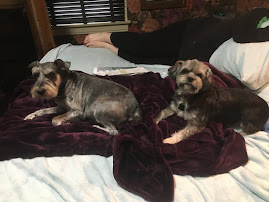
When the humans go on vacation, the dogs get to vacation too.  In this case, Donna took a five-day trip with her friend and colleague Cindy to The Villages in Central Florida, and Sophie came to stay with us in resort-like Clifton.  Sophie, of course, is Mike and Duffy’s younger sister, and they spend so much time together that they constitute a pack.  Nonetheless, it’s a special and exciting occasion when Sophie comes to live with us for a while.


Sophie is very attached to Donna, so the first thing she does with her human’s departure is to sit in front of the gate and stare at it, as if some magic will make her mother reappear.


Finally Sophie gives up and comes in the house.  She goes straight up to the bedroom and jumps in the bed.  I think she must associate this with security since it’s the place that she’s closest to the humans.  She may also want to get there first to establish her place before Duffy and Mike arrive.


Once Katja, gets in bed, everybody gets in.  As you can see, Sophie gets a prime location, up with the humans, while Mike and Duffy are relegated to the lower levels.  


We spend a lot of time walking on Ludlow Avenue.  The three sheepdogs are a wonderful sight, and passing drivers yell out from their happiness in seeing them.


Katja and Sophie, as the only females in the pack, enjoy a special bond, so sometimes they may have a girls-only excursion.


We had some nice trips to Mt. Airy Forest and Burnet Woods on this visit.  The dogs get very excited when they get in the car, and they pant with emotion by the time they reach their destination.


Despite a leash law backed up by $100 fines, I let the dogs run free in the forest.  Sophie and Duffy generally lead the way, while Mike lags behind.  There is a lot of good stuff to sniff.  Sometimes Sophie runs so far ahead that I worry about losing her.


We spent a lot of time watching the US Open over the weekend.  At this particular moment, Sophie seems more interested than does Katja.


One interesting feature of Sophie’s visits is that when the dogs hear a strange noise outside, Sophie begins howling, and Mike and Duffy join in.  They only do this when Sophie is here, and the three of them sound like werewolves on the Scottish moors.


Sophie had a swell time, but she was extremely happy when her Mom returned home.  Now we miss her.


Love,

Dave


Gmail Comments:

-Ami G (9-10): This saga is adorable, as are all of you!

-Vicki L (9-10): thanks for the great dog report complete with pictures, David. Too wonderful...such cozy happy images. what lucky dogs. love, sis

-Donna D (9-10): oh, david, this is so wonderful!  what great pictures.  i didn't realize she sat by the gate when i left...i think you must have set her there for the picture, right?  i just loved this so much.  thank you!


Sunday, September 6, 2009

TREASURE-HUNTING IN NORTHSIDE


Dear George,


In my book, the Northside community yard sale is the event of the year in Cincinnati for us bargain hunters.  Northside is just across the viaduct from Clifton, but it’s a more traditionally blue collar neighborhood.  Over the years it’s become a location of choice for the arts community, gay and lesbian couples, young UC faculty members, and generally folks with hippy-like dispositions.  Given people’s aesthetic sophistication and alternative life styles, Northside is a yard sale paradise.  The community sale occurs once a year in late summer, and over a hundred homes participate, spearheaded by a big church rummage sale.  The merchandise is esoteric, e.g., art books, crystal goblets, tarot cards, sea shells, Grateful Dead placards, 8-track tapes, scented candles, ostrich feathers, mountaineering equipment, you name it.  The people are mellow, the prices are low, and you’re expected to bargain.  Last year I bought six bottles of Yellowtail wine for six dollars.


I went along with my friend Phyllis on a recent Saturday morning. Our spouses are more highbrow in their tastes and thus disinterested in the Northside sale.  As an opera devotee and world traveller, Phyllis has a highbrow side too, but, in her second self, she is a flea market/thrift shop junkie, and she wouldn’t miss Northside.  It’s a walking adventure, much of it contained within a five block by five block radius.  Phyllis likes to go to everything, so we spent four hours scouring the neighborhood.  It’s a very pleasant outing for a sunny Saturday morning.  People are in a good mood and like to chit chat, there’s tons of stuff to look over, and there is that exhilarating feeling of being on a treasure hunt where you never know what fascinating thing you’ll find next, usually being sold for about 10 percent of its original price.  The event also has a carnival atmosphere to it.  Hundreds and hundreds of people, mostly middle-aged, mostly white, mostly middle-class-looking, are out on the sidewalks, searching for whatever bargains strike their eye.  These are people who have housefuls of stuff already and don’t have room for much more.  Nor do they want to spend any money.  But they do like to devote their leisure time to the all-American quest of accumulating more material goodies.  Rather than go to the mall, a more serious venture, they wander around to see what objects can be found from somebody else’s attic or basement.  And everybody is ecstatic.  I would claim to be skeptical of all this except that I clearly am one of them.


Both Phyllis and I had successful outings.  Phyllis has a particularly effective bargaining style.  She doesn’t asks the price of things, but rather says in a pleasant voice, “Will you take a quarter for this?”  Almost always people say yes.  On this trip, she got jewelry and clothing and books and linens and pez containers and many other things I can’t even recall. Because I spread out my take on the dining room table, I can give you a more detailed list of my acquisitions: 


1 Mickey Mouse keychain                                     $0.50

1 black folding umbrella                                        $0.50

5 12” metal tent stakes                                         $1.00

1 1956 Dinah Shore NBC publicity photo             $1.00

1 dish towel for camping                                      $0.25

1 white hooded Gap coat                                     $3.00

1 8’ x 10’ woven rug for my office                        $7.00

1 camouflage Belterra Casino cap                      $0.50

1 bag of colorful stones & arrowheads                $0.50

2 videos of W. Allen & H. Bogart movies            $1.00

1 Cincinnati magazine (Dec. 2000)                     free

2 French prints                                                    free

1 rubber Superman toy                                       $0.50

1 Dockers broad-brimmed camping hat             $1.00

1 album of horse prints                                       $0.25

4 black and brown leather belts                         $3.00

TOTAL                                                               $20.00


In these days of over-priced commodities, you probably find it hard to believe that one could get all this for only $20.  Not only that, but I had been wanting to get every single item.  This is the wonder of the yard sale as an American institution.  You could furnish your entire life with the stuff that other people put out in their yard.  After finishing Northside, we drove across the river to the Mainstrasse area in Covington, KY.  Mainstrasse was the starting point that weekend of the World’s Longest Yard Sale, which stretched 500 miles from Covington down Route 127 to Gadsen, Alabama. An important perk of living in Cincinnati is that this world class event has its beginning here.  After browsing the tables of 40 or 50 vendors, we considered driving down Route 127 into rural Kentucky.  However, we’d been so successful in Northside that, aside from checking out Mainstrasse, we actually decided to bypass the longest sale in the world.   


Love,

Dave


Friday, September 4, 2009

ON THE ROAD AGAIN


Dear George,


I wrote the other day about my trip to San Francisco in the summer of 1958, but, after I posted it, I realized I’d left out a few details.  I’d driven to California in my 1951 Buick with the intention of selling it there  I’d heard that there was such a shortage of cars on the West Coast that you could sell a used car for double the price that it would bring in the Midwest.  Because I’d had some transmission problems and was worried about my car surviving much longer, I decided to dispose of it.  I took it to a big used car dealer when I got to San Francisco, but the guy showed no interest.  He said, while there was in fact a shortage of good used cars in California, nobody would want to buy my car.  Dejected, I parked it next to a city park in my neighborhood and moved it every few days to avoid getting a ticket.


As I mentioned previously, Bill H., a fellow Antiochian, asked in early August if I’d like to drive back to Yellow Springs from San Francisco, and I said I would.  We agreed to share the driving and do the trip nonstop.  We left on a Saturday morning.  However, as soon as Bill began his stint at the wheel, it became clear our plan wouldn’t work out.  He had had some lessons as a high school student and possessed a driver’s license, but, as a city person, he’d never really driven a car on his own.  He wobbled over the center line, got unduly nervous when a car passed him, and was generally overwhelmed by the demands of highway driving.  After a harrowing mile or two he said he didn’t feel comfortable driving, and I said I wasn’t comfortable either.  Actually I was terrified.  We decided that I would do the driving, and he would stay awake, read the map, and keep me company.


We travelled through California and into Nevada, then started climbing the Rockies.  I was worried about the Buick making it, but it chugged its way up for miles and miles.  As we descended on the Colorado side of the mountains, a gas station guy told me that my brakes were getting hot and that I should wait till they cool down, then avoid braking as much as possible.  I followed his advice, and we coasted down the ten thousand foot descent to the flat lands below.  Night fell, and I drove and drove and drove.  We went from Colorado to Nebraska.  I took NoDoz and drank a lot of coffee, and Bill helped to keep me awake by telling stories.  After about thirty-hours of driving with only two or three brief rest room stops, we reached the outskirts of Kansas City.  I was functioning pretty much like a zombie by that point.  I ran a red light in the suburbs and almost immediately heard a siren behind me.  The police officer checked my driver’s license, noting that I was from Michigan, and asked if I’d seen the red light.  I said I did see it, but I’d chosen not to stop.  He looked at me perplexed and asked why that was.  I said that a guy in the mountains had told me my brakes were hot and that I should us them as little as possible.  I was worried that my brakes might fail if I hit them too hard.  The policeman was startled.  “The mountains?  What mountains?” he asked.  “The Rockies,” I said.  The policeman was taken aback and shook his head.  “The Rockies?”  He explained to me the Rockies were over a thousand miles away.  I suddenly realized that I’d been in a heightened state of vigilance for the last fifteen hours, my right foot poised to avoid using my presumably hot brakes the whole time.  The policeman was polite but firm.  He said I should leave the state of Missouri as soon as possible.   I should go straight back to Michigan.  Then he let us go on our way. 


We did get back to Yellow Springs without further incident.  We’d taken one three-hour nap in the car, but, basically, I’d driven forty-plus hours in a row.  While the car did make it to the coast and back, I still didn’t feel good about how it was running.  Later in the school year my friend Newt was talking about his desire to have a car, and I told him he could have mine.  He didn’t feel it was fair to take it for nothing, so he gave me thirty dollars.  It wasn’t much, but I felt relieved.  Then a couple months later, Newt also decided the car wasn’t doing that well, and, since he’d gotten his thirty dollars out of it, he gave it away to Art F.  That was the last I heard of it until I went home over spring break.  On my first day home my dad suggested we take a walk on the road, always a bad sign that I was going to hear about some serious life error that I’d made.  My dad was really angry this time.  It turned out that my car had been found abandoned on the New York Thruway.  Because the car was in my dad’s name, he had received a bill for over a thousand dollars in fines and associated costs.  I tried to explain that I didn’t own the car any more, that I’d sold it to Newt who had then given it to Art.  My dad asked if I’d had the title for the car transferred to Newt in Ohio, and I said we didn’t bother doing that.  This only made him still angrier, since he had been legally liable for any potential accidents my friends might have gotten into.  My dad insisted I contact Art right away and get him to pay back the thousand dollars.  I knew that Art didn’t have any money, so that this was an unlikely possibility, but I said I would try.  And that was the end of my first distressing experience as a car owner.


Love,

Dave


Wednesday, September 2, 2009

My Brief but Exciting Career as a Writer


Dear George,


In the summer before our last year at Antioch, Katja was finishing her year abroad in Vienna, and I decided to go to San Francisco to explore my dream of becoming a fiction writer. I had majored in creative writing for a while, but was dissuaded by a disgruntled English prof who claimed there were few if any rewards available to the literati in American society. I had taken his advice to heart, but a lingering part of my true self still clung to the idea of a writing career. I saw this as my last chance to test that life option.


Four Antioch students were bound for San Francisco that summer – Eleanor Holmes, Eddie Lemansky, Betsy Riggs, and myself. I was the only one with a car, so we contracted to travel together, sharing the gas expenses. Eddie and I did the driving. Betsy didn’t have a license, and Eleanor wasn’t comfortable with it. We decided to drive nonstop from Ohio to the coast, and, in fact, we only took one or two short naps along the way. The westward trip is a blur in my mind. We drove through Nebraska at night, and the highway was filled with long-legged hares, a goodly number of which we ran over. The car broke down in Ogallalah, and a kind mechanic did the repairs and charged me a dollar twenty-five. We stopped to look in the Mormon Temple in Salt Lake City and took a swim in the Great Salt Lake. We drove over the Rockies. Then, before you knew it, we were in San Francisco.


Eddie and I dropped the women off at their destinations, and we went downtown to the Tenderloin District, San Francisco’s skid row. We asked a homeless lady living in her car where the cheapest hotel was, and she directed us to a cheesy looking three-story SRO on O’Farrell St. The nightly fee was two dollars. Eddie got a room that was lined on all four walls with bright red velvet curtains and smelled strongly of perfume and room deodorizer. The room clerk told us that its prior occupant had entertained his friends there. My room was less gaudy, but wouldn’t have earned a single star from AAA.


I’d brought just fifty dollars with me as my stake for the summer, so I scanned the classifieds in the Examiner for job possibilities. What caught my eye were positions that offered free room and board, but no pay, in exchange for kitchen work. This seemed to offer maximum flexibility for an aspiring writer, and the element of no pay actually appealed to my self-picture as a starving artist. I arbitrarily picked one of the ads for a place called The Mansion, located near to California and Fillmore, and walked over to check it out. The manager’s name was Lindy. He said it was a pearl-diving job, and, when I looked puzzled, he explained that that was the insider’s name for washing dishes. After a brief interview, Lindy offered me the job.


Lindy was an out of the closet middle-aged, balding gay man, tall and skinny, flamboyant in style, and very funny. He looked and talked like Larry David. After the first evening meal he was less than impressed with my dishwashing ability and showed me how to speed it up. Lindy’s opinion, which he offered on numerous occasions, was that college students were just fine on theory and lofty abstractions, but they were wholly lacking in real-life skills or practical knowledge. I didn’t quarrel with him, and I worked hard to improve.


The mansion was a fancy place – in fact, it had been a real mansion, dating back to the late 1800’s, which had been converted into a high-level boarding house for professionals in their 30s and 40s. People took their breakfast and supper at the Mansion, so my work duties centered around these two meals. After a few weeks Lindy tried me out as a waiter, but I did miserably at it, failing to remember people’s orders by the time I reached the kitchen, and I was quickly demoted back to my lower level pearl-diving job.


My room was in the basement and had formerly been the mansion’s library, a cavernous space lined with empty oak bookshelves. It was secluded, quiet, and an excellent place for writing. I had brought my Olympia portable typewriter with me, along with a ream of paper, and I spent many hours there churning out material. William Saroyan was my favorite writer at the time, and he had spent part of his early career in San Francisco, frequenting the San Francisco Public Library. Emulating my idol, I did that too, writing longhand drafts of short stories at a table in one of the large reference rooms.


The Mansion’s owner was a staid, mustachioed British man named Gordon who made regular visits to monitor goings on. Lindy was condescending toward Gordon in his absence, but cowtowed to him when he was there. Gordon became incensed when he learned that a single man and woman had removed the lock on the door that separated their adjacent rooms so that they could more readily share a common bed. Gordon went up, entered the man’s room while he was sleeping, and proceeded to nail the door shut in an effort to restore morality.


Late in the summer Lindy smuggled a pregnant woman named Jeannie into the Mansion and gave her a room on the top floor. Lindy explained that he had nothing to do with Jeannie’s pregnancy, but that she was a close friend who needed help. Because of her mammoth size, I guessed Jeannie to have been in her ninth month. Along with being pregnant, Jeannie also had a fondness for vodka. One night there was a huge thunderstorm, and, as Lindy recounted to me the next day, Gordon came by to make sure everything was o.k. at the Mansion. Jeannie had gone down the hall to take a shower, and, besotten with vodka, she had locked herself out of her room. Because she was naked, she didn’t try to go for help. Instead she climbed out of the bathroom window and began walking along a ledge on the exterior wall of the Mansion’s top floor. She was midway at the very moment that Gordon got out of his car below and looked up at his building as the lightning flashed. There the sight of a huge naked woman scaling the building’s ledge in the midst of the storm was nearly enough to cause his demise. I’m not sure how Lindy got out of it, but he did some kind of fast talking that allowed him to keep his job. Jeannie moved out the next day.


San Francisco was an exciting place to be. I spent a lot of time in North Beach, the bohemian area that had been home turf for Jack Kerouac and the beatnik generation. I went to a poetry reading by Lawrence Ferlinghetti one night at the City Lights Bookshop. The place was jammed, and I got one of the last seats which was hastily added to the stage at the last moment, just behind Ferlinghetti himself. He chatted with me a little bit before the poetry reading began, and I mentioned my writing pursuits. For a moment I felt I’d arrived in the literary world.


I wrote 27 short stories that summer. I sent the intial ones to the New Yorker, from whom I received form letters of rejection by return mail. Having had rich childhood experiences with cowboys and Indians, as well as cops and robbers, I tried sending fictional accounts to Western and Detective magazines, but these too met with prompt rejection. I sent a couple of manuscripts to True Romance, but my plot lines were even less authentic there. By the end of the summer I had enough rejection letters to paper a wall, and I came to the conclusion that my writing career was an abject failure. Though I was personally happy with my products, the literary world had no interest.


I had run into an Antioch acquaintance named Bill H. who had come out to San Francisco after I did, and Bill asked me if I were interested in driving back to Yellow Springs. I said I was, and we set out in early August. We got back to Yellow Springs about 48 hours after our departure time. I had twenty dollars left from my original fifty. All in all, I considered my trip a success. I’d gained some clarity about life directions, I’d had some S.F. adventures, and I had lived on less than five dollars a week. Who could hope for more than that?


Love,

Dave