Dear George,
On our December family
visit to New Orleans, we were excited to see our son J’s most recent
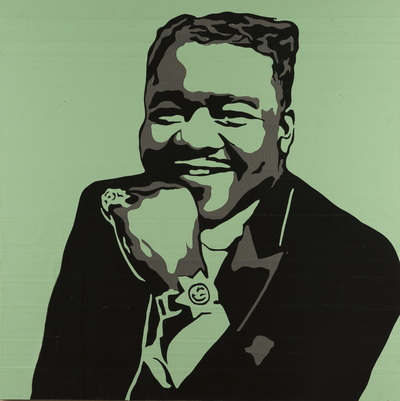
artwork. For some time he’s been creating elegant portraits by using
layers of multi-colored duct tape on plywood which are cut and peeled away to
create photograph-like images. J has concentrated particularly on New
Orleans jazz, rhythm and blues, and Zydeco musicians, and over two dozen of his
works are being shown from April 1 to 30 at Gallery Treo in Mid-City in New
Orleans (3835 Tulane Ave.). I’ve posted a sampling of the exhibition
pieces here, along with brief biographical blurbs of the musicians. The
full set of portraits plus contact information for the artist are available at
J’s website (nola-tape-art.weebly.com). If readers will be in the vicinity, I hope
you get to see the show in person.
Love,
Dave
Louis
Armstrong (1901-1971), Trumpet, Cornet, Vocals
Louis Armstrong was born on
Aug. 4, 1901 in New Orleans. He grew up in the Storyville legal
prostitution district, listening to the bands in brothels and dance halls.
Armstrong developed his cornet skills at age 13 in the band of the New
Orleans Home for Colored Waifs, then played trumpet in brass band parades and
learned from Bunk Johnson, Kid Ory, and Joe “King” Oliver. Armstrong
joined King Ory’s band in 1919 and became the most influential figure in jazz
over the next five decades.
Danny
Barker (1909-1994), Banjo, Guitar, Ukulele, Vocals
Danny Barker was born to a
family of musicians in New Orleans, Jan. 13, 1909. He began his career
with the street band, the Boozan Kings, and subsequently became the rhythm
guitarist for some of the best bands of the day, e.g., Cab Calloway, Benny
Carter, Lucky Milliner. Barker formed the Fairview Baptist Church Marching
Band in 1970 which is credited with producing many renowned musicians, e.g.,
Wynton and Branford Marsalis, and ensuring the longevity of jazz in New
Orleans.
Professor
Longhair (1918-1980), Piano, Vocals
Born Henry Roeland “Roy”
Byrd in Bogalusa, LA, Dec. 19, 1918, Longhair learned to play on a piano which
was missing several keys, resulting in his distinctive style. He first
recorded with the Shuffling Hungarians in 1949 during the heyday of early
rhythm and blues. Professor Longhair later became a staple of the New
Orleans Jazz and Heritage Festival. He is credited with important
influence on Fats Domino, Huey “Piano” Smith, Allen Toussaint, and Dr. John.
Fats
Domino (1928- ), Piano, Vocals
Antonio “Fats” Domino, Jr.,
was born in New Orleans’ Lower Ninth Ward to a French Creole family on Feb. 27,
1928. He began his career with Billy Diamond’s band, the Solid Senders,
at the Hideaway Club in New Orleans. “The Fat Man,” released in 1950 by
Imperial Records and often cited as the first rock and roll record, sold a
million copies, and Domino went on to have 37 Top 40 singles, including his top
hit, “Blueberry Hill”. Fats Domino appeared as himself in 2012 in the HBO
series, Treme.
Boozoo
Chavis (1930-2001), Cajun accordion, Vocals
Wilson Anthony (“Boozoo”)
Chavis was born in Lake Charles, LA, on Oct. 23, 1930. He was a singer,
accordionist, and prolific writer of Zydeco songs — music created by
Louisiana’s French-speaking Creoles. Chavis learned to play the button
accordion at age nine, and he is considered one of the fathers of Zydeco
music. His single, “Paper in My Shoe” (1954), is considered to be the
first modern version of Zydeco. Chavis was crowned “The King of Zydeco”
in New Orleans in the 1990s.
Earl
King (1934-2003), Guitar, Vocals
Born Earl Silas Johson IV
in New Orleans, Feb. 7, 1934, Earl King was an important figure in New Orleans
Rhythm and Blues music. King started playing guitar at 15, and, when his
idol Guitar Slim was injured in an auto accident in 1954, King was recruited to
continue Slim’s band tour, pretending to be Guitar Slim. His 1955
recording of “Those Lonely, Lonely Nights” reached #7 in the Billboard R&B
charts. King composed blues standards recorded by many fellow performers,
e.g., Dave Edmunds, Elvis Presley, Jimi Hendrix, Stevie Ray Vaughan, Professor
Longhair.
Allen
Toussaint (1938-2015), Piano, Vocals, Composer, Record Producer
Born on Jan. 14, 1938 in
New Orleans, Toussaint grew up in the city’s Gert Town neighborhood, where he
learned to play the piano as a child and performed as a teenager with guitarist
Snooks Eaglin in a band called the Flamingos. At 17 he stood in for Huey
“Piano” Smith with Earl King’s band and was introduced to a group of musicians
who played regularly at the Dew Drop Inn in Uptown New Orleans. A
prolific songwriter, Toussaint produced hundreds of recordings including “Right
Place, Wrong Time” by Dr. John and “Lady Marmalade” by Labelle. He was
known as “one of popular music’s great backroom figures.” Toussaint was awarded
the National Medal of Arts by President Obama in 2013.
James
Booker (1938-1983), Piano, Organ, Vocals
James Booker, the son and
grandson of Baptist ministers, was born in New Orleans on Dec. 17, 1939.
Highly skilled in classical music, Booker’s rhythm and blues playing
combined elements of stride, blues, gospel, and Latin piano styles. Dr.
John described Booker as “the best black, gay, one-eyed junkie piano genius New
Orleans has ever produced.” His flamboyant style led to his nickname as
“The Black Liberace.” Booker died at Charity Hospital from renal failure
associated with heroin and alcohol use.
Aaron
Neville (1941- ), Vocals
R&B Singer Aaron
Neville was born in New Orleans on Jan. 24, 1941. His first major hit,“Tell It Like It Is,” topped
Billboard’s R&B chart for five weeks in 1967 and sold over a million copies.
Neville has had four Platinum-certified albums and four Top 10
hits. He has also recorded with
his brothers Art, Charles, and Cyril as The Neville Brothers. Neville left New Orleans
when his home was destroyed by Hurricane Katrina but returned in2008, resuming
the tradition of the Neville Brothers closing the Jazz and Heritage Festival.
Irma
Thomas (1941- ), Vocals
Born on Feb. 18, 1941, in
Ponchatoula, LA, Irma Thomas is known as the “Soul Queen of New Orleans.”
Thomas sang with a Baptist church choir as a teenager and auditioned for Specialty
Records at age 13. Her first single, “Don’t Mess with My Man,” reached #22 on the
Billboard R&B chart in 1960, and a string of successful releases on Imperial
followed, though Thomas never attained the mainstream commercial success of
contemporaries like Aretha Franklin or Dionne Warwick. Thomas appears annually at
the Jazz and Heritage Festival and she and her husband own the Lion’s Den Club
near the French Quarter in New Orleans.
John
Boutté (1958- ), Vocals
John Boutté was born into a
Creole family in New Orleans on Nov. 3, 1958. As a teen, he formed an a
cappella group that sang on New Orleans streets. After service in the
army, he began working for a credit union until Stevie Wonder persuaded him to
pursue a career in music. He and his sister Lillian, a jazz and gospel
singer, toured in Europe, and they recorded an album together in 1994. In
recent years Boutté has worked with ex-Cowboy Mouth guitarist and
singer, Paul Sanchez. One of Boutté's compositions is the theme song of
HBO’s Treme series, and Boutté appeared in the first three seasons of the
show.
Kermit
Ruffins (1964- ), Trumpet, Vocals
Kermit Ruffins was born on
Dec. 19, 1964, in New Orleans. Influenced by Louis Armstrong and Louis
Jordan, Ruffins began playing trumpet in junior high school in the Ninth
Ward and co-founded the Rebirth Brass Band in 1983 while attending high school
in Treme. Ruffins’ bands perform New Orleans jazz standards, though he
also composes many pieces and accompanies his songs with his own vocals.
Having learned to cook from his grandmother, he is known for cooking on a
barbecue during his shows.
Bruce “Sunpie”
Barnes (1963- ), Accordion, Harmonica, Piano, Percussion, Vocals
Sunpie Barnes was born in
1963 in Benton, Arkansas. A park ranger, TV and film actor, former H.S.
teacher, and former NFL player for the Kansas City Chiefs, Barnes
has played his own style of blues, Zydeco, and Afro-Louisiana music with
his group, Sunpie and the Louisiana Sunspots, in festivals and concerts in New
Orleans, across the US, and in over 35 countries. Deeply involved in New
Orleans parade culture, Barnes is Second Chief of the North Side Skull and Bone
Gang, one of New Orleans’ oldest existing carnival groups.
Wynton
Marsalis (1961- ), Trumpet, cornet, flumpet, flugelhorn
Wynton Marsalis was born on
Oct. 18, 1961, in New Orleans. His father Ellis (piano) and brothers
Branford (saxophone), Delfeayo (trombone), and Jason (drums) are also jazz
musicians. At age 8 Marsalis performed in the Fairview Baptist Church
band, and he debuted with the New Orleans Philharmonic at age 14. After
studies at Tanglewood and Julliard, he joined Art Blakey’s Jazz
Messengers. Currently the director of Jazz at Lincoln Center, Marsalis
has won 9 Grammy Awards and is the only musician to have won Grammys for both
jazz and classical records.