Tuesday, August 9, 2011

Isaac Stephenson, Marinette Lumberman


Portrait Bust, Senator Isaac Stephenson


Dear George,

I was Googling some Menominee history the other day, and I kept running into Isaac Stephenson’s name. I shouldn’t have been surprised. I used to ride my bike home from school evert day on Stephenson Avenue, and once in a while I’d drive on Stephenson St. in Marinette. My grandfather’s Menominee drug store was across the street from the Stephenson Building. Aunt Martha worked at the Stephenson Public Library in Marinette. Katja and I used to visit the logging museum on Stephenson Island, and we’d take in the views of the river from Stephenson Park. On our way home we’d drive past the Stephenson National Bank. Then we’d sometimes go to the movies in nearby Stephenson, Michigan. Hmm, I guess Isaac Stephenson had some impact on the Twin Cities area. Actually the story of his life is so amazing, I thought I would pass along some of the highlights.


Stephenson Banking Co., Hall Ave., downtown Marinette


Known as “Ike” or “Captain”, Isaac Watson Stephenson was born on June 18, 1829 in York County, New Brunswick. His mother was a farm wife from Great Britain, and his father was a Scotch-Irish farmer and lumberman. As a child, Isaac attended public school for a few years, then dropped out to help his father in farming and logging. The New York Times (1918) observed that “his early education was, to say the least, of a practical nature, in which the great outdoors played a very important part.” In 1840 the family relocated to Bangor, Maine, and at age 16 Stephenson moved with prominent lumberman Jeffrey Sinclair’s family to Milwaukee where he worked on an unimproved farm with Mr. Sinclair. When the crops failed, Sinclair became interested in pine lands in the Upper Peninsula and sent Stephenson there to work in lumbering. Despite very harsh and dangerous conditions, Stephenson’s ability and diligence resulted in his being put in charge of the lumber camps at a very young age. In the winter he managed lumber operations in the Escanaba area, and in the summer he sailed freighters between Escanaba, Milwaukee, and Chicago. He owned and captained the Great Lakes schooner Cleopatra before he turned 21, though his ship was destroyed in a Lake Michigan gale a few years later. In 1852, when Stephenson was 23 and had entered business for himself, the city of Chicago awarded him the contract to supply timber for the construction of the city’s massive breakwater. Stephenson transported 100-foot pine logs lashed to the sides of ships because there were no Lake Michigan vessels with decks large enough to accommodate such huge logs.


Marinette County Logging Museum, Stephenson Island


Because of his expertise in lumbering and knowledge of the U.P.’s pine regions, Stephenson accompanied Daniel Wells Jr. to Sault Ste. Marie to the U.P.’s newly opened land office to purchase large tracts of Michigan timber land. His business rapidly expanded over a period of several years, and he was on the way to becoming one of the leading lumbermen of the Great Lakes region. He established the first steamboat service on the Menominee River, as well bringing steamboats to the Cedar, Ford, Escanaba. and White Fish Rivers near Escanaba. Despite skepticism by shipping experts that it would be possible, Stephenson developed a barge line on Lake Michigan which shipped greater quantities of lumber to Chicago than had ever been imagined. He went on to build the Sturgeon Bay Ship Canal through Wisconsin’s Door Peninsula to Lake Michigan which saved freighters 150 miles in their trips to Chicago and avoided the highly dangerous straits where Green Bay opened into the lake.


Stephenson Lumber Mill Company Store, Wells, MI


In 1858 at age 29 Stephenson settled in Marinette, Wisconsin, and gained the controlling interest in Nelson Ludington & Co. and its great sawmill there. He built the Lauerman Brothers Department Store in Marinette and became the principal owner of the Peshtigo Lumber Company, the Menominee River Boom Co., the Stephenson Transportation Co., the I. Stephenson Co. of Escanaba, the Marinette and Menominee Paper Co., the Stephenson Manufacturing Co., the Escanaba and Lake Superior railway, and farms, hotels, northwestern U.P. iron mines, the Stephenson Opera House, and numerous other establishments and enterprises. The Menominee Boom Company sorted and delivered more logs than any other company in the world. To accomplish its work, Stephenson constructed 40 dams in the Menominee River. The Boom Co. handled an average of 700,000,000 feet of timber annually, and one year exceeded a billion feet. His principal sawmill at Peshtigo had a greater capacity than other other mill in the world, and Stephenson built the largest woodenware factory in the world at the site. The Peshtigo Fire of 1887 destroyed his company, resulting in $2,000,000 in losses, but they rebuilt immediately and resumed their operations.


Stephenson Block, downtown Marinette


Isaac Stephenson was founder and president of the Stephenson Banking Company in Marinette, the area’s first bank, and he was a founder of the Menominee Herald, Menominee’s first newspaper and predecessor of the Herald-Leader (now the Eagle-Leader). He owned nearly half a million acres of timberland in Michigan, Wisconsin, and Louisiana, land totaling the size of the state of Delaware. Stephenson built five houses in Marinette and Menominee, two of which are still there on Riverside Avenue. He owned a 900 acre dairy farm in Kenosha, regarded as one of the model farms in America; a Marinette farm devoted to solely trotting horses; and a cattle farm in Grass Lake which supplied President William Howard Taft with a prize Holstein cow named Pauline Wayne who lived and grazed on the White House lawn. One biographer said that Isaac Stephenson could rightfully be regarded as the industrial pioneer of northeastern Wisconsin and Upper Peninsula Michigan since his enterprises accounted for much of the development of the region.


Sen. Stephenson’s Household Artifacts, Marinette County Museum, Stephenson Island


Stephenson led in organizing Marinette County, donating land for the courthouse and other county buildings. He built the Stephenson Public Library, donated land for the Stephenson Training Institute and Stephenson Island Park, and provided land and cash for new churches in Marinette. Stephenson was active in Republican party politics throughout his adult life. In Marinette he was a town supervisor, county board chairman, and justice of the peace. He was elected to the Wisconsin state legislature twice. In 1882 he was elected to represent Wisconsin in the U.S. House of Representatives where he served for three terms (1883-1889). In 1900 he supported Robert M. La Follette’s gubernatorial campaign in Wisconsin, donating $500,000 to the candidate, and he served as an influential advisor to the Progressive faction of the Republican party. It’s estimated that he donated a million dollars to Republican candidates and causes during this period. In 1901 he established the Milwaukee Free Press, providing Progressive Republicans with a reform-minded metropolitan newspaper and competitor to the Milwaukee Sentinel.


Stephenson Public Library and Stephenson Island


In 1907 Stephenson ran for a U.S. Senate seat made vacant by the resignation of John C. Spooner and was elected. He was the wealthiest man in the Senate. In 1908 he ran for renomination, spending $130,000 of his own money on his campaign. He was opposed by his former ally Robert La Follette, purportedly because Stephenson refused to donate large sums of money to the latter. Though his re-election was blocked by investigations of charges that he had used his money to influence votes, Stephenson was vindicated and resumed his Senate seat from 1907 to 1915. The New York Times reported that, when Stephenson heard other senators in 1912 refer to his election as “a revelry of corruption,” he wept openly on the Senate floor and was subsequently reported to be dying of heart disease in the Michigan wilderness fifty miles from Escanaba. He recovered and announced in June 1914 his permanent retirement from public life. Stephenson spent his final years in Marinette, where he died at home at age 88 at 1:30 a.m. on March 15, 1918. He is buried in Forest Home Cemetery in Marinette.


Stephenson Family Tomb, Forest Home Cemetery, Marinette


The National Cyclopaedia of American Biography (1910, p. 51) states that "Mr. Stephenson is tall, spare, quiet and thoughtful…He is democratic and kindly in his intercourse with others, generous to individuals, liberal toward public enterprises and tenacious in his friendships. He is the wealthiest man in Wisconsin, but modest and considerate in all the ways of life. His memory is so remarkable that he is able to carry the infinite details of his many great business enterprises in his head.” Men of Progress (1897, pp. 76-78) states: “Though a man of great wealth he is free from ostentation, and is justly proud of what he has accomplished, because it came to him as the result of unremitting industry, enterprise and the sagacity born of a study of his opportunities and their possibilities.”


Nellie Walker (sculptor), Isaac Stephenson Monument, Marinette, 1921


Isaac Stevenson had seven children from three marriages (his first two wives having died). One of his great-grandsons, an aviator and yachtsman, was a contemporary of our parents and lived two blocks up the street from us in Sheridan Circle in Menominee. Last year they held an estate auction of 150 years of Stephenson family memorabilia, remnants of a remarkable legacy in Menominee-Marinette history.

Love,

Dave


[References: “Isaac Stephenson” in www.wikipedia.org; www.books.google.com (The National Cyclopaedia of American Biography, 1910, pp. 50-52); www.books.google.com (American Lumbermen, 1905, pp. 251-254); www.books.google.com (I. Stephenson, Recollections of a Long Life, 1829-1915); www.rootsweb.ancestry.com; www.wisconsinhistory.org; www.marinette.wi.us/history; www.bioguide.congress.gov; www.nytimes.com. Image sources: “Isaac Stephenson” search on Google Images.]


G-mail Comments
Vicki L. (8-10): Wow David, What a fascinating history. I'm curious ... did you cull all this information from several sources and then put it together? If so - what an incredible amount of work. No wonder you want the 'kids' to preserve Jean Worth's history of the UP - you're developing your own! Very fascinating. Thank you for your many contributions.
Love, Vicki

Friday, August 5, 2011

Passing the Torch: Jessica's Farm Pics

Silver Dollar Pool Room, Silo, & Barn


Dear George,

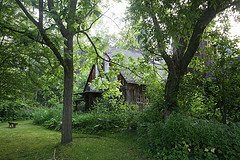
This is a big year for our family because members of the older generation (Vicki, Margie, Gayle, and I) are transferring the joint ownership of our family property in Menominee County (“Farm”) to Vic and Doris’ nine adult grandkids. As I’ve mentioned previously, our parents bought their property as a land investment in the 1960’s, then decided to restore the old and deteriorated compound of farm buildings to create a leisure retreat. Before they knew it, they’d become passionately committed to the project and, with all of their children having left home, they wound up selling our family house on the river to move permanently to Farm. Our family began having annual reunions there in the early 1970’s, and the grandchildren began attending as tiny children. I would have to say these were among the most joyful events of my life. With the accumulation of years of good memories, the grandkids developed a strong emotional attachment to Farm. Though our parents still lived there in the 1980s, they transferred ownership of the property to a corporate “Tree Farm” entity made up of their four children as joint partners. Steve was the original manager of the property, and Peter and Vicki later did subsequent turns in this task. During the past year we partners decided it was time to transfer ownership and management of Farm to the younger generation, and this group enthusiastically accepted the responsibility. My niece Jessica (Peter and Faith’s daughter) and her husband Sean drove up to Farm in early July and spent the week doing cleaning, organizing, and restoration projects. This week Greg and Jennifer (Steve and Margie’s son and daughter), Abra (Vicki and George’s daughter), and J (our son) have gathered for a “work vacation” at Farm with an extensive agenda of replacing the roof on the house, rebuilding the bridge over Birch Creek, and completing numerous other improvement projects. It’s a very exciting time to have a new, energized group launching Farm’s long-term future for the family. Vic and Doris would be thrilled out of their minds. Jessica took a batch of photos of Farm during their July visit and placed them on her Flickr site. Here’s how our sweet family property is looking these days.

Love,

Dave


House from the Driveway


Front Porch


Front Door


Kitchen


Living Room


Vic's Bedroom


Doris' Bedroom


The Medicine Wheel


The Chicken Coop (guest house)


The Barn


Work Space in the Barn


Vic’s Office


Art Studio


Barn Bedroom


Chair in Barn Bedroom


Second Barn Bedroom


Lamp in Barn Bedroom


West Wall of Barn with Stained Glass Windows


Silo


Gazebo and Pond


House from the Gazebo


[Image source: All photos by Jessica L. McCarthy, Flickr]


G-Mail Comments

-Jennifer M (8-9): These are great, as are the pictures and story you posted on your blog. It's fun for me to see the farm. I look forward to hearing from you what J** has to say about the progress they made.

-Kiera O (8-7): O those pictures Jessica took are just magnificent. Vic and Doris would be so richly happy at these new developments at Farm. So, I"m assuming no one is renting there anymore, correct?

-Phyllis S-S (8-7): Dave, How beautiful it is on the farm. Not like the house you had on the river as you've said but the farm is charming, I think. How wonderful you and your sister are passing it on and the children want to have the responsibility. Phyllis

Tuesday, August 2, 2011

Our Underworld Chums


OUR UNDERWORLD CHUMS*


Dear George,

It’s always interesting when you see people you know in the local news. But it’s not always positive. I was reminded of this recently when one of our acquaintances, Marilyn Frye, began dominating daily headlines in the local newspaper. We originally met Marilyn because she owns Ozzie, Mike and Duffy’s younger sheepdog brother. We’ve gotten together with Marilyn a couple of times for sheepdog birthday parties, and she’s taken the dogs for a ride in her yellow convertible. She’s always struck me as a friendly, outgoing person with a good sense of humor. Marilyn is the founder and president of a local organization of several hundred public employees. For the most part, she seems to have done an excellent job as her organization’s president. But it also turns out that she is charged with having absconded over $700,000 in member dues. With her trial coming up soon, Marilyn faces the prospect of twenty years in prison. We wonder if we should offer to adopt Ozzie. It’s hard to reconcile someone being an Old English Sheepdog lover with also being an alleged embezzler.


It would be a stretch to say that Katja and I are members of the world of organized crime. However, this is hardly our first such experience. I’d have to say that Katja seems to have been particularly drawn over the years to lawbreakers and their victims. One of her close grad school friends was Annalisa Gettler, the wife of a local Ob-Gyn. Katja found the husband a quite charming fellow, but, when Annalisa started showing up with bruises on her face, her classmates began to wonder. Annalisa did eventually leave her abusive spouse, but soon afterward he murdered their child. Sent to prison, he then got murdered himself after a year or two. Nobody felt that sad.


Betsy Feldstein was another of Katja’s good grad school friends, Betsy was married to local pornography king, Stanford Marstein. Stan was Cincinnati’s predecessor to Larry Flynt. He introduced porn to our prudish city through his downtown adult bookstore, violated numerous local laws and regulations, made millions of dollars in profits, and was constantly in and out of jail. A jolly, extroverted man, Stan would show us his cache of gold bullion bars which he kept in his wall safe at home rather than putting money in the bank. Katja and Betsy went on a European vacation together but they didn’t get along well because Betsy’s porn-inspired sexual attitudes were at odds with Katja’s mainline Philadelphia moral standards.


The University, of course, is a huge place and consequently is home to myriad law-breakers. I haven’t kept track of all the students I’ve had over the years who have showed up in the newspaper crime reports, but it’s run in the dozens. Drug dealing, domestic violence, assault, shoplifting, and negligent manslaughter are just some of the instances that come to mind. One of my memorable teaching experiences occurred when federal authorities showed up in my Social Psychology classroom to handcuff and take away a junior Business major who was convicted of buying assault rifles in Ohio and transporting them across state lines for sale to gang members in the Bronx.


One would hope the faculty to be more law-abiding than the students, but that’s not necessarily so. One of my friends and tennis partners, Rick Patterson, was appointed to a high-level administrative position. He recruited me for various committee assignments, but that came to an end when the university fired Rick for having sex with a doctoral student in his walnut-paneled office. Shortly afterward, one of Rick’s key aides, a likeable fellow with whom I’d worked for years, was fired for embezzling funds from the student affairs program, treating himself and his wife to trips around the world. Two years later one of Katja’s favorite professors, considered on the fast track to a full professorship in his early thirties because of his fantastically productive publication record, was fired when it was discovered that he had simply made up the titles of nearly all of the 75 purported journal articles which he listed on his vita.


Sex gets a lot of people in trouble. Katja and her friend Amy were thrilled when we hired new Ph.D. Andy Sampson because he described to them how he loved to stay up till dawn discussing philosophy and literature with his wife. Whether true or not, it turned out that dawn did enjoy staying up till dawn with various coeds in the department. When several of his romantic liaisons found out about one another, they paraded en masse to the department head’s house in the middle of the night and demanded that Andy be fired. He was. Another of my acquaintances, fellow dissertation committee member Ronny Barker, was arrested one night in Cincinnati’s tough Over-the-Rhine section for soliciting a prostitute for a hand-job. The student newspaper made it a front-page new story, suggesting that a hand-job was a stupid way to ruin one’s career when you could simply do it yourself for free.


We made lots of friends in the tennis world when our son J was a tennis star in high school. I hung around at most of the H.S. matches with a genial fellow named Harry Whitrock whose son also played for the team. Harry was a local businessman who I later learned had defrauded the federal government of millions of dollars through a sham urban development enterprise that he had created. He offered J a recruiting job at a good salary, but J sensibly turned it down. Harry was gunned down one midnight in a public telephone booth at the city tennis courts. His killers were never found. I thought maybe some secret government agency had rubbed him out, but I recently read some Internet gossip that implied that things went wrong in a drug deal designed to cover Harry’s gambling debts.


Maybe the fact that we have all these criminal connections has to do with our family history. I don’t remember any gangsters on my side, but Katja seems to have enjoyed some sort of family link to the mob in Philadelphia. The main episode involved her uncle Louie (actually her mother’s uncle rather than her own). Uncle Louie was in the fish business, but he also was mixed up in some shady dealings. One day he was found bound and gagged in the trunk of a limousine, dead as a doornail. They never found the murderers, though the execution had a professional feel about it. Katja had another uncle in Chicago who her aunt Dorothy had married. Joe was a multi-millionaire entrepreneur in the food-processing business. When he was recuperating in Florida from a stroke, Dorothy came home from shopping one day and found a note that said, “We’ve got your husband; don’t tell nobody,” and asked for a large sum of money. Dorothy, never one to keep things to herself, immediately called the police. The detectives discovered that Joe had been kidnapped by his Cuban male nurse who was also a drug addict. As they closed in on him, the male nurse pushed Joe’s wheelchair (with Joe in it) into the swimming pool. The FBI fished Joe out, captured the nurse, and the story had a happy ending.


We, of course, also have some other friends who aren’t criminals. The interesting thing is it’s hard to see any difference between our criminal friends and our noncriminal friends. They all tend to be cleancut, intelligent, reasonably well-adjusted middle-class people who are pleasant to be around. It may be that our noncriminal friends have just never been caught. Or perhaps our criminal friends happened to find themselves in situations offering opportunities they couldn’t resist. You can’t embezzle hundreds of thousands of dollars unless you’re in a position where you have access to it. Whatever the case, Katja and I have remained mostly on the straight and narrow over these many years. With all this free time from retirement, though, you never know for sure what’s going to happen next.

Love,

Dave


*Pseudonyms used in this story.


G-Mail Comments

-Vicki L (8-5): Dear David,

What fantastical stories - I had no idea your lives were so adventurous. Try not to pepper your retirement with crime. I know you miss your brothers - but after all, Steven for example, only stole headstones from their manufacturer. Along with a few beer and stop signs. God knows what Peter did. But clearly, neither of them embezzled or murdered anyone. My main criminal activity involves stealing wooden stirring sticks and sugar packets from coffee shops. We must endeavor to keep our baser instincts in check. Love, Sis

-Mary B (8-3): A delight to read. I couldn't resist looking up laws in your state that you now have time to break. Have fun!

- Play croquet or pitch horseshoes within a mile of an orator on Decoration day (be forewarned -- you could be fined $25).

- Tell K to flash her patent leather shoes (according to the law, they're prohibited in public).

- Refuse to honk your horn when passing another car and you're breaking a law.

- Challenge someone to a duel -- they're prohibited, and add a lot of excitement to life (you can choose you own weapon, so there's flexibility there).

-Jennifer M (8-2): I'm glad you wrote this one up. There's someone missing, but that's okay because I already knew about him. ;-)

-Donna D (8-2): Sorry David I just think this blog is risky and a bit "je ne sais pas". Maybe if you revealed that you and Katja had done your own criminal stuff I'd think differently. Sorry

Friday, July 29, 2011

Photo Tour: The Butler County Fair


Dear George,

I’ve always loved fairs. Each summer our parents would take us to the Upper Peninsula State Fair in Escanaba. It was the highlight of the year -- a big, extravagant hodgepodge of people, animals, arts and crafts, vegetables, tractor displays, and many other exciting attractions. We returned there as adults and got to see the John and June Carter Cash show one year. In Cincinnati Katja, J, and I would go each August to the Hamilton County Fair in Carthage. The highlight was Zambora the Gorilla Woman, a booth in which you would actually see an attractive woman in a filmy evening gown being transformed into a huge gorilla which then would break through the bars of its cage and chase the screaming patrons out of the enclosure. At family reunions in Birch Creek we’d sometimes go to the Marinette County Fair in Wausaukee, the most rural and primeval of all our fair outings over the years.


I’d hoped to go to the big Warren County Fair in Lebanon two weeks ago, but it was blazing hot. Then the Butler County Fair in Hamilton opened. It was still in the mid-nineties, but, when the humidity dipped down one day, Katja volunteered to go along just to make me feel better. I later told a friend we’d had a romantic outing. She wondered if Katja had found it romantic too. I hadn’t asked her but I thought she did. We did have a fun time. The fair wasn’t very crowded on a hot Tuesday afternoon, but everything was up and running. We checked out the rides with their little kid patrons, had lunch on the midway (leather-tough steak for Katja, chicken breast sandwich for me), spent a lot of time looking at rabbits and also sheep and pigs, admired the flowers and vegetables, inspected the arts and crafts (Katja thought the hand-sewn clothing was from the 1940s), and stopped by the Democrat and Republican political booths to get free pens and pencils. This was an iconic county fair. It was nice to be out mingling with real people, there was lots to see and do, and it took me back to my rural roots. I don’t think that the basic elements of the fair have changed much over the last half century. Here are some photos which give a sampling of our experience.


The rides and games may look rinky-dink, but they can be thrilling when you’re seven or eight.


The Midway offered an endless assortment of delicious, unhealthy foods.


The county fair is an ideal venue for people to exhibit their year’s creations, whether gardenias, quilts, or wood-carvings.


The small animal barn offered a hundred bunnies or more and many other delights.


We enjoyed the big animals too.


The sheep-judging was definitely the highlight of our day.


So that’s a solid afternoon’s worth. We heartily recommend the Butler County Fair if anybody’s in the vicinity. Saturday’s the last day though.

Love,

Dave


G-Mail Comments

-Jennifer M (7-29): Great! It's just how I imagined. Looking at the photos, I could even smell it!