Sunday, December 15, 2013

The Meaning of Dukkha


Dear George,
Recently Katja and I went to a lecture at the university on the paradoxes of Buddhism, and it jogged our minds.  The speaker dealt primarily with Buddha’s concept of dukkha.  He presented it as the most central idea in classical Buddhism.  Buddha stated, “I have taught one thing and one thing only, dukkha and the cessation of dukkha” (1).  [Note: numbers in quotes refer to sources at end.]   As I understand it, Buddha regarded dukkha as the fundamental feature of the human condition.  The original translation of “dukkha” from the Pali language into English was “suffering”, and that’s often given as the meaning of the word.  However,  modern translators note that there’s no single word in English that encompasses the complex, multi-faceted meanings of dukkha in Pali and that the term implies a host of concepts such as anxiety, stress, discontent, frustration, conflict, misery, etc.  Thus dukkha entails a wide range of negative affective states, from mild irritation to extreme pain and suffering.  The notion of “unsatisfactoriness” perhaps comes closest to capturing the broad meaning of dukkha.  Dr. Kingsley Heendeniya (4) has defined dukkha in the following way:  “Dukkha is sorrow and lamentation, pain, grief and despair, separation from loved ones, from associating with those you do not like and from not getting what you want.”

Buddha’s teachings about dukkha are given most fully in the Four Noble Truths (6).  The four truths are: (1) the truth of dukkha; (2) the truth of the origin of dukkha; (3) the truth of the cessation of dukkha; and (4) the truth of the path leading to the cessation of dukkha.  Thus, the Four Noble Truths explain the nature of dukkha, the conditions which give rise to dukkha, and how dukkha can be overcome.

The First Noble Truth addresses the nature and pervasiveness of dukkha in people’s lives.  Human existence is difficult and imperfect, and people inevitably experience pain, suffering, discontent, conflict, etc.  Buddha referred to three different categories of dukkha.  The first is “ordinary suffering”.  It includes the physical and mental suffering inevitably associated with birth, aging, illness, and dying.  In addition, “ordinary suffering” includes negative emotions from experiencing events and outcomes that we find unpleasant and undesirable.  This may occur because we fail to attain outcomes that we want, or because we receive outcomes that we don’t want.  For Buddha, “union with what is displeasing is dukkha; separation from what is pleasing is dukkha; not to get what one wants is dukkha…”  (5)  These are simply pervasive aspects of everyone’s daily lives.

A second source of dukkha has to do with change.  In Buddhist thinking, all objects and events are constantly in a process of change, and consequently all life forms are impermanent.  Change is intrinsically stressful.  Dukkha (e.g., frustration, discontent) results from striving to hold onto things in the face of change. 

The third pattern of dukkha is termed “conditioned states” or “all-pervasive suffering,” and it refers to a form of unsatisfactoriness that characterizes all aspects of existence.  In essence, we experience dissatisfaction because things and events virtually never live up to our standards or expectations (5).

The second noble truth involves the origins of dukkha.  In Buddhist thought, dukkha results from cravings, accompanied by ignorance of the true nature of things.  Such cravings include desires for sensory pleasures; cravings for something solid and enduring (e.g., wealth, fame) and domination of others; and cravings to disconnect ourselves from pain and avoid suffering.  In addition, dukkha has been interpreted as resulting from three disturbed emotional states associated with cravings: (1) Ignorance (bewilderment about the nature of the self and reality); (2) Attachment (to pleasurable outcomes); and (3) Aversion (a fear of not getting what we want, or of getting what we don’t want) (6).

The third noble truth is that the cessation of dukkha is possible.  This is the goal of spiritual practice in Buddhism.  The causes of dukkha can be eliminated when individuals achieve a genuine understanding of the origins of suffering in craving and ignorance.  When the causes of suffering cease in one’s mind, this constitutes nirvana (enlightenment and a freeing of the spiritual self from attachment to worldly things).  In Buddha’s words:  "And this, monks, is the noble truth of the cessation of dukkha: the remainderless fading and cessation, renunciation, relinquishment, release, and letting go of that very craving" (SN 56.11) (2).
The fourth noble truth specifies a path to the cessation of dukkha, the Noble Eightfold Path.  It involves eight dimensions of human action and thought: Right Understanding, Right Thought, Right Speech, Right Action, Right Livelihood, Right Effort, Right Mindfulness, and Right Concentration (6).

I think everyone can readily find instances of dukkha in their lives.  For myself,
the loss of my two brothers and my brother-in-law over the past eight years has radically altered my life in painful ways.  Katja recently spent five days in the hospital, and they’ve been unable to come up with any clear diagnosis of her nagging problems.  My hearing is doing poorly and is a daily source of consternation.  One of our young relatives faces major surgery in the coming year.  Beyond these clear and dramatic examples, though, the further implication of Buddhism is that virtually all experiences involve dukkha.  A trivial example of this occurred when I took the dogs out for a walk the other morning.   With dukkha already on my mind, I noticed how badly cracked our sidewalk is and how much of it will need replacement in the near future.  I worried about the brown patches on the small evergreens next to our house and what that meant for their longevity.  I worried still more for the giant yew bush in our front yard that the tree people have been trying to save.  I picked up litter and cigarette butts on the lawn, annoyed at the irresponsible people who had dropped it there.  All this, of course, illustrates the extent to which dukkha is a standard part of the environment and of ourselves. 

I think dukkha is also implied by the connotations that we attach to our cultural meanings of “reality”.  We commonly think of “” as something abrasive that we have to come to terms with.  Thus, we refer to “harsh reality” or “cold reality” or the “facts of life”.  In all these instances, reality is contrasted to our wishes, dreams, desires, and ideals.  That discrepancy between what we wish for and the reality that we face is another way of getting at the meaning of dukkha.  It ties into the Buddhist admonition that the cessation of craving is the route to the elimination of dukkha. 

I find myself convinced by the argument that dukkha is at the essence of human consciousness.  As human beings, we engage in a constant process of evaluating objects and events on a good-bad continnum.  We experience ourselves, others, every aspect of our worlds as pleasing or painful, desirable or unwanted, useful or a waste.  Moreover, we don’t make such evaluations in a vacuum, but rather we assess current events in terms of standards or expectations that we’ve acquired from the broader culture and/or from our own life histories.  Because our standards of what’s good or desirable tend to be idealized, immediate events typically fall short, and the experience of dukkha (or dissatisfaction) is the consequence. 

Reducing or eliminating dukkha seems a foreboding challenge.  Doing so by eliminating craving would seem to make sense, but isn’t striving to satisfy cravings a major avenue to human pleasure?  I personally think of Buddhist philosophy as emphasizing coming to terms with human reality and accepting and embracing events for what they are, e.g., “going with the flow,” rather than what we wish they were.   That’s easier said than done, though I’m struggling to work at it.
Love,
Dave


SOURCES:  (1) = www.accesstoinsight.org, “Dukkha”; (2) = www.accesstoinsight.org, “Cessation of Dukkha”; (3) = www.buddhasociety.com, “The Word of the Buddha”; (4) = www.centrebouddhique.net, “The Buddha’s Concept of Dukkha”; (5) = wikipedia.org, “Dukkha”; (6) = wikipedia.org, “The Four Noble Truths” 

Saturday, December 7, 2013

Giving Thanks for Kids and Dogs and Family


Dear George,
This Thanksgiving we drove from Cincinnati down to New Orleans for a five-day stay with our family -- J and K and grandkids V and L.  It was the longest road trip that Katja and I have done in decades (806 miles each way), but I like long drives and the trip was interesting.  The sheepdogs got to come too, which we enjoyed.  We got off the Interstate and travelled on a two-lane highway for a hundred miles or so in Alabama and Mississippi on the way down and on the way back.  We were a little nervous -- me wary about getting stopped by the sheriff in a small town speedtrap, Katja imagining what it was like for the Freedom Riders in the 1960s.  Katja thought the scenery looked like rural Kentucky and I was reminded of the U.P., though the scenery differed in various ways. There were lots of places with Dixie in their names, restaurants serving Po-Boys and pork BBQ, and a few more gun shops and discount liquor stores than I’m used to seeing.  We traveled via Nashville, Huntsville, Birmingham, Tuscaloosa, and Meridian but didn’t make any sightseeing stops.  Katja was angry that I didn’t stop in Nashville to get some of her favorite bread, but I was intent on covering ground.   


We had worried beforehand about our elderly doggies doing o.k. such a long car trip, but they were excellent travellers, sleeping or looking out the window most of the time.   It took a lot of Google searching to find a "pet friendly" motel that would accept two large sheepdogs, but we wound up with a pleasing motel stopover in Birmingham in both directions.


We arrived at J and K's house (left) about 6:30 p.m. on the Monday of Thanksgiving week.  Their Mid-City house is a duplex, and their tenant, Claire, had gone away for the holiday, providing us with comfortable accommodations.  


The children, V and L, were excited about our arrival.  L gave us a picture he'd drawn of Darth Vader, and V had done a picture of “Nana” (Katja).  A little later J put on a TV cartoon show, and the children recruited Katja to watch with them. 


V, L, and I worked on drawing turkeys to celebrate the holiday.  Here's V’s product.  


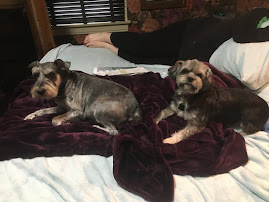
There's a double bed in Claire's apartment, and it took a little doing for two dogs and two humans to find a good sleeping arrangement.  We did work it out though (humans on each edge and dogs lined up in the middle), and we all slept soundly. 


J and K's Mid-City neighborhood is doing excellently, enjoying a brand new mall area on Carrollton Ave. and showing virtually no signs of Katrina’s aftermath.  On our first morning Katja and I enjoyed a late breakfast at the Ruby Slipper, right down the block.  


Thanksgiving Day is the season opening of the Fairgrounds race track in New Orleans, and it's a popular event for locals.  Here V is watching the thundering herd come charging down the track.


The New Orleans crowd comes to the races decked out in all sorts of costumes.  Here’s a mysterious New Orleans couple (along with K’s dad Ted, also visiting for the holiday).  


At Thanksgiving dinner with family and friends, the children and I (as narrator) did the second annual performance of our “First Thanksgiving” play, with L playing the roles of Growling Bear and Miles Standish, and V as Flying Squirrel and Priscilla Mullins.  Betsy, a visiting three-year-old family friend, joined right in with the five-year-olds, giving herself the name of the “Princess of the Ball”.  


The dogs, of course, got more walk time in the neighborhood than they normally do at home.  The weather was cool during our stay -- highs in the mid-40's to mid-50's -- and perfectly suited for sheepdogs.  


We enjoyed lunch with J and K at chef John Best's restaurant, the Peche Seafood Grill in the warehouse district.  As is her tradition, Katja enjoyed oysters on the half shell for her appetizer.  I had a delicious entrĂ©e of drum fish, fresh from the Gulf.


J asked Katja what she would like to do most, and, without a second’s hesitation, she said she’d like to go to Saks Fifth Avenue.  She did some shopping there while J and I browsed in a couple of other stores in the Shops at Canal Place.


On Saturday I went along with J and V to a 24-hour "draw-a-thon" at the Opera House in the Marigny district.  Hundreds of kids were busily engaged in one art project or another, and V completed numerous artworks in the space of ninety minutes.


While V was drawing, I took a short walk around the neighborhood.  It's filled with colorfully decorated house and buildings, including this one.  


One afternoon Katja and I went to the Sculpture Garden in City Park.  The Sculpture Garden, adjacent to the Art Museum, is set among ponds, bridges, and live oaks and displays works by Henry Moore, Fernando Botero, Jacques Lipchitz, George Segal, and many others.  It’s the most visually appealing place that we’ve discovered in NOLA.  


While Katja and I were doing aesthetic things, J took the kids to the City Park playground.  Afterward we all got together for beignets at the Morning Call Restaurant in the park. 


The dogs, meanwhile, were having the time of their lives.  J and K's family dog Iko, a little stray who they rescued from the neighborhood streets, was excited about having two large playmates.  He's peppier and more social than Mike and Duffy, and he kept the sheepdogs physically and mentally busy throughout their stay.  


One evening we all went to the Celebration of the Oaks at the Botanical Gardens in City Park.  It's similar to our Cincinnati Zoo Festival of Lights, but bigger and with more things for kids to do.  


I’d say the children were most excited about the bumper cars.  Here are K and L in the middle of the pack.


This is a pretty blurry night-time photo, but that's Katja and V going up in the ferris wheel.  It must have taken twenty minutes for the operator to unload and load new passengers for each of the gondolas.  V suddenly noticed from the top of the ferris wheel that her brother on the ground had gotten cotton candy.  She yelled down to the operator that she was hungry and wanted to get off.  He politely accommodated.  


We were scheduled to depart on the Sunday morning after Thanksgiving, and J cooked up tasty omelets for everybody.


Here's our group as we're getting ready to leave.  I wish we'd had a few days more, and I'm still recovering from a case of post-vacation blues.  Being together with our family is always my favorite time of the year.  I’d say it’s the time that I feel most complete.  But such is life, and now we'll look forward to our next get-together.
Love,
Dave


G-Mail Comments
-Gayle C-L (12-9):  David,  I have to say, this trip and these photos are your absolute best!!  So wonderful
I don't know if it's the technology or the simply all the love coming thru but all of that is there than some;))))
I really felt like I was there ;)))
And wish I were!
The one picture of J making the Omelettes
From my I phone,  he looks so much like a young Peter.. OMG :))
Too Much !! 
Thx for keeping this tradition, one of your great many claims to fame:)
Until the next trip 
Lots of love.    G. ;)

Saturday, November 23, 2013

Archive: Vic's Photos #5


The Menominee River from our front lawn (late 1940’s)

Dear George,
This is number five in a series of cumulative archives of family photos taken by my dad, Vic L., in Menominee Mich. in the 1940s and 50s.  These images previously appeared on a rotating weekly basis in this blog’s righthand column under the label, “Vic’s Photos”.  The earlier four archives can be accessed by going to the righthand column, scrolling down to “Labels”, and clicking on “Archives”.  My father documented our home and family lives during our childhood and adolescent years and beyond.  My brother Peter reprinted these images from Vic’s original negatives in the form of postcards, and his project is the source of most of the photos contained here.  A few also come from family photo albums.  The subjects include my parents Doris and Vic; my brothers Steven and Peter, my sister Vicki, and myself; and various other family members and friends who will be identified as they appear.  Thanks to Vic and later to Peter for chronicling our family history. 
Love,
Dave 


This is my brother Steven, perhaps a year and a half old (circa 1942), on our front lawn on the river bank.  We used that wheelbarrow a lot for gardening, toting firewood and coal, and various chores.  My mother was the family gardener and annually planted a lengthy garden of flowers along the rock wall which separated our yard from the field next door.  


This is my mom and my two-year old self on the couch at our Ogden Avenue apartment.  It’s a funny thing about childhood memories.  I think it all becomes so familiar and repetitive that it simply vanishes from memory.  I can’t remember much about my early experiences with my mother or my father, though mom and son both look pretty happy on this occasion.  


Vicki (b. 1947) and Peter (1945) were younger than Steve (1941) and myself (1937). and Steve and I always referred to them as “the babes”, with a mixture of affection and dominance.  Here you can glimpse the affection component.  Vicki’s looking very intense and Peter’s looking very sweet, a pretty typical scenario.  


My uncles Kent (right ) and Karl were identical twins, though they differed in temperament (Kent more serious, Karl more ebullient).  Kent was married to Millie (pictured), while Karl was a bachelor for most of his life.  Thor was the oldest of Kent and Millie’s three boys.  We’d have a big extended family gathering at  our house at Xmas, and this photo was taken on one of those occasions.  Karl would drive up from Neenah-Menasha where he worked at the Kimberly-Clark Corporation, and he’d deliver a carload of wonderful presents to all – like having Santa in the family.  


Here’s my mom with a beer, me with a spoon, and an unidentified girl sitting in the sandbox.  That’s probably a representative image.  One of my earliest memories at age three or four involved feeling uncomfortable with other children.  I didn’t seem to know how to play.  Neither I nor the girl in the photo appear to be social butterflies.  


Xmas was always a wondrous time in our childhood.  We fully believed in Santa for a long time, and he always came through.  And we took care that each successive sibling maintained his or her beliefs as long as possible.  In the gift department, we were a lot more interested in toys than in new clothing, though we always got some of both.  This is our mom, my younger brother Steve, and myself (age 5 or 6).  


Florence and Bill Caley were two of my mom’s and dad’s closest friends, and they were parents of our childhood friends Bill Jr., Tom, and Bruce.  Bill Sr. was a business executive, boater, artist, host, and man about town.  Florence was a former English teacher, housewife, and a devoted mom.  She was a very warm, supportive person who occasionally counseled me when I encountered teenage crises.  She always had wise and knowledgeable advice to offer. 


I wonder if I’m holding an engineering blueprint in order to construct these architectural wonders.  Frankly the scene looks a little staged to me, though it looks like I had some nice play things.  


This is Kevin (Kiera) O’Hara, my brother Peter, and my sister Vicki, looking over a photo album.  Vicki has a big grin on her face.  Kevin and Vicki were best friends, and Peter, two years older than Vicki, would frequently join them in their pursuits. 


When I was in eighth grade my dad and one of his World War II veteran acquaintances formed a troop of Air Scouts in Menominee, an advanced group of 14-year-olds that kids joined after completing regular scouting.  Our peak experience of the year was a trip to O’Hare Air Base in Chicago, where we slept in pup tents near a runway at night and did Air Force-like things in the day.  O’Hare was having a simulated lockdown during our trip, so tension was high.  We also visited the Maxwell Street Flea Market in the city.  This is one of my fellow Air Scouts, Jim Hazel, somewhere in downtown Chicago.  


My mother, Doris L., was an avid horseback rider in her younger years, stemming back to her days as a young girl growing up in Omaha.  In Menominee there was a riding stable near the intersection of Riverside Boulevard and Highway 577 at the edge of town.  I seem to be accompanying Doris on this trip, though I have no recollection of being on a full-sized horse in my childhood.   


Jean O’Hara was one of my parents’ dearest friends, and she was mom to Terry, Michael Dennis, Kevin (Kiera), and Patrick Sean.  This is a picture of Jean with Kevin (circa 1947).  


My parents always encouraged their childrens’ arts and crafts activites, and, when I got to fifth or sixth grade, I started creating dioramas of various peopled scenes, e.g., a symphony orchestra or a pirate ship.  The content of this project is hard to make out from the photo, but I’m sure that many hours and emotions went into its construction.  


I have strong recollections of the various trees at our family home on the Menominee River – Norway pines, the weeping willow, oaks, maples, cedar, and, of course, the birch trees.  This group is right on the river bank, and there was another extensive stand of birches growing between our property and our next door neighbors, the Orths.  My siblings and I would gather up birch bark and use it for writing messages, constructing miniature birchbark canoes, and lighting fires.


This is me (left) and my younger brother Steve, age two or three.  I’m feeding him a drink from a Kodak acid container which appears to be labeled “Poison”.  I’m not sure if my photographer father was gathering evidence to use as Prosecuting Attorney, or if this simply reflects his quirky sense of humor.  In any case, I used to act sufficiently malevolently toward my younger brother that the fratricidal theme of this photo isn’t total fantasy.


Here’s my cutie sister Vicki around 1948 or 1949, clutching her doll at the Xmas tree in our living room.  She looks like she’s going to have a lot of important things to say to the world.  And, unsurprisingly, that’s how it turned out.  


My brother Steve is playing quarterback in the front yard of our house on the Menominee River.  This is one of the few photos in which we seem to look very similar in terms of common family facial features.  Steve and I, as well as Peter and Vicki a few years later, played a lot of football in the front yard over the years, centering the ball, running passing routes, and kicking field goals over a clothesline tied between the Norway Pines.  Four years older than Steve, I was the dominant player in our younger years, but the older we got the clearer it was that Steve was the superior athlete in our family. 


My sister Vicki (left) and her best friend Kevin (now Kiera) are decked out in their tap dancing uniforms.  I was away at college and missed out on their gala performances, but my brother Peter, who sent me this postcard image, said that this accomplished pair of dancers performed for a TV production filmed at the Marinette TV station.   


Each summer I’d be sent (entirely against my will) to YMCA camp near Green Bay.  The camp was situated on a lake, so swimming and boating were part of the daily activities.  Families would come up on a Sunday visiting day, and I always fantasized my parents would take me home if I looked and acted morose enough.  But it never worked.  


We enjoyed many grand sunsets on the Menominee River.  I suspect this is our mom standing on the boat dock off our front lawn.  Pig Island is in the background.  Doris cherished sunsets over the river and would call us all out of the house at twilight to watch them.