Monday, November 16, 2015

Losing Mikey


Dear George,
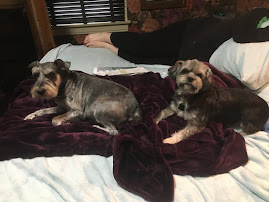
Last Saturday morning we took Mike, our remaining sheepdog, to the vet for an assessment, and, after some consultation, we made the difficult decision to have him euthanized.  We’d gone through the same procedure with Duffy several months ago.  The decision with Duffy was more clearcut since he was diagnosed with bone cancer, had fractured a leg, and was in severe pain.  There really wasn’t any choice in the matter.  Mike was more of a quality of life issue.  He’s been unable to get up from the floor by himself for months, has needed help getting up and down the stairs, had become incontinent, was suffering chronic pain from severe arthritis, and couldn’t be left alone in the house for any period of time without experiencing extreme distress.  We could have continued as we have been, providing him with a lot of physical caretaking, but, with the prospect of no improvement and continued decline, Mike’s  painful situation didn’t seem to warrant it.  I think we made the correct decision, but it’s hard nonetheless.  We were with Mike when the vet administered a sedative and then a drug to stop his heart.  It was painless for Mike, literally a matter of being put to sleep.  Lots of tears for us.     

Mike and Duffy have given us untold joy for over thirteen years, and we’ll experience their loss for a long time to come.  The dogs were my loyal companions on hikes in local parks, long neighborhood walks, camping expeditions, occasional road trips, and just hanging out in the house.  They were widely known in our neighborhood and provided the occasion for lots of casual contact with fellow dog owners and passersby.  Despite being brothers from the same litter, Mike and Duffy were very different in temperament.  Duffy was the alpha dog — more aggressive, dominant, and anxious.  He was the rowdier of the two.  When I think of Mike, the two words that pop into mind are “sweet” and “gentle”.  He was much more laid back than Duffy.  I can’t think of a single time where he ever barked at another dog on the street, and he stopped and stared at strangers, hoping to get a few pets.  He liked to lie in bed and lick our feet, and he was an expert at balancing on his back for minutes at a time with his legs outstretched and paws up in the air.  We still are attuned to his presence in the house, expecting him to be around the corner or to remind us that it’s 5:00 and time for dinner.  Katja was certain that she could hear him whimpering in the dining room yesterday evening.   

We’ve worked through losses in the past with pet dogs that we’ve been very attached to, and I know that we’ll cope with this all right and eventually get back to normal.  For myself, I’ve lost two loved companions and a significant and happy slice of my daily routines.  We’re at a life stage where we probably won’t get another dog.  I’ll have to figure out what will replace Mike and Duffy, or if that’s even possible at all.
Love,
Dave


Wednesday, November 11, 2015

The Night Our House Turned Blue


Dear George,
Last month Katja and Donna went on a two-week Rick Steves tour in France, starting out in Paris and working their way up to Normandy.  I stayed home to look after Mikey and Donna’s sheepdog, Sophie.  It wasn’t as exciting, but I do enjoy the peace and solitude, and the dogs and I had a relaxing time.  I did have a strange dream on the second night though, and it prompted me to try to capture it in a poem.  Here it is.
Love,
Dave

The Night Our House Turned Blue

My wife has been traveling in Europe
I stayed home to take care of the dog
Actually the dog’s taking care of me
I seem to be lost in a fog

I usually do fine when I’m home alone
But things got strange on Day Two
I woke up at dawn and I looked around
The entire house had turned blue

The walls were blue, the floors were blue 
The flowers and the bric-a-brac too
I wondered if aliens came in the night
Why they’d do this, I wish that I knew

It wasn't the blue of midsummer
More like ice on a far northern lake 
Or an overcast sky in November
It’s the blue of an Indigo snake

Even my dog has a bluish tint
And my skin when I look in the mirror
I could be a corpse in the city morgue
Who knew blue could cause so much fear?

I called my wife in a panic
She said Paris was golden and yellow
She plans to bring home some very bright hues
So now I am feeling more mellow


Thursday, November 5, 2015

The Mighty Ohio


Dear George,
Cincinnati is a quintessential river town.  The earliest settlers arrived at this area by way of the Ohio River, and they staked out their space along the river’s shoreline across from the mouth of the Licking.  Fort Washington was built to protect the local population in 1789, and the village soon grew to nearly 500 people.  Additional settlers continued to arrive by the hundreds, believing they could make their fortunes by providing supplies to soldiers and Ohio River travelers.  By 1792 thirty warehouses existed in the growing city, and it had gained a brewery, a spinning wheel manufacturer, and a chair manufacturer.  Due to the city’s strategic river location, there were nearly a thousand residents by 1803 and nearly ten thousand by 1820.  Steamboats were manufactured in Cincinnati, and farmers throughout the region brought their crops to be shipped down the Ohio and the Mississippi to New Orleans.  The Ohio River remains one of Cincinnati’s most significant geographic features today.  Here are some interesting things to know about the Ohio River, then and now: 

·       The river’s name:  From the Seneca (Iroquoian) Ohiːyo', which means “good river”. 
·       Namesake: The state of Ohio is named after the Ohio River.  
·       Termini: The Ohio begins at the confluence of the Allegheny and Monongahela Rivers in Pittsburgh and ends at Cairo, Illinois, where it empties into the Mississippi.
·       Length: 981 miles.
·       Rank among U.S. rivers: The Ohio is the longest river east of the Mississippi and the 10th longest in the nation.   
·       Maximum width: one mile at the Smithland Dam near Louisville.
·       Average depth: 24 feet.
·       Deepest point: 132 feet (near Louisville).


Ohio River From Eden Park, Cincinnati, O.

·       Age: Relatively young, the river’s formation began 2.5 to 3 million years ago near the beginning of ice ages.  Glacial meltwater probably cut the Ohio’s original channel.   
·       States along the Ohio River: Pennsylvania, West Virginia, Ohio, Kentucky, Indiana, Illinois.  
·       Drainage basin: 14 states, 204,000 square miles..   
·       Chief tributaries of the Ohio: the Tennessee, Cumberland, Wabash, and Kentucky Rivers. 
·       Early Native American inhabitants: Mississippian and Hopewell cultures, Osage, Omaha, Ponca, and Kaw.
·       First European to see the Ohio: French expedition leader René-Robert Cavelier Sieur de La Salle (1669).  LaSalle named it “La Belle Riviere.”


Ohio River at Cincinnati, U.S.A.

·       Lewis and Clark: Lewis and Clark’s expedition to find a water route to the Pacific began at Pittsburgh on Aug. 31, 1803, with Meriwether Lewis and a crew of eleven men paddling and sailing down the Ohio River.  They reached Cincinnati on Sept. 28 and spent nearly a week  there, during which time Lewis collected 300 mastodon and mammoth bones at Big Bone Lick to send to President Jefferson.
·       Thomas Jefferson’s (1782) appraisal: “The Ohio is the most beautiful river on earth.  Its current gentle, waters clear, and bosom smooth and unbroken by rocks and rapids, a single instance only excepted.”  (Note: the exception is the Falls of Ohio, a drop of 26 feet over 2 miles near Louisville.) 
·       Ohio River pirates: In the early nineteenth century pirates had their hideouts at Cave-In-Rock, Illinois, where they waylaid river travelers, killed them, stole their goods, and scuttled their boats. 


Along the Levee, Cincinnati, O.

·       Steamboats: The first steamboat successfully navigated the Ohio in 1811, and fifteen steamers were in service  on the river by 1818. 
·       The Lucy Walker: One of the nation’s deadliest steamboat disasters occurred on the Ohio River near New Albany, Indiana, on Oct. 23, 1844.  The Lucy’s Walker’s boilers exploded, killing as many as 100 passengers and crew.  The Lucy Walker had a Native American owner, and her crew consisted of African-American slaves.  
·       North-South border: The Ohio River was the western extension of the Mason-Dixon Line and thus part of the border between free and slave territory.  Slaves who crossed the river via the Underground Railroad called it the “River Jordan”.  More slaves escaped across the Ohio than anywhere else on the Mason-Dixon Line. 


Ohio River By Moonlight

·       The phrase “sold down the river” originated with Kentucky slaves who were split apart from their families and shipped down the Ohio River to the Mississippi and New Orleans.  
·       Current population in the Ohio River basin: 25 million people (nearly 10% of the U.S. population).    
·       Major cities along the Ohio: Pittsburgh, Parkersburg, Wheeling, Huntington, Steubenville, Marietta, Owensboro, Cincinnati, Covington, Louisville, Paducah, Evansville.
·       The 1937 flood: 385 people died, a million were left homeless, and property losses reached $500 million from the Ohio River flood in late January and February 1937.  River gauge levels reached 80 feet in Cincinnati, the highest level in city history.  Twelve square miles of the city were flooded.      
·       Source of drinking water: To over 3 million people. 
·       Dams on the Ohio: 20; power generating facilities: 49.


 Suspension Bridge, Cincinnati, O.


·       Bridges: 118 bridges and other crossings across the Ohio River.  Cincinnati’s bridges are the Cincinnati Southern Bridge, Brent Spence Bridge (I-71/75), C&O Railroad Bridge, Clay Wade Bailey Bridge, John A. Roebling Suspension Bridge, Taylor-Southgate Bridge, Newport Southbank Bridge (the Purple People Bridge), Daniel Carter Beard Bridge, and the Combs-Hehl Bridge (I-275).    
·       Annual tonnage of cargo shipped on the Ohio: over 230 million tons — mainly coal, oil, and steel.
·       Number of species of fish found in the Ohio: 164, including Bass, Crappie, Bowfin, Carp, Buffalo, Bullhead, Catfish, Codfish, Darter, Drum, Eel, Garp, Chubs, Shiners, Lamprey, Paddlefish, Perch, Pike, Pickerel, Muskellunge, Sauger, Walleye, Sculpin Shad, Sturgeon, Sunfish, and others
·       Largest fish on record caught in the Ohio: 106-pound Paddlefish (Kentucky, 2004).

With many dog walks over the years, I’ve spent a lot of time along the Ohio River shoreline — at Eden Park, Fernbank Park, and, most recently, Smale Park.  The river’s presence is a great source of pleasure to many people.  
Love,
Dave      

Sources consulted:  www.infoplease.com, “Ohio”; www.newworldencyclopedia.org, “Ohio River”; www.ohioriverfacts, “Ohio River Facts”; www.ohioriverfdn.org, “Exploration”; www.theohioriver.com, “Ohio River Facts”; www.wikipedia.org, “List of crossings of the Ohio River”; www.wikipedia.org, “Lucy Walker steamboat disaster”; www.wikipedia.org, “Ohio River”; www.wikipedia.org, “Ohio River flood of 1937”; www.wvexp.com, “Ohio River”


Wednesday, October 28, 2015

Monsters, Creatures, and Evil Spirits: A Halloween Primer


Dear George,
Next to Xmas, Halloween is definitely the best holiday for kids.  You get to disguise yourself in a costume so people don’t know who you are.  When you get old enough, you go out after dark with your friends with the possibility of engaging in mischief.  You collect tons of candy and goodies.  And there’s a lot of scary excitement about the prospect of encountering evil beings and monsters in the night.  

There are many things to be scared about in life, and witches, vampires, and ghouls give us entities upon which to target our worries.  In the interest of pinning down just who we should be concerned about this Halloween eve, I’ve compiled a taxonomy of evil beings and monsters.  Here are the most important ones.  


The Devil
The devil, of course, is number one, since he is the very personification of evil.  Most religions and cultures acknowledge the devil’s existence.  In Christianity he is a rebellious fallen angel who fights with God over the souls of human beings.  The American public, by and large, tends to believe in the devil’s reality and power.  67% believe in the devil’s existence (3), 51% believe that people can be possessed by the devil or other evil spirits (10), and 45% believe that Satan is the cause of most of the evil in the world (11).   The devil doesn’t just come around on Halloween — he’s here all the time.  


Demons
The devil commands an army of demons.  Often fallen angels or the spirits of those who have died recently, demons are evil spirits who have the capability of possessing living beings.  (12) Upon entering the body, demons “seize” the victim and cause nightmares, disease, epilepsy, and even death.  Rites of exorcism are used to expel demons.  Exorcism is practiced on occasion by Catholics, Jews, Muslims, and Hindus.  (13) 


Succubi
There are important sub-categories of demons.  A succubus is an attractive female demon who appears in dreams and seduces men.  Having sex with a succubus results in loss of one’s health or even death.  Adam’s first wife, Lilith, later became a succubus.  She left Adam and the Garden of Eden after mating with the archangel Samuel.  A male sexual demon who seduces women in their sleep is an incubus.  (12) 


Ghosts
Ghosts are particularly likely to be hovering about on Halloween night and are probably the supernatural creatures we are most likely to personally encounter.  Ghosts are apparitions or spirits of deceased persons that appear after death.  Descriptions of ghosts range from an invisible presence to barely visible wispy shapes to lifelike visions.  Experiences of ghosts of deceased ancestors appear to exist in all human cultures.  While ghosts can be good or evil, people generally fear ghosts and see them as an omen of death.  (14) About 42% of American believe in ghosts.  23% report that they have actually seen a ghost or been in a ghost’s presence.  (9) 


Vampires
If you go to the movies or watch TV, you probably know a lot about vampires already.  Vampires are undead creatures who feed on human blood.  They are believed to come from the grave at night to suck blood from sleeping victims.  Vampires are capable of immortality, though they can be killed by sunlight or a stake driven through the heart.  (7)  A Fox News poll found that only 4% of American adults believe in vampires.  (3)   I find this surprising since I notice one or two vampires on Ludlow Avenue almost every day.  According to one informative website, prominent vampire communities are located on the Sunset Strip in L.A., in New Orleans cemeteries, in the Caves of St. Louis, Missouri, and in downtown Detroit.  Georgia Tech professor and researcher John Edgar Browning interviewed 35 vampires in New Orleans and reports that there are at least twice that many in the city.  (6) 


Zombies
Zombies  are all the rage these days.  They are undead creatures who are created when human corpses are reanimated through a sorcerer’s or witch’s magic or other means (e.g., viruses).  Zombies are mindless, primitive, uncontrollable, and extremely violent.  They are also very ugly.  Some zombies hunger for human brains.  (12)  Victims of zombies may become zombies themselves.  Both zombies and vampires are undead creatures, but zombies are brainless, repulsive creatures, while vampires are attractive, intelligent, finely dressed, and can blend in with the living.  (2)   A 2014 Chapman University survey on American Fears found that 18% of Americans are at least somewhat afraid of zombies.  (5) 


Ghouls
Ghouls are undead monsters who live in graveyards and eat human flesh.  Ghouls prey on young children as well as adults, and they like to drink human blood.  Sometimes ghouls and zombies get confused.  Ghouls live in graveyards, are attracted to the dead, and are created by black magic or possession by demons.  Zombies are attracted more to live human beings and are created by voodoo or the bite of another zombie.  I used to watch out for ghouls when riding my bike past Riverside Cemetery outside Menominee in the dark of night.  (2) (12) 


Werewolves
A werewolf is a human being who has the ability to shape shift into a wolf, either purposely or after being placed under a curse or an affliction (e.g., a bit from another werewolf).  Werewolves are aggressive and malevolent.  The full moon causes the transformation from human being to wolf.  Werewolves have superhuman speed and strength, though they can be killed by a silver bullet or blade.  (12)  I didn’t think we had any werewolves in Cincinnati until I ran across an account by William D. Carl in a book called “Bestial: Werewolf Apocalypse”  (Kindle, $10.99).   Here’s what happened (or might happen) in our city: “As night descends on Cincinnati, the city braces for hell on earth: The populace mutates into huge, snarling monsters that devour everyone they see and act upon their most base desires. Planes fall from the sky. Highways are clogged with abandoned cars, and buildings explode and topple. The city burns.”  (1) 


Witches
Witches possess evil magic powers.  Though both women and men can be witches, they usually are older women who wear black cloaks and a pointed hat and fly on a broomstick.  Modern witches are generally followers of Wicca, “a modern pagan, witchcraft religion” (12).  According to Marla Alupoaicei, co-author of “Generation Hex”, Wicca is the fastest-growing religion in America and will soon be the third largest religion after Christianity and Islam.  Witch School, one of thousands of occult websites on the Internet, reports that it has trained over 200,000 witches to date.  Currently there are over 200,000 registered witches in the U.S. and about 8 million unregistered practitioners of Wicca.  (8)  According to Gallup, 21% of Americans believe in witches, though my opinion is that that’s an under-estimate. (4)  

So there are quite a few evil beings to be worried about this Halloween.  I think back to a conversation with a graduate school friend many years ago.  He remarked that we all have monsters hidden within ourselves.  That struck me as a profound truth, and, if so, it also means that we are surrounded by hidden monsters all the time.  Maybe it’s not just werewolves that we should be worried about.
Love,
Dave

SOURCES:  (1) www.amazon.com, “Bestial: William D. Carl”; (2) www.differencebetween.net, “Difference between Ghoul and Zombie”; “Difference between Zombie and Vampire”; (3) www.foxnews.com, “Fox Poll: More believe in Heaven than Hell”;  (4) www.gallup.com, “Three in four Americans believe in paranormal”; (5) www.neurologicablog, “What Americans believe”; (6) www.sciencealert.com, “There are real-life vampire tribes roaming New Orleans”; (7) www.skepdic.com, “Vampire”; (8) www.thetruthwins.com, “The fastest growing religion in America is witchcraft”; (9) www.thinkprogress.org, “More Americans believe in witchcraft that agree with Citizens United”; (10) www.washingtonexaminer.com, “57% believe in the devil, 72% for blacks, 61% for women”; (11) www.washingtonpost.com, “Study: Americans are as likely to believe in Bigfoot as in the big bang theory”; (12) www.wikipedia.org, “Demons”, “Witchcraft”, “Zombies”; (13) www.wikipedia.org, “Exorcism”; (14) www.wiktionary.org, “Ghost” 

Wednesday, October 21, 2015

Archive: Vic's Photos (#12)


Dear George,
I’ve been posting one of my dad’s family photos from the 1940’s and 50’s once or twice a week since I began this blog, and then I started posting accumulated batches of them as archives every few months.  My brother Peter reprinted many of Vic’s photos as postcards which he sent to family members, and the photos here are from Peter’s project as well as from family albums.  A large number of these are also available on my Flickr website: www.flickr.com/photos/lundgrdc/.  
Love,
Dave


My parents met while my dad was in college or law school at the University of Wisconsin.  This is the earliest photo I’ve seen of them as a couple.  They’re certainly dressed up, my mom (Doris) looking like a flapper (which she probably was in the late 1920’s) and my dad (Vic) a dapper young man about town. 


My mother looks very pretty against this backdrop of a snowy U.P. winter.  She and Vic were married on June 1, 1932, in Omaha.  Doris was 22, Vic was 24.  They lived in Omaha for a short time, then moved to Menominee where Vic began his law practice.


I’m not certain but I’d guess that this photo was taken sometime before my birth in July 1937, perhaps in 1936 or 1935.  Doris and Vic look very happy together here.  It was the midst of the Great Depression, and they had very little in the way of money, worldly goods, or security.  As did many couples and families, they struggled and eventually made their way to a better life. 


It’s a shame we can’t remember anything about our first year or two.  This is me in a tub in 1938, age one.  I look sort of serious, perhaps wondering what I’m doing in the world and why my father is pointing that strange machine at me.  


This is my Uncle Ralph Buscher as a young man.  He worked at my grandfather's Rexall Drug Store in Marinette, and he was my boss when I clerked there in my teenage years.  Ralph sang in a prize-winning barber shop quartet and a Marinette church choir.  He and my Aunt Martha lived at Pine Beach with our cousins, Ann and John, and our grandfather, V.A. Sr.  


This is my paternal grandmother and grandfather, Olga and V.A.L. Sr.  I didn't really know Olga who died on July 22, 1942, but who had suffered a major stroke several years before and was bedridden.  I learned from family history that she was an important figure in the state Republican Party in Wisconsin and influenced my dad's going to law school (having told him that he was a good talker).  V.A. emigrated to the U.S. from Sweden with his family as a teenager in the early 1890’s, worked in a lumber camp, went to pharmacy school, and opened and ran drugstores in Marinette and Menominee throughout his career.  Close to his four children, their spouses, and his nine grandkids, he died on Nov. 20, 1959.


My dad took an annual photo of our family every summer, almost always at our house on the Menominee River.  This one was in 1953.  Vic had a gizmo which enabled him to set the camera up, then run over and get in the picture before the shutter opened.  Peter’s at the left (age 8), then Steve (12), Vicki (6), and myself (16).  This was a big year for me since I got my driver’s license and could take the family car to cruise around town with my chums. 


Jean Worth and his wife Margaret were among my parents’ very closest friends.  Jean was the editor of the Menominee Herald-Leader during my youth, and he was widely known in the region as the U.P.’s most accomplished historian.  Their three daughters, Dooley, Jean, and Ann were childhood friends of my siblings and myself.  We spent many fun times at the Worth’s hunting camp at Cedar River, about 25 miles north of Menominee.  


This is my freshman hallmate and Antioch college friend, Arnie P.  I visited Arnie's White Plains NY home in 1959, and he drove up to Menominee with me that winter.  There was a blinding snowstorm in Wisconsin and the Highway Patrol closed Highway 41 north of Milwaukee, but we took a two-lane back road and made it through the three-foot snow drifts  We didn't see another car for 150 miles.  Arnie and my dad had a lot of good conversations at river house.  Vic was disappointed that Arnie didn’t enjoy his required military service.  After Arnie graduated from Antioch, he went on to become a psychotherapist.  


This is my mom, Katja, and myself at the Menominee C&NW depot in the late 1950’s.  On at least one occasion Katja and I traveled from Springfield, Ohio (near Antioch in Yellow Springs) to Menominee and back by train, nearly a 24-hour journey each way.  Vic and Doris were probably seeing us off on our way back to college.  


From the cigarette in my hand, this was definitely taken when I was on a visit home from Antioch, maybe in 1959.  We’re out near the driveway at our house, with the Norway pines and the river in the background.  If it was 1959, I would have been 22, Steve 18, Peter 14, and Vicki 12.   


This is my Antioch College psychology professor, Clarence Leuba, his wife Frances, and their daughter.  I worked as Dr. Leuba’s teaching assistant for Intro Psych in 1958-59, and he was my main adviser for grad school planning.  My parents met the Leubas when they came down to Yellow Springs for our graduation and then several months later at our wedding.  They all hit it off together and became friends.  Professor Leuba taught at Antioch from 1930 to 1962 and lived in Yellow Springs until his death at age 86 in 1985.   


This is my sister Vicki in her early teens.  Vicki could be serious, and she could be lots of fun.  I left for college when she was 8, so I wasn't around much for her adolescent years.  All of us kids got resistant to having our pictures taken, so that may be the case for Vicki’s non-ecstatic expression here. 


This was taken of me in 1960 in Yellow Springs.  My parents and siblings drove down for my graduation from Antioch in June of that year, then again for Katja's and my wedding in late August.  We were certain we were more than old enough to be getting married, though I look pretty young in this photo.  


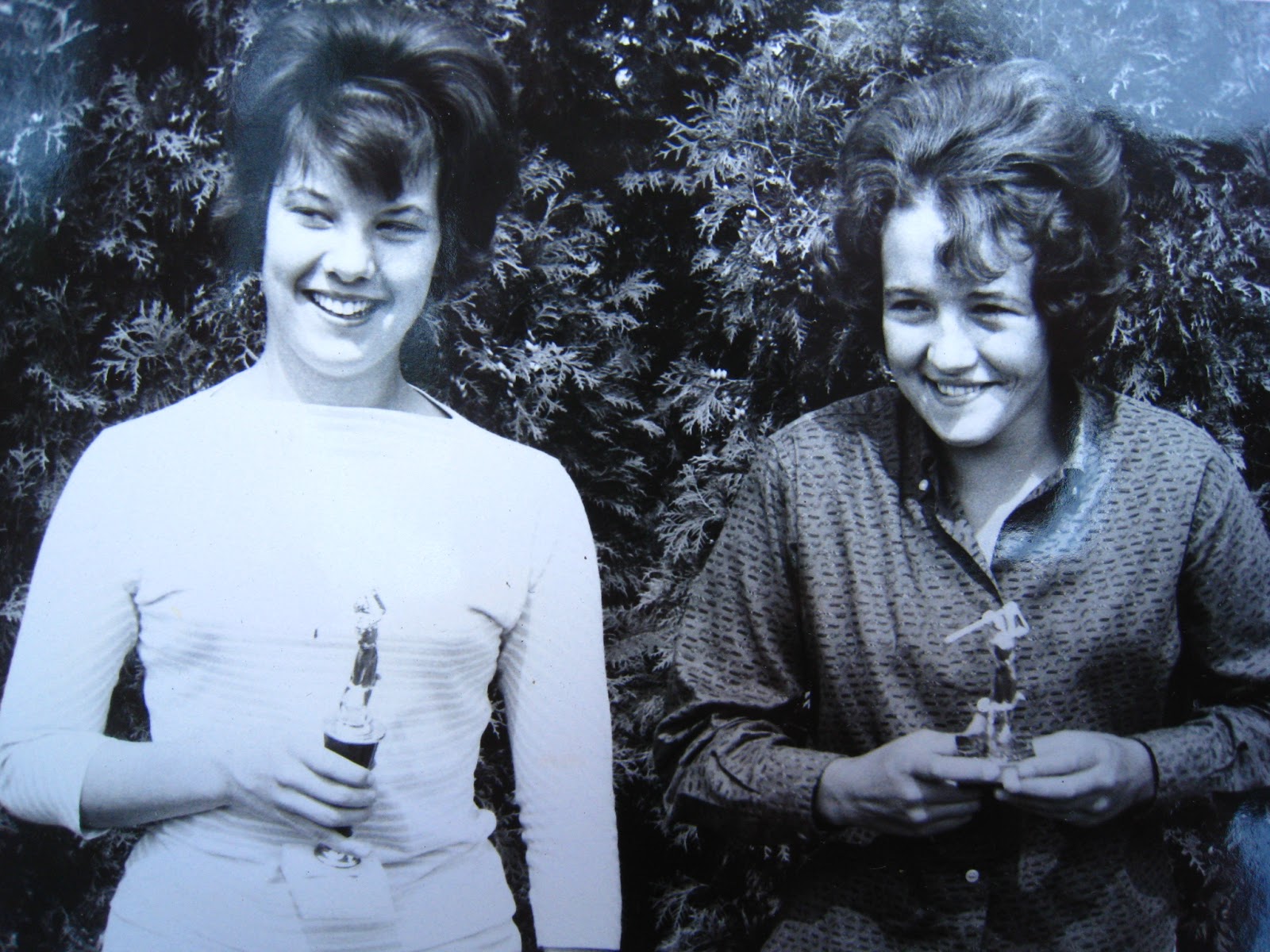
Here’s my sister Vicki (left) and her best friend Kiera, either at the O’Hara’s house on Green Bay or perhaps at our house on the river.  Our families were close, and the girls were inseparable from the time they were toddlers.  Vicki went to church with Kiera’s family so often that she wanted to become a nun herself.    


Peter came of age in the rock and roll era, and he had the most distinctive hairstyles of the four of us siblings.  I’m not sure if Peter’s style was directly patterned after Elvis, but I know it involved a special greasy mixture and careful pruning.  We teased Peter about his hair style, but he shrugged it off and did his own thing.  


Here are my brother Steven, Katja, and I on an unknown second floor building patio.  Because we’re well-dressed, I initially thought it might be our wedding.  However, that was on a very hot August 28th, and we wouldn’t have been wearing heavy coats.  More likely an Ann Arbor get-together.    


My brother Steve and sister-in-law Margie were married on June 20, 1964, in Elmhurst, Illinois.  Katja and I were delighted to have a second married couple in our cohort, and Margie brought a vivacious spirit to our family.  Steve and Margie were great dancers and made family gatherings full of fun.