Friday, August 28, 2020

Number Sixty -- That's Amazing!


Dear George; 

Katja and I are celebrating our sixtieth wedding anniversary today.  We were married on August 28, 1960, in the Quaker Chapel on the Antioch College campus in Yellow Springs.  I remember that day better than any other day in the past sixty years.  Among other things I went to the local drugstore to see if I could get  some pills to stop sweating.  (There aren’t any pills to stop  sweating.)  Katja looked very beautiful, and we were overjoyed about the occasion.  After a one-night honeymoon in Dayton; we set off for graduate school in Ann Arbor.  


The next sixty years, in hindsight, have passed by much too quickly.  What pops into my mind includes our both getting graduate degrees; my mentor recommending me for a faculty job in Cincinnati; Katja giving birth to our son J (which was to lead to the most meaningful and ; rewarding part of our marriage); buying our house on Ludlow Avenue; Katja teaching French at UC and then getting her Social Work degree and working at the Cincinnati Association for the Blind; lots of tennis; camping trips with Katja and J; J going to Columbia, marrying K, and then off to med school; our annual family reunions at Farm in Birch Creek; Xmas trips to New York City to visit Ami and Bruce; Beach Haven with Buck and Helen in late summer; California expeditions to see Vicki, David, and families; our many dogs (especially sheepdogs Mike and Duffy); rabbits as well (e.g., Thumper); our many good friends over the decades; CCM, the symphony, and Linton concerts; becoming grandparents; and our golden retirement years with classes at OLLI.  


This time around we are sheltering in place, a disappointing restriction given the significance of the occasion.  However, it does provide for a celebration in which our being together is first and foremost.  If I had to pick someone with whom to sit out the pandemic, Katja is the perfect choice.  Yesterday she bought filet mignon at Fresh Market and a chocolate cheesecake at the Cheesecake Factory, so we are due for a feast this evening.  We’ll be thinking of all our beloved family and friends.

Love,

Dave


Thursday, August 20, 2020

A Coronavirus I Ching Reading


Dear George, 

Having drifted into a state of total lethargy,  I haven’t checked the I Ching even once since the pandemic began.  That’s ridiculous.  The I Ching, of course, is the ancient Chinese Book of Changes.  Drawing from Confucianism and Buddhism, it provides guidance for moral decision-making and action.  One typically consults the I Ching by asking a question and then tossing three coins six times in a row.  The pattern of heads and tails for each coin toss results in either a solid or broken line (see citations at the end for details), and the six lines are arranged vertically in a stacked hexagram as in this example:   


Hexagram 43: Kuai - Breakthrough (Resoluteness)


Each possible hexagram, subdivided into an upper trigram and a lower trigram, represents a  specific life situation.  With six coin tosses, there are 8 trigrams possible and 64 (8 x 8) hexagrams possible.  The 8 trigrams represent heaven, lake, fire, thunder, wind, water, mountain, and earth.  The I Ching provides an interpretation for each of the 64 hexagrams.  Each interpretation includes an Image (the state of mind a superior man would adapt under the circumstances) and a Judgement (the best strategy for action under the circumstances). 


I asked the I Ching, “How can I best cope with the pandemic?”  Like Michelle Obama, I find myself increasingly experiencing “low-grade depression”.   Most of our major pleasures in life have been closed off, and I wake each morning with a sense of dread and an expectation that there is nothing to look forward to.  I tossed the coins six times and recorded each solid and broken line.  My hexagram (shown above) is titled Kuai (Breakthrough [Resoluteness]).  The upper trigram is Tui (The Joyous, The Lake), and the lower trigram is Ch’ien (The Creative, Heaven).  The hexagram suggests that the lake has evaporated and ascended to the sky where it will discharge itself as a cloudburst, hence the imagery of a breakthrough.    


Richard Wilhelm’s commentary.  In the most highly regarded rendition of the I Ching, translator Richard Wilhelm writes:  “This hexagram signifies on the one hand a break-through after a long accumulation of tension, as a swollen river breaks through its dikes, or in the manner of a cloudburst. On the other hand, applied to human conditions, it refers to the time when inferior people gradually begin to disappear. Their influence is on the wane; as a result of resolute action, a change in conditions occurs, a break-through. The hexagram is linked with the third month (April-May).”


My comments.   As usual, the I Ching is uncannily on target.  April-May, of course, is when the coronavirus’s major surge began in the U.S., including a sharp increase in hospitalizations and  deaths, shelter in place mandates, the prohibition of large public gatherings, and the closing of restaurants, bars, and many retail establishments.  Like most people, I’ve experienced more and more tension since that time, and my mode of coping, frankly, has been that of an “inferior person”.  Morose, passive, self-pitying, hopeless. 


How can one break through the paralyzing funk that the pandemic produces?  First, it’s helpful to recognize that there are wide differences in how people respond to the situation and that depression isn’t an inevitable alternative.  Many people, of course, experience catastrophic personal losses — of loved ones, of jobs and income, of their businesses or families.  People in our age group are likely to feel particularly vulnerable to the virus and may fear the prospect of an imminent death.  At the opposite extreme, some regard the pandemic as a complete hoax and adopt a far more cavalier attitude.  Or persons may not let themselves be overwhelmed by the situation.  In occasional instances, the pandemic provides a desirable opportunity for financial profit (e.g., pharmaceutical companies).  Likewise, there are divergent ways of viewing the pandemic.  Probably a majority dwell on the fact that 1 of 60 Americans have been infected by the virus, while others are reassured that 59 of 60 haven’t been.  Experts estimate that 1% or fewer of infected persons are likely to die (though, on the other hand, 99% or more will not).  


It seems to me that two things are required for a breakthrough.  The first is to adopt a less exaggerated and more realistic view of the pandemic.  I spend endless hours soaking in frightening information from the media (which concentrates almost entirely on death rates and largely ignores rates of recovery).  In looking at relevant statistics, our odds, in fact, are pretty good.  Second, I think a breakthrough occurs which one engages in meaningful, rewarding activities that provide a renewed sense of mission.  Something beyond watching Netflix and taking naps.   A lot of my own gloomy state is linked to the loss of so many activities in our community.  I have lost my poetry classes, but I can still write tons of poems.  The gym has been shut down, but I can do a challenging exercise program at home.  The same for blogging, reading, art, music, photography, and playing cards and Trivial Pursuit with Katja.  I’ve been a slug-a-bed for much too long.  Hopefully finishing this blog post will be the first step in a personal breakthrough.  Time will tell. 

Love,

Dave 


SOURCES: 

Wilhelm, Richard.  (1950). The I Ching or Book of Changes. Cary Baynes, trans. Bollingen Series 19. Introduction by Carl G. Jung. New York: Pantheon Books. 3rd edition (1967), Princeton: Princeton University Press.

mindsports.ni, “Interpreting the I Ching” 

taopage.org, “Content of the I-ching” 

the-iching.com, “43. Parting (guài). Breakthrough”


Wednesday, July 29, 2020

MEERKAT POEMS

Dear George,
The meerkats are among my favorite exhibits at the zoo.  They’re always busy and active, diving in and out of their burrows, checking out the world about them.  I think they enjoy watching the humans as much as the humans enjoy watching them.  Here are a few meerkat poems, dedicated to their happy spirit.
Love,
Dave


My Meerkat Family


Here you have my family.
Meerkat Mob Number Two Thousand Four.
That is our mother standing at the rear.  
We Meerkats are called mobs.
though the British call us gangs.   
I am right near the middle.  
They say I have a serious look.
but it doesn’t really matter 
because all Meerkats have serious looks.  
We are not separate beings  
but interchangeable pieces  
in the Great Meerkat Collective.   
We look alike
think alike
act alike.
We are not as quick as cheetahs
as majestic as lions
as strong as rhinos.
But we are brave
and determined 
and when the apocalypse arrives
as it surely will 
we will be the last remaining species on earth
because we stick together
and prize the group above the individual.  
Humans could learn a lot from Meerkats. 

                           * * *


A Meerkat Primer


Not just anyone can be a Meerkat.
You have to be tough
also smart
very quick on your feet
able to scramble through a four-inch bolt-hole.
My family has lived in the desert for eons.
In July, one hundred and twenty at high noon
so we retire to the depths of our burrow
where it’s pitch black, cooler.
We spend the remainder of our time
hunting for food.
Butterflies and beetles, moths
maybe a lizard or a baby bird
if lucky, a small snake
an egg or two, some cactus seeds 
even a scorpion.
I get new brothers and sisters four times a year 
usually after a rainy season 
sometimes six or seven pups, sometimes three or four 
We Meerkats live to age thirteen 
longer than squirrels or skunks or rabbits.
There are half a million Meerkats
in the world today
five times as many Meerkats as giraffes. 

               * * *


The Sentries 


Raza and I are sentries
posted at our station dawn to dusk 
rain or shine, dust storms, lightning.
Ever vigilant
we don’t allow ourselves to  blink. 
Meerkats have deadly ancestral enemies
the hawk-eagles
the bat-eared foxes, the jackals
the spotted snakes with their long fangs
and poisonous venom.
My responsibility is to watch to the north
where the eagles fly in 
while Raza looks south
for the foxes and jackals.
We have keen vision and keen hearing
and at our slightest warning cry 
our family members dive into their burrow holes
ready to enjoy another Meerkat day 

               * * *


What Meerkats Think


Meerkats think all the time, you know. 
Not so much about life’s meaning
but more practical stuff
like the dozens of things my mom has told me.
Keep out of the midday sun
Mark our territory
 and defend against the rival mobs
Always take care of the baby pups
Drink the water when you come across it
The juiciest beetles hide under rotten logs.
And every day, of course, I think about our enemies.
How I might snatch an eagle right out of the sky
or twist a desert snake into knots
Gang up with my sisters and brothers
to chase away a hungry jackal. 
And most of all I think about Lavinia 
the sweetest Meerkat I’ve ever seen
who lives with her sisters across the great valley
and hopefully one day will be my bride.
I wonder if Lavinia ever thinks of me.


Tuesday, July 21, 2020

Eight-Three and Chugging Along


Dear George,
As I write this our son J and grandkids V and L are busy pressure washing our patio deck.  I can’t think of a better birthday gift.  Our deck has long been in a sad state of disrepair, and J has been working on fixing it since they arrived from California 10 days ago.  The last task is painting the deck.  J is supervising, while V is manning the pressure washer, and L is dislodging the chunks of dried paint.  Since Katja has been thinking about tearing the whole thing down and starting from scratch, their birthday gift of manual labor is going to save us about $5000. 

One thing I think about turning 83 is that our family becomes more important every year as we grow older as a source of social, emotional, and practical support.  We’re very proud of our grandkids, delight in their growing up.  J and our daughter-in-law K are our good friends to us as well as our closest family members.  Our group is driving back to New Orleans in two days, returning to their regular lives (as much as possible) after a summer in Half Moon Bay.  We will miss them dearly.   

J asked me how it felt to be 83, and I said it wasn’t much different from being 60 or 50 or even 40.  My poor hearing is my major sign of being in my eighties, but it’s been poor for the past two decades and it’s not nearly as bad as it might be.  I think I am more aware of being in my eighties because of the pandemic because I read in the paper every day that Katja and I are in a high-risk category.  I’m going to be extremely angry if I catch the coronavirus and die from it because that isn’t part of my game plan.  

I’ve often thought about which decade of life is the best.  When I was a kid in grade school, a pharmacist in our family drugstore named Lucien regularly told me to enjoy life because I was in the best time I would ever know.  I didn’t pay attention, but I think he had a case.  Now I think the eighties are also a strong contender, at least if one is relatively healthy and financially stable.  Since retiring twelve years ago (fourteen for Katja), we’ve been free as birds and unencumbered by job tasks, bosses, annual evaluations, and difficult colleagues.  We’re more mature, we devote ourselves to enjoyable pleasures, and life is full of contentment.  I never really expected this, and it’s a welcome surprise.  

I don’t know what my 83rd year will bring.  We have the rest of the Trump presidency, the pandemic, unrest from police brutality, the economic disaster.  My hope is that we will successfully wend our way through a chaotic world.  I wish the same for you and your family.
Love,
Dave
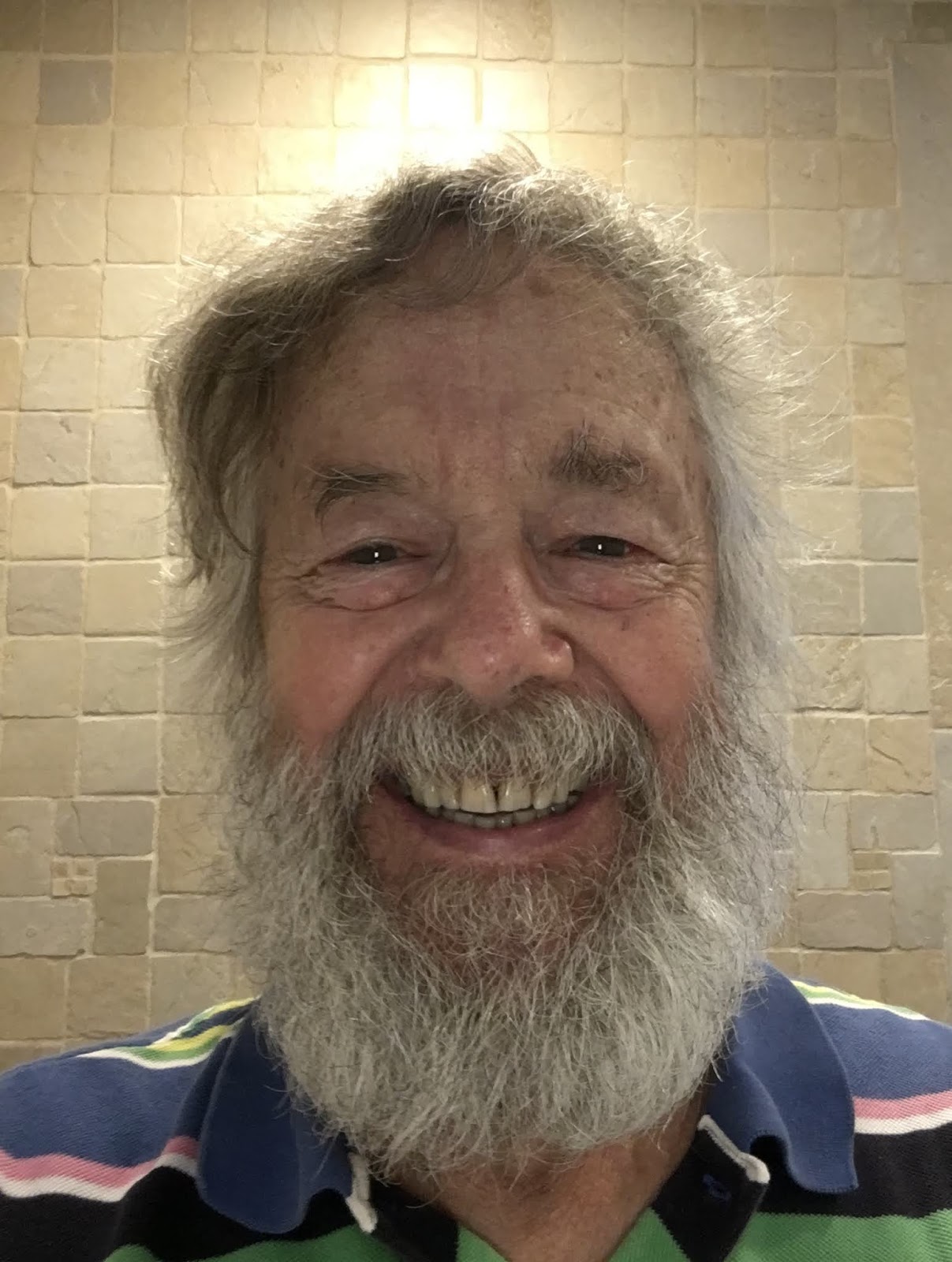
P.S.  The photo is my pandemic hairdo and beard, untouched since last February.  This geezer looks much more like an 83-year-old than he used to.  


Tuesday, July 14, 2020

Will This Actually Happen?


Dear George,
We have “sheltered in place” for four months, and that arrangement appears likely to continue indefinitely.  Our lives, while less damaged than most, remain pretty bleak.  No outings, no social gatherings, no events, no sports, no music, no art, no restaurants, not much except TV and red wine.  Recently, however, it’s been dawning on me that something stupendous and wonderful is likely to happen in the foreseeable future.  I’m referring, of course, to the November elections.  Every day more evidence becomes available that Trump has little or no possibility of being re-elected.  In my mind, the inauguration of a new president in six months.  I’m sure you’ve see the news reports.  Here is a sampling:    

87% of Americans are dissatisfied with how things are going in the country, and only 17% are proud of the country’s condition.  (late June Pew survey; brookings.edu

As of the end of June, only 39% approve of how Trump is handling his job as president.  (Pew survey; brookings.edu)

Younger white working class voters (ages 18-39), a major Trump constituency, tend to view Trump’s presidency as “poor” or “terrible” (46%) and are unlikely to think that he handles race relations well (35%) or brings the country together (35%).  (Pew survey; brookings.edu

Trump has received severe criticism for mishandling the pandemic crisis and for his responses to protests over the death of George Floyd.  (theguardian.com)

According to CNN analysts, “the toll the coronavirus will have taken on the American economy and people will be too great for him to overcome.”  (cnn.com

Though seniors (65 and over) favored Trump by 8 points in 2016, most surveys in June 2020 found Biden leading Trump by 2 to 8 points among seniors.  (nbcnews.com

A recent NY Times poll found Biden leading white women with college degrees by 39 points (compared to Hillary Clinton’s 7 point margin in 2016).  (slate.com)

In 2016 Trump won white women without college degrees by 37%.  Recent polls have found that number shrinking to single digits.  (slate.com) 

According to a June 2020 NYT poll, Biden is leading by 6 to 11 points in six battleground states that Trump carried in 2016 and that were crucial to his election: Michigan, Wisconsin, Pennsylvania, Florida, Arizona, North Carolina.  (nytimes.com)  

A late June Pew Center survey found Biden leading Trump nationally by 10 points, 54%-44%.  (brookingsedu)

It sounds almost too good to be true, and I’m immediately reminded how we celebrated Hillary Clinton’s “landslide victory” up until the polls closed on election day.  Momentous things could happen in coming months with the pandemic, the economy, race relations.  And/or Joe Biden could mess up.  Right now, however, there’s lots of reasons for anti-Trumpers to feel optimistic.  I’m determined not to die from the coronavirus while Trump is in office.  I plan to avoid all germs until 2021.  (But in the worst circumstance, if need be, I’ll hide out at home till 2025).
Love,
Dave


Saturday, July 4, 2020

Skipping the Fourth


Dear George,
Thanks to the coronavirus, this may be the most un-Fourth of July since 1776.  No fireworks extravaganza on the riverfront, no band concerts or parades or community-wide picnics.  You don’t even see that many flags.  Just a lot of firecrackers that have been going off late at night for the past two weeks and terrifying neighborhood dogs.  It’s just as well.  Between Trump, the country’s failure to control the pandemic, George Floyd, the uproar over monuments to white supremacy, and economic collapse, it’s hard to dredge up any feeling of patriotism.  Here is my optimistic, if somewhat delusional thought.  Six months from now we’ll be inaugurating a new president, they’ll be distributing a vaccine to hundreds of millions, police reforms will be in place in many U.S. cities, racist monuments removed, and an increasingly successful reopening of business and industry worldwide.  Probably too much to hope for, but some of it could actually happen.

This is pretty much a lost year so far since virtually everything pleasurable has been put on hold.  On top of it all, I woke up on June first with every muscle in my body aching.  Thinking it due to the statin I take for high cholesterol, I emailed my doctor’s office and asked if I could stop the statin.  During these perilous times it’s difficult to see or talk to a doctor, so the nurse-practitioner said by return email it was o.k. though she thought it more likely to be arthritis.  My son and daughter-in-law, the two doctors in our family, tentatively diagnosed my condition as Polymyalgia Rheumatica, a mysterious but not uncommon ailment apparently linked to being older than one should be.  I relayed this to the nurse-practitioner, and she started me on a low dose of steroids (prednisone).  That helped quite a bit for the first two days, then seemed to reach a plateau.  The pain is tolerable, gets better in the course of the day, and I’m patiently waiting for it to go away altogether during my three-month steroid treatment.  

The other painful thing is that my close friend Jennifer and her partner Brian moved this week from Cincinnati to Virginia where she’s taken a high level position in the state university system.  Jennifer came here twenty years ago, and, because she lived right down the street, we walked home from work together practically every day.  That’s a lot of walks and talks, maybe 3 or 4 thousand.  This is the second time in a couple of years that one of my closest friends has moved away, and these are losses that are pretty much impossible to overcome. 

A bright spot is that our son J and grandkids V and L will be coming to visit in about a week, and they’ll stay with us for two weeks, the longest get-together we’ve ever had.  I think it’s a great opportunity.  I worried that with so many things shut down it will be hard to keep the kids entertained, but J reassured me that they are very content to spend the whole day playing video games.  I myself have never played a video game, so I’m going to ask them to give me some lessons.  At the end of their stay they’ll drive back to New Orleans, taking one or both of their dogs with them.  J asked if we might want to keep Iko in Cincinnati.  Katja’s been wishing for that for some time, but then she changed her mind, thinking back to a childhood trauma when her veterinarian dad said she couldn’t keep the new puppy he gave her because its original family wanted it back.  Dog arrangements will work out one way or the other.   This three and a half month visit from Iko and Lil Paws has been a great treat and has reminded us how much we are dog people.  

Katja sent me off to Clifton Market yesterday with a grocery list that included some challenging items, e.g., unsweetened cocoanut, cider vinegar, two avocados.  A staff person stocking shelves found the cocoanut for me, and I actually found the vinegar myself, though I had to call home to see if apple cider vinegar was correct.  Another staff person pointed to the end of the aisle where the avocados were, but unfortunately the labels were missing from the various fruit and vegetable boxes.  I picked up two dark green lumpy items shaped like small footballs and took them back to the staffer, asking her if these were avocados.  She looked at me strangely and nodded yes.  Then she asked if I would like her help in picking out which avocados would be best to choose.  I declined but sincerely thanked her for her offer.    

So we are muddling along.  Cincinnati is one of the worst places in Ohio for spread of the virus right now, so we’re trying to be as careful as possible.  Take care, wash frequently. 
Love,
Dave     


Friday, June 26, 2020

Embracing Dementia


Dear George,
Another of my early-eighties birthdays is coming up soon.  I don’t look forward to it that much.  When I was a kid between eight and twelve, I was always excited about becoming a year older.  Nowadays I wish I were going in the opposite direction.  The two birthday aging things on my mind are death and dementia.  Neither are popular with the general public.  Death sounds the worst, but, when you think about it, it has its advantages.  You’ll definitely never be bored or irritated again.  I think that dementia gets a particularly bad rap.  I’ve been mulling it over ever since Katja asked me to bring the laundry downstairs and I brought down two pillows instead. 

My main thought is that dementia is not unique to old age, but really it’s around from the very beginning and persists throughout most of life.   You can see this immediately by going to the zoo and looking at babies in strollers. We all, of course, begin life as babies, and it’s interesting to note that they have practically no minds at all.  They gurgle, drool, pass gas, suck their thumbs, scream, cry, and poop and pee.  That’s about it.   When we think of the so-called symptoms of dementia (e.g., confusion, inability to comprehend things, difficulty learning new tasks, mood swings, poor judgment, disorientation, inability to concentrate, difficulty of thinking of words, risk of falling down, etc.), we are essentially describing what babies and toddlers are like for the first several years of life.   This suggests to me that dementia is elemental human nature.  On a 0-100% scale, I would say that babies get a dementia score of 98%.

Children, of course, are taught a lot of things as they grow older.  They still, though, remain mostly demented.  When I think of the highlights of my childhood from, say, ages five to twelve, what comes to mind is praying that the Easter bunny and the Tooth Fairy will come, not stepping on cracks which would break my mother’s back, setting the living room curtains on fire, and stealing my brother’s Halloween candy.  Based on such experiences, I’d estimate that school-age children are about 80% demented.
Teenagers aren’t much better.  They’re taller and possess better verbal skills, but they’re not much oriented than 7 or 8-year-olds.  As an adolescent, I mainly remember being overwhelmed by social anxiety, alienated from my parents, subject to mood swings, perplexed in relationships with peers, beset by fantasies, obsessed with trivialities, and worried about psychic survival.  Dementia level?  Maybe 70%. 
Adulthood is usually seen as the peak of mature mental functioning, but that’s a myth.  Society demands a certain amount of rationality and logic in the workplace, but, below that surface level of conformity, we remain largely motivated by impulse and craziness.  This is what Freud meant by the primacy of the Id.  We just keep our real selves hidden away, though our demented selves regularly break through.  At work, dementia = 45%.  The rest of the time, 60%.    
All of this changes in our older years when society kicks us out of the workplace.  Rules, roles, and social expectations gradually recede, and we become free for our real selves to emerge – silly, confused, emotional, and bumbling.  Though we get distressed about this, we could also think about it as a normal and liberating state of affairs.  Dementia, creeping up to 75% or even more.      
The conclusion seems clear.  Rather than resisting or denying dementia, we ought to recognize that it’s actually our natural state throughout our lives and embrace its presence.  Being demented, from this perspective, is the ultimate form of self-realization.  Having resolved this in my mind, now I have to think a little further about death.  Given my demented mind, that shouldn’t prove difficult. 
Love,
Dave


Wednesday, June 3, 2020

Excerpts From My Coronavirus Journal


Dear George, 
I’ve had lots of time on my hands since retiring, but now, because of the pandemic and stay at home orders from the governor, it is virtually endless.  One of the things I’ve done to keep productive is to start a daily Covid-19 journal.  Here are some excerpts.
Love,
Dave


Thurs., Apr. 16, 2020.
It’s been 45 days since Governor DeWine ordered schools closed and 25 days since the Ohio Board of Health issued a stay-at-home order.  Job losses in the state have surpassed 855,000, and, as of today, there’ve been 389 reported deaths (an under-estimate of unknown magnitude).  As retirees, Katja’s and my situation is not nearly as catastrophic as that of millions of others.  We’ve pretty much stuck to the stay at home rule and have lost, at least temporarily, most of our main life pleasures: OLLI courses at the university, eating out, movies, concerts, art museums, the zoo, library visits, sports events (NBA, NCAA, French Open, Wimbledon), my line dancing and zumba classes, Katja’s shopping expeditions, our respective writing groups, and social gatherings of all sorts.  We cancelled a family trip to New Orleans and will almost surely miss a long-expected July trip to visit loved ones in California.  It’s unknown when we will be able to see family members again.  Perhaps most of all, it’s unclear when our community and society might return to any semblance of normality, or whether this will even happen at all during our lifetimes.  Too much to contemplate. 

Sun., Apr. 19, 2020
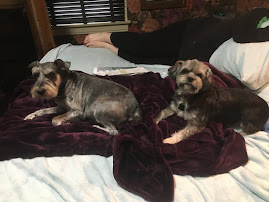
We and the doggies, Iko and Li’l Paws, actually slept in till 11 a.m. this morning.  Iko had climbed onto my chest and was sleeping there, while Li’l Paws cuddled next to my rib-cage.  J brought the dogs up from New Orleans one month ago and left them in our care while he and his family are in northern California.  It’s been a blessing for us.  The dogs fit right in, and Katja and I are happy to have them.  Something brand new at a time when the pandemic has taken so many things away.  I do four walks and 12,000 steps a day with Iko and Li’l Paws, plus lots of rough-housing and petting.  An unexpected benefit is that my blood pressure has dropped from 140/85 to under 120/80.   

Wed., Apr. 22, 2020 
More people in our Ludlow Ave. business district are wearing masks.  I’m going to guess 50%, more for solo walkers, less for couples.  I’ve taken to wearing my blue bandana when I go into stores, but pull it down when I’m out on the sidewalk where I maintain physical distance.  I find all of this distressing.  In the beginning days of the pandemic, my sense was that strangers were being more friendly to one another, exchanging smiles and hellos, encouraging words.  Now people spread as far apart as possible and avert their eyes.  We are all turning into alien beings. 

Wed., Apr. 29, 2020 
It’s well-known that the novel coronavirus is much more lethal for elderly people.  Age, however, factors in beyond the prospect of dying from the virus.  At age 82 we might have up to ten years or more left to live (if we’re lucky).  However, are our lives going to be radically diminished because of the lingering pandemic?  Will we be wearing masks and keeping away from others in public for the rest of our years?  Avoiding stores and restaurants?  Right out our quality of life is seriously diminished.  I’m hopeful we’ll be able to recover some portion of it without having to risk illness and death.   

Fri., May 1, 2020
I woke up this morning with a feeling of dread.  Laying there, it dawned on me that it had to do with social isolation.  Up until recently I’ve been active member of five groups that met weekly: a writer’s group, two writing classes, two group exercise classes.  Plus going to a variety of events when we were part of big groups, e.g., concerts, musical theater, opera, art exhibitions, the zoo, etc.  Now all of that’s gone, at least for the foreseeable future, and Katja and I spend nearly all of our time by ourselves.  I never think of myself as a particularly social person, but now even I am feeling socially deprived.  

Tues., May 5, 2020
Katja’s crown on a front tooth came out, and the dentist’s office, just reopened, was able to see her the next morning.  New age dentistry was upon us.  We waited in the car, rather than the waiting room, till a masked staff member came out to escort Katja in while maintaining a six-foot distance.  Katja wore her mask too.  They took her temperature, asked her questions, and she cleaned her hands with Purell, washed her hands in the sink, and soaked them in Lysol for 30 seconds.  The dentist in his protective equipment fixed her up in half an hour.  We headed for home, nervous about having been out in the contaminated world.  

Thurs., May 7, 2020
What groups are experiencing disproportionate deaths during the pandemic?  People over 65, particularly those with underlying medical conditions like heart disease or cancer.  Health care workers.  African-Americans, Hispanics, Native Americans.  People in nursing homes, prisons, group homes, immigrant detention centers.  Lower income people and/or those lacking health insurance.  The homeless.  Meat-packing employees.  People who live or work in crowded, high-density locations.  For the most part, the disenfranchised members of our society.  

Sat., May 9, 2020
Usually I try to find something humorous when I meditate on life, but, along with climate change and the Trump presidency, I can’t find anything amusing about the pandemic.  I googled “COVID-19 jokes” and was surprised to get a number of hits.  Most of the jokes were mildly humorous at best.  Here is my favorite”  “So far my self-isolation life is remarkably similar to my normal life.”  (Too true.)  

Tues., May 12, 2020
Katja is off to her doctor’s appointment to check out severe pains in her hand.  She was excited about going, and I was mostly nervous.  Katja said she would wear her gloves and mask and would be fine.  She said the doctor’s office wouldn’t be open if it wasn’t safe.  I thought to myself that the doctor’s office is opening even though it isn’t safe.  Perhaps I’m overly cautious.  Or maybe Katja is overly risky.  Or some combination of the two.  

Wed., May 13, 2020
Our local newspaper carried the stupidest article about pets and the coronavirus today.  The general theme was that the coronavirus is very upsetting to dogs and cats.  They’re not used to having humans home all day, and it messes up their routines, especially sleep patterns.  Also getting petted so much is stressful and makes pets cranky.  They can get injured from jumping around and playing so much.  Because they’re not confined, dogs and cats are getting into more fights.  I say all this is hogwash.  Our visiting dogs love having the humans with them all day, and they can’t get petted enough.  They don’t get injured jumping and playing (though their humans are more likely to).  All in all, the pandemic is like utopia for pets.  

Mon., May 18, 2020
Today Katja and I took a trip to the Party Source in Northern Kentucky, billed as the nation’s largest liquor store.  It is big, like a Kroger super-store.  But talk about nonessential trips.  We only had three bottles of expensive whiskey left in the house, so that was a seemingly good reason to go.  Sort of.  I picked up a cart at the entrance, and then an employee wiped down the handle with disinfectant.  A stupid system since I was already infected from touching the cart.  I bought more whiskey than usual, either to delay a next trip or to drink more whiskey because of the pandemic.  If we wind up infected, at least we can stay in a stupor.   

Sun., May 24, 2020 
So, does the coronavirus have a silver lining?  I’ve been trying to think of positives that have resulted.  The most obvious is that we have gotten to have two sweet dogs in the house that otherwise wouldn’t be here.  Katja and I necessarily spend more time together, and I think we’re more positive to one another as a consequence.  I’m more in touch by phone and text with several loved ones.  I watch more funny sitcoms on Netflix.  Katja has been cooking up a storm, lots of delicious meals.  I’m more careful about staying well.  On the other hand…   

Tues., May 26, 2020
Our streets have been near-empty at night since the pandemic started, and I walk the dogs in the business district because at least it is well-lighted.  Tonight Lil Paws barked at an apparent homeless man who stepped out of an alley, and he started following us, screaming gibberish at the dogs and waving his arms.  Both dogs started barking wildly and strained at the leash to get at him, which only made the homeless man more agitated as he followed us.  I pulled the dogs into the street and over to the opposite sidewalk.  The homeless man stayed on his own side, but continued to shout obscenities at the top of his voice.  The near-violent episode still makes me uncomfortable.  

Mon., June 1, 2020
Kroger is having its current Lean Cuisine sale (5/$10), so I decided to stock up.  I skipped our nearby Clifton store because I read that three employees had the coronavirus, and I skipped the second closest store in Corryville because Katja said hardly any of the customers wear masks there.  Instead I drove 10 miles to the Harrison Avenue Kroger store on the West side.  About half the customers were wearing masks, and half weren’t.  As an in-store mask wearer myself, I identified with the former group and looked somewhat askance at the latter group.  Though I wasn’t fanatic about it, I think wearing masks when in close proximity indoors is  considerate.  So it was easy to tell the good guys from the bad guys.  In my mind, I imagined that the non-mask-wearers were Trump voters.  Just another example of our society becoming polarized.        

Wed., June 3, 2020 
I can’t believe that it’s already June.  Dr. Amy Acton issued a stay at home order for Ohio on March 23, and we haven’t eaten out or gone to any sort of event since that time.  72 days of “sheltering in place.”  All these days run together, and, even though the reopening process has begun, it’s going to be some time before we’re comfortable venturing out.