Monday, January 31, 2022

WHAT'S ALL THIS FUSS ABOUT THE FILIBUSTER?


 Dear George, 
I’m by no means a political junkie, but I try to keep abreast of the news as best I can. Recently I’ve been confused about all the controversy regarding use of the ilibuster in the Senate. The Democrats are pressing for reform but can’t get consensus in their own ranks. Joe Biden has changed his opinion in recent months. What’s been most confusing to me is how the filibuster is connected to 60 votes being necessary to pass legislation in the 100-member Senate. After some reading I did manage to figure that out. Here’s what I learned about that and other matters. 
Love, 
Dave 

 What is the definition of “filibuster”? The U.S. Senate defines “filibuster” as “the tactic of using long speeches to delay action on legislation.” (11) 

 Where does the word “filibuster” come from? The word derives from the Spanish “filibustero” (“freebooting”), a reference to 16th century pirates who plundered ships and colonies. Its first use in a political sense occurred in the late 1800s when it was an insult directed toward lawmakers who held up legislation by effectively “raiding” the Senate like pirates. (4) 

 When did the filibuster begin in the Senate? The filibuster is not part of the Constitution, nor was it recognized in original Senate rules. The original rules specified that cutting off debate of a motion required a simple majority. The filibuster was accidentally created in 1806 when Vice President Aaron Burr argued that the rarely used majority rule was redundant, and the Senate eliminated it as a housekeeping matter. Though not their intent, the change gave senators the right to unlimited debate, meaning that they could indefinitely delay a bill without ever getting to a vote. The filibuster wasn’t used regularly until the mid-1800s when Southern senators employed the tactic to block debate over abolishing slavery. In order to support the American war effort in World War I, the Senate in 1917 passed the cloture rule which made it possible to end a filibuster with a two-thirds majority. Because a two-thirds majority proved difficult to obtain, the Senate in 1975 reduced this requirement to 60 votes. While a final vote to pass legislation in the Senate requires a simple majority of 51 votes, a supermajority of 60 votes is needed to start or end debate on the bill. Consequently 60 votes has become the minimum needed for most bills to advance to a vote. In a highly partisan, polarized Senate with a 50-50 split between parties, obtaining 60 votes to end a filibuster is often impossible. (1, 3, 16) 

 What’s the difference between “talking” vs.“silent” filibusters? Originally, filibusters involved long speeches in which a senator attempted to block a vote from proceeding by refusing to yield the floor. The longest filibuster ever recorded was by South Carolina Senator Strom Thurmond, whose speech opposing the Civil Rights Act of 1957 lasted for over 24 hours. Since the early 1970s, however, senators have been able to use a “silent” filibuster. Any time a group of 41 or more senators threatens a filibuster, the Senate majority leader, knowing the legislation lacks sufficient support, can refuse to call a vote and instead moves on to other matters. Use of the filibuster escalated dramatically with the availability of the silent filibuster. Of the more than 2000 filibusters in the last century, over half have occurred in the Obama, Trump, and Biden administrations. (3) 

 Are there exceptions to the filibuster rule? Yes, in 2012 Democrats changed Senate rules to enable confirmation of executive branch positions (e.g., Obama’s cabinet) and non-Supreme Court judicial nominees by a simple majority vote. In 2017 Senate Republicans expanded this change to include Supreme Court appointments, enabling President Trump to fill three Supreme Court vacancies over the course of his term. Both changes involve what is known as the “nuclear option”, i.e., changing a Senate rule to pass legislation with a simple majority and overcome obstruction by the minority. (“Nuclear” because both parties saw it as an unthinkable final recourse, much like nuclear war.) “Budget reconciliation” is one such way to get around the filibuster. That is, a bill may be passed with a simple majority if all of its provisions relate to the federal budget. This process was used to pass the Democrats’ $1 trillion spending package to help people struggling during the pandemic (the American Rescue Plan). In addition, the Senate has also exempted certain other types of legislation from the 60-vote requirement, e.g,, certain trade agreements, military base closures, arms sales. (2, 9, 10) 

 What are pros and cons of the filibuster? Pros include the argument that the filibuster makes the Senate more deliberative and prevents hasty legislation from being pushed through without adequate debate. It’s also argued that the filibuster encourages bipartisan compromise, forcing the majority to negotiate a version more acceptable to the minority, thus protecting rights of the minority party. Without the filibuster, the majority party would be able to pass anything for which it could get a simple majority. The major con is that the filibuster has made accomplishing anything in Congress extremely difficult. In effect, it’s argued that the filibuster gives the Senate minority too much power. Additionally use of the filibuster prevents other critical issues from being addressed. In the current congress Republicans have used the filibuster to successfully block legislation on police reform, immigration reform, voting rights, and a host of other measures. Finally, no other part of the government requires a super-majority to pass a law. (7, 15) 

 What are options to reform the filibuster? Six options are evident. First, eliminate the filibuster altogether. (However, ending debate on changing the Senate’s standing rules requires a two-thirds majority, making this change extremely unlikely.) Second, use the nuclear option in which the Senate majority leader would use a nondebatable motion to bring a bill to a simple majority vote. Third, go back to the talking filibuster and require that objectors to a bill be present with one of them speaking at all times. Fourth, shift the burden onto the filibustering Senators to muster the required number of 41 votes to maintain the filibuster (instead of requiring votes from 60 who wish to proceed). Fifth, get rid of the 60-vote hurdle to start debate on a bill but keep it in place for ending debate. Sixth, do not eliminate the procedure altogether, but make an exemption for voting rights legislation and other pro-democracy measures (similar to the existing procedure for budget reconciliation). (3, 5, 14) 

 What is likely to happen with the filibuster? The future is uncertain. Many Democrats see the 60-vote rule as a stranglehold on their agenda, and the pressure to pass at least some party priorities is pushing Democratic leaders to call for filibuster changes. Last week the Democrats brought to the floor a proposal to change Senate rules to force GOP senators to use a talking filibuster in their opposition to voting rights legislation. However Kyrsten Sinema (D-Ariz.) and Joe Manchin (D-W.Va.) opposed the proposed rule change, resulting in its defeat. Nonetheless, there is near-unanimous support for filibuster reform among Democrats, and if they are able to hold the House and add a few Senate seats in 2022, experts suggest that change is likely in the near future. In 2022 the late Senate Majority Leader Harry Reid predicted: “The filibuster is on its way out, It’s not a question of if but when. It may not be tomorrow or six months from now, but the filibuster is doomed for failure. You can’t have a democracy that requires 60 percent of the vote on everything.”  (6, 7, 13) 

 SOURCES: (1) abcnews.go.com, “What is the Senate filibuster?; (2) ballotopedia.org, “Filibuster and reconciliation in the United States Congress”; (3) brennancenter.org, “The Filibuster, Explained”; (4) britannicacom, “filibuster: parliamentary tactic”; (5) brookings.edu, “Filibuster reform is coming — here’s how”; (6) brookings.edu, “What is the senate filibuster, and what would it take to eliminate it?”; (7) cnn.com, “Why Democrats want to change the Senate’s filibuster rules”; (8) filibusterreform.com, “What is a Filibuster and Why Reform is Good”; (9) nbcnews.com, “The Nuclear Option: What It Is and Why It Matters”; (10) nor.org, “Senate Democrats plan a vote to change the filibuster. So what is it?”; (11) senate.gov, “About Filibusters and Cloture: Historical Overview”; (12) theblaze.com, “2 pros and 3 cons of ending the filibuster”; (13) thehill.com, “Democrats say change to filibuster just a matter of time”; (14) thehill.com, “Manchin: ‘Heavy lift’ to change the filibuster through nuclear option”; (15) thinkehevote.com, “Should the Senate Reform the Filibuster?”; (16) usatoday.com, “What is the filibuster?”

Tuesday, January 11, 2022

ARCHIVE: VIC'S PHOTOS #15


Dear George, 
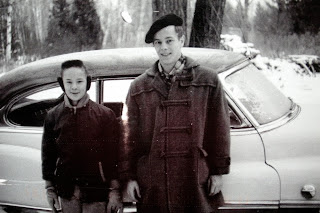
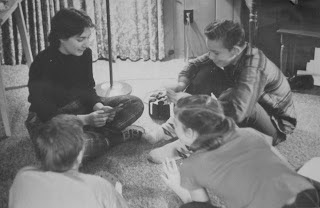
 Here is another archive of my dad Vic’s family photos, mostly taken between the mid-1930s and the mid-1950s. The source for most of them is my brother Peter’s postcard project in which he printed Vic’s negatives in postcard form and sent them to family members. I’m very grateful to my dad for keeping such a good visual record of our family history and to Peter for keeping them alive. 
 Love, 
Dave


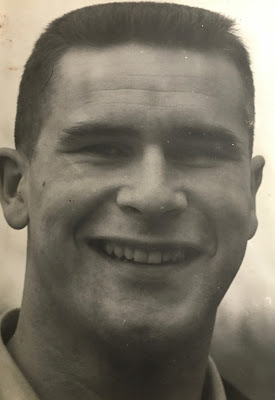
Here’s my dad, Vic L., as a young man from his senior high school yearbook photo.  Vic was born and grew up in Marinette, Wisconsin, across the river from Menominee, with his siblings, Kent, Karl, and Martha.  He graduated from Marinette High and went on to St. Thomas College in St. Paul and the University of Wisconsin where he obtained his law degree.    


Here’s our mom, looking like a bathing beauty.  Given the high hills in the background, this was nowhere near Menominee or the U.P., and it looks like California to me, probably taken in the 1930s before any of us were born.  


Here are my mom and myself on the Green Bay shore, perhaps at Henes Park or the Caley’s Northwood Cove beach.  I wonder if I caught something to put in the pail.  In any case, I look quite pleased.  


Here is our family in 1941, posing in from of the Tourist Information Lodge on Ogden Avenue.  Vic, Dave, Doris holding infant Steven.  Vic would be joining the Navy in two years, and Doris would be at home with Steve and myself. 


Christmas was a major celebration at our house from early on.  I will guess that Steve was 1 and I was 5 in this photo (if so, it would be 1942).  It looks like we got a bonanza of presents, and we children look pretty happy.  


Here’s my dad, looking trim and fit in his Navy uniform, with Steve (maybe 3) and me (maybe 7).  Vic was sent to the Pacific around this time, and we boys missed our father badly.  He spent time in occupied Japan, then returned home in 1946.


These are my parents’ close friends Bill and Florence Caley at their family home on Sheridan Road in Menominee.  Bill was the president of the Signal Electric Company in Menominee, and Florence was a former teacher and homemaker, mom to Bill Jr., Tom, and Bruce.  


The Cedar River is 25 miles north of Menominee along M-35.  We knew it best because Jean Worth’s hunting camp was on the banks of the Cedar, and we took many hikes along the river bank trail on visits.  This was the most beautiful primeval forest that we knew in our youth.   


Jean Worth, one of my parents’ closest friends, was the editor on the Menominee Herald-Leader and a pre-eminent U.P. historian.  Our family had many adventures and good times at Jean’s hunting camp at Cedar River, along with his and his wife Margaret’s three kids, Dooley, Ann, and Jeanne.  


Here is baby Vicki (my sister) and our Irish setter Mike on the window seat in the living room at river house.  Dog and baby seem very compatible, and Vicki loved Mike more and more as she grew up.  


My brother Peter is intently soldering together components of the ham radio set that Vic bought for him to put together.  Though I was away at college at the time, my recollection is that the radio actually wound up working.  Good for kid and father.  


I’m in the background with the bow, and my younger brother Steve is lying dead with an arrow in his chest.  Since, in real life, I was a bully older brother to Steve, I suspect my photographer father was documenting my various travesties.  


Here is an entertaining fire hydrant portrait, probably dolled up for the purposes of this photo.  I don’t know the back story, but I’d have to guess that this is my father’s humorous creation.  


A year older than me, Bill Caley was one of my childhood friends, and our family would visit his  in their Northwood Cove home on Green Bay.  Bill was a star football player for the Menominee Maroons, played football and graduated from Dartmouth in 1958, and established the successful Twin City insurance agency in Menominee and throughout northern Michigan.  An avid sailor, Bill passed away in 2017.


Here is my brother Steve with his motorcycle in the driveway at river house.  As you can tell from his taped up leg and bruised face, he took a nasty spill on his bike and wound up at the hospital.  I was away at college at the time and only heard the gory details afterwards.  


Here are a pair of lovebirds making faces.  Steve and Margie met on spring break during college in the early 1960’s and got married on June 20, 1964, in Margie’s home town, Elmhurst, Illinois.  


Friday, December 31, 2021

BEST CINCINNATI NEWS STORIES OF 2021


Dear George, 
While I grew up in a town of ten thousand, Greater Cincinnati’s population is over 200 times greater, and consequently there are 200 times as many newsworthy events each year. Many of these border on the weird, silly, or perplexing. Here are my favorites for 2021 (note: pseudonyms used throughout). 
Love, 
Dave 

 ANTI-VALENTINE’S DAY 
 In support of people who plan to hold an anti-Valentine’s Day celebration to purge themselves of past relationships, Cincinnati’s Junk King company is sponsoring a “Dump Truck” in suburban Blue Ash. People are invited to dump all reminders of their ex-lovers, from photos and stuffed animals to clothes and jewelry. For each item dumped, Junk King will donate $1 to the American Heart Association. (local12.com, 2-3-21). 

 BAD WIFE 
Linda Cretch, 67, has a parole hearing next month for her life sentence for murdering her husband. Cretch shot her husband, Walter, in the head, then wrapped his body in a rug and kept him in the basement before finally burying him in their backyard. She enlisted the help of her three young children, a neighbor, and her father-in-law with digging the hole on the pretense of fixing drainage issues and planting grass seed. Cretch then went on a spending spree. Her father became suspicious about the backyard hole, dug it up, and found Walter’s body a week later. (cincinnati.com, 2-5-21) 

 FOLLIES OF YOUTH 
A 15-year-old boy is facing criminal charges, accused of secretly recording video footage in a girls’ locker room at his high school. Two girls found the boy’s phone on a pipe in the rafters during a swim meet, and it was recording video. Minutes later the boy came to the locker room and asked if anyone had seen his phone. The girls gave the phone to the authorities, and the boy now faces three counts of attempted voyeurism. He was not successful in capturing any illicit images. (cincinnati.com, 2-18-21) 

CORN FLAKES WITH A KICK 
U.S. Customs officers in Cincinnati reported finding 44 pounds of cocaine-coated cornflakes that had been shipped from Peru to a Hong Kong home. A narcotics detection dog named Bico alerted officers to the package. The corn flakes had an estimated street value of $2,922,400. (wlwt.com, 2-19-21) 

 SALES SURGE 
Cincinnati’s Gorilla Glue company has been in the news a lot, even making Saturday Night Live, ever since Tessie Brawn tried catastrophically to straighten her hair with Gorilla Glue. Local fans worried that the bad publicity would harm the company. Quite to the contrary, Google searches of “Gorilla Glue” are up 50%, and national sales have more than doubled. It’s not clear whether recent buyers are using the product on their hair. (wcpo.com, 2-19-21) 

 BAD MAN UNDER THE BED 
A Cincinnati mother of a teenage girl discovered that a 20-year-old man had been living under her daughter’s bed for three weeks. Jared Wight from Barberton met the girl on instagram. He came out during the night to have sex, take nude photos, and then return to his hideaway. Authorities charged him with three counts of rape and child pornography. (cincinnati.com, 3-18-21) 

 GUN COUNTRY 
According to federal authorities, Addyston police chief Darian LeCour, 65, procured hundreds of machine guns under the guise of testing them for police use, then sold them to two Indiana gun dealers who resold them for a profit. One of the guns with a vehicle-mounted M2 .50 caliber machine gun designed to be used against armored vehicles and low-flying aircraft. Chief LaCour faces 5-10 years in prison on each of 17 counts. (cincinnati.com, 3-26-21)

 MISSING MONKEYS 
Sammy Trinch reported to the police that she saw at least five monkeys across from her home near St. Joseph’s Cemetery on West Eighth Street. Her neighbor Lucy Griffin recorded a video, although the quality is grainy. Trinch said the video shows three monkeys in a tree, but there were two more on the ground. Another woman said she saw one of the monkeys. “I was right here and it was standing over by the garbage can…Its arms were real skinny.” Police responded the next day but only found owls mating — a noise that could sound like monkeys. The Cincinnati Zoo said that none of their monkeys were missing, leaving the monkey mystery unsolved. (wlwt.com, 4-16-21) 

 WORST MOTHER EVER 
 Brittany Gorney, 29, and her boyfriend, James Hamil, 42, are charged with murder, kidnapping, endangering children, and abuse of a corpse. The couple hog-tied Gorney’s three kids, tying their hands and feet, and placing a cloth material in their mouths for a period of hours. Later they drove the three children to the Rapid Run Wildlife area in order to abandon them. Six-year-old James grabbed the door handle as Gorney sped off. When she returned 40 minutes later, she found James dead. They put the body in the car with the other children, kept it at home for 48 hours, then tied it to a concrete block and dumped it into the Ohio River. The body hasn’t yet been recovered. Brittany pled not guilty by reason of insanity. (wlwt.com, 4-26-21) 

 EIGHT ARRESTS THIS YEAR 
Cassandra Richards, 28, of nearby Blanchester was arrested for the eighth time in a year after at an incident at Gold Star Chili. Richards came to the store to demand a refund for food and was asked approximately 20 times to leave the premises. When employees called the police, Richards went outside, opened the drive-thru window, and tried to climb through. She resisted arrest and repeatedly banged her head against the interior of the police cruiser while being taken to jail. Richards already faced nine criminal trespassing charges, one aggravated menacing, one possession of drug paraphernalia, and six resisting arrest. (local12.com, 4-1-21) 

 CICADA CRASH 
Vince Bingram, 20, of New Richmond was driving his 2017 Chevy Cruze along Riverside Drive during the dinner hour when a cicada flew in through his open car window and struck him in the face. Bingram lost control and crashed into a pole, totalling the car. The cicada stayed in the back seat. Bingram was not alone. Cincinnati police reported responding to four different local crashes involving cicadas. (10tv.com, 6-9-21; wlwt.com, 6-11-21) 

 BB ATTACKS 
Sisters Brittany Hepper, 29, and Kelsy Hepper, 28, and driver David Wright, 30, were arrested for shooting at homeless people from their car in downtown Cincinnati and Over-the-Rhine with BB guns. The results were recorded by cameras on the scene which led police to the car. The Heppers had spray-painted the hood of the car to avoid detection, but their effort was unsuccessful. Both Hepper sisters face assault charges. (wcpo.com, 6-9-21) 

 GREAT CINCINNATI CICADA ROBBERY 
This month marks the 34th anniversary of the Great Cincinnati Cicada Robbery. According to police reports, two men walked into the Grand Slam Restaurant brandishing a cicada. They thrust the bug at the cashier Marquita Kellagg, 22, who then fled from her post. Later, after Ms. Kellagg had recovered and returned to the register, she found that it was missing $25. The cicada robbers were never found. (cincinnati.com, 6-19-21) 

 THE MAGNETIC VACCINE LADY 
Republican State Rep. Jennifer Grotch of West Chester helped spread the claims of Dr. Sherry Tenperry when she invited the doctor to testify before the Ohio House Committee in support of “Vaccine Choice”. Tenperry reiterated her claims that COVID-19 vaccines turn people magnetic and “interface” with 5G cell towers. The publicity promoted a slew of social media videos of vaccinated people trying to get spoons to stick to their noses. (citybeat.com, 7-15-21) 

 OUR NEW HIPPO 
Tucker, an 18-year-old Nile hippopotamus, arrived at the Cincinnati Zoo from the San Francisco. He will be the new boyfriend of 22-year-old Bibi, and they have begun to spend time by the pool bonding and sharing beets, squash, melons, and hay. Male hippos are typically 1,000 pounds larger than females. Also, when pooping, they spin their tails like a propeller and spray feces everywhere. A big mess for keepers in the hippo barn. (wlwt.com, 9-17-21) 

 NEEDS A HUG 
40-year-old Trenton Antonio Fortey of North College Hill was arrested after stabbing his mother multiple times with a kitchen knife while she laid in bed in an apartment. His mother, Vanessa Quarreles, was pronounced dead at the scene. Booked into the Hamilton County Justice Center, Fortey asked Sgt. Marc Drones for a hug. When Drones asked why, Fortey responded, “Because I stabbed my mother.” (cincinnati.com, 12-20-21)


Saturday, December 25, 2021

Tales of Christmas Past


Our family's 1940 Season’s Greetings card (Dave with Santa, V.A.L. photo) 

 Dear George, 
I’ve never re-posted something from my blog before, but, when I looked back over Christmas posts, I decided that my 2012 story covered everything about the holiday I could think of. So here it is again: 

 Dear George, I’ve written about our family Xmases on a couple of occasions.  Those childhood celebrations have to be among the most thrilling times of our lives.  But post-childhood Xmas holidays are important too.  Some elements remain stable over the years, e.g., Santa, gifts, the Xmas tree, “Jingle Bells”, eating too much fruitcake.  But other aspects of the holiday season change dramatically.  Once you reach that post middle-age milestone, you’ve accumulated a lot of Xmases.  Here are a few personal tales that illustrate the striking discrepancies in holiday experiences that can occur as one moves through the life course. 

 I started college in September 1955, so Xmas of that year was the first time that I’d been living away from home.  My freshman hallmate Newt, who was from Walla Walla, traveled to Menominee with me from Yellow Springs. I arranged dates for us for the Holly Hop, the annual holiday dance held at Menominee High.  We all went to dinner first at the Cholette Hotel in nearby Peshtigo.  When Newt tried to pay his bill with an American Express Traveller’s Check, the clerk had never seen such a thing and refused to honor it.  None of us had sufficient cash in hand.  After a lengthy, heated negotiation, the clerk finally reached the hotel owner by phone and reluctantly accepted a twenty-dollar traveler’s check.  Newt, disgusted, decided he had truly entered the wilds of rural America.  After the dance we went and parked under the light of the moon in Henes Park.  A police car pulled up behind us moments later.  Nervous because we were under-age teens with open bottles of beer in the car, I started the car, slowly backed up, and crept through the park at its ten m.p.h speed limit with the police car following closely behind.  We managed to escape without further incident.

 
My younger brother Peter and I in our driveway with my first car (circa 1957) 

 December 1957 was the first time that I didn’t come home at all for Xmas.  I was on a coop job in New York City.  I lived on 163rd St. in Washington Heights, and I decided to spend Xmas eve at an Irish bar in the neighborhood.  After three or four shots of whiskey, I called home to exchange holiday greetings before my speech got too slurry.  A little while later some of the men in the bar decided from my newly acquired accent that I’d recently come from Ireland.  Another guy disagreed saying I sounded more Scottish.  I admitted to being from Scotland rather than Ireland, and, as the questioning from my barmates unfolded, we determined that I had jumped ship in New York harbor and was in the country illegally.  Two of my new Irish friends said that they had contacts in the criminal underworld and that they could arrange to get fake papers to keep me in the country.  At that point I decided that I’d enjoyed enough Irish Xmas cheer and bid my farewells. In 1958 my college friend Arnie P. came to visit our family.  Arnie was from White Plains just outside NYC, and he was curious about visiting the U.P.  He’d jokingly referred to me for some time as coming from Menominee, Mishigas (Yiddish for “craziness”).  A major winter storm moved in as we drove north from Chicago.  Shortly after we’d passed through Milwaukee we were stopped at a state police barricade shutting down Highway 41, the main highway to the U.P.  A policeman explained that the roads were impassable, and all the roads heading north from Milwaukee had been closed except one county highway.  He cautioned us not to risk it, but we decided to try it anyway.  With at least two feet of freshly fallen snow on the ground, we couldn’t see the roadway at all, so I just steered the car straight ahead through the open space between the trees. We rarely saw a house with a light on, and we didn’t see a single other car between Milwaukee and Green Bay.  It was a long, tense, probably dangerous trip, but we did eventually make it.  I think Arnie enjoyed his Mishigas visit.  He and my dad had a spirited debate about the military.  Arnie described his Army Reserve military experience as a thoroughly unpleasant waste of time, while Vic considered his experiences in the Pacific in World War II as the most meaningful of his life.  Their discussion may have marked the beginning of the generation gap.    

 
Arnie P. at river house in Menominee

 Though we’d been dating for two years, Katja didn’t make her first Xmas visit to our house until Xmas of 1959.  Vicki was 12; Peter, 14; Steve, 18.  They and my parents took to Katja immediately, and she to them.  She remembers Peter getting a barbell set for Xmas and embarking on his teenage body-building career. We went with my dad to cut down an evergreen tree on our back lot and then take it to town to have it spray-painted (perhaps yellow or red) at Van Domelen’s auto body shop.  Katja and I walked across the river to Pig Island and spotted a mud puppy through the ice lying on the river bottom, looking like the prehistoric creature it was descended from.  All our extended family came for dinner on Xmas eve, Uncles Kent and Ralph distributing cosmetic samples from the Menominee and Marinette drugstores and bachelor Uncle Karl bringing extravagant gifts from Neenah-Menasha. As she did each year, my mother made a delicious turkey Xmas dinner, topped off with her famous cherry, pineapple, whipped cream molded jello salad.  Katja couldn’t get over the parade of wonderful friends who came through our front door throughout the holidays. All in all, it was a memorable Xmas.

 
Katja playing cards with Dave, Vicki, and Peter (circa 1959)

Katja and I graduated from college and got married in 1960.  That year was our first Xmas in Menominee as a married couple.  The main thing I remember is that my parents turned over their bedroom to us, and I was totally embarrassed to come out in the morning, having spent the night there with a strange woman.  Thanks to my parents subsidizing us, we started flying up to Menominee for Xmas on North Central Airlines, the line of the Grey Goose.  North Central had smallish, propeller-driven planes.  On one of our trips Katja had a bad cold and her ears felt like they were going to explode.  She asked the stewardess if there was anything she could do, and the stewardess recommended swallowing deeply.  Five minutes later, the stewardess came back and asked Katja if she were feeling better.  She said she was, and the stewardess explained that the pilot had dropped the plane’s elevation by 3000 feet.  We decided North Central was the best. Our son J was born in September 1969, and we made a big deal about Xmas from the outset, even though J was only three months old.  Once he reached two or three we’d take him to a big local toy store to look over the merchandise (in order to get clues for Santa).  J would get very excited seeing all the wonderful things, but after twenty minutes he would invariably wind up in tears because of the over-stimulation.  I always enjoyed Xmas morning at least as much as J because I got to play with the new toys too.  Usually I was more of a playmate than a dad.  One December I went to the Digby tennis courts and cut down a sumac tree on the forested hillside.  I made dozens of paper mache ornaments over balloons with painted faces, hanging them from the sumac’s branches.  It started out as our Xmas tree, but became a permanent year-round decoration in our dining room.  As J got older we began making snowmen in our side yard each Xmas, then switched over to snow rabbits.  They were the hit of the neighborhood.

 
J in his Xmas cowboy outfit (circa 1973)

 With our families living in opposite directions, we decided in the early 70s to go to Menominee each summer and to Katja’s family in Philadelphia and New York City each December.  Katja’s parents, Helen and Buck, lived on Sherwood Road in west Philadelphia, and her sister Ami and brother-in-law Bruce lived in Manhattan.  We’d drive the turnpike to Philadelphia four or five days before Xmas.  We’d typically do the Art Museum, the Franklin Institute, the Italian market, Philly cheesesteaks at Pat’s, the Wanamaker tearoom, supper at Howard Johnson’s, a great G.I. surplus store, Bookbinder’s downtown bookstore, Katja’s shopping expedition to the suburban Lord & Taylor’s, sometimes a visit to the zoo, sometimes Independence Hall.  Bucks’ relatives would have a big family gathering at Aunt Miriam and Uncle Moe’s, along with Aunt Beatrice and Uncle Joe, Aunt Sophie and Uncle Nate, Katja’s aged grandmother, and various cousins.  Katja’s parents didn’t celebrate either Channukah or Xmas, so we were always eager to move on to New York for Xmas eve.    
Buck and Helen enjoy a holiday hug in their kitchen on Sherwood Road (ca. 1972) 

 We’d set off on the New Jersey Turnpike on the morning of Dec. 24th in order to exchange gifts with Ami and Bruce at their Upper West Side condo.  Bruce, J, and I would go out on Broadway and bring home a Xmas tree (always over-priced by Cincinnati standards).  Katja and Ami were both extravagant gift-givers, and they’d shower us all with numerous presents.  Ami would usually invite friends for Xmas eve or Xmas day dinner, and we’d get together with Bruce’s Bronx family as well.  We’d go to the Met, to MOMA, and to the Whitney or the Guggenheim.  Ami and Bruce would treat us to dinner one night at a cutting edge Manhattan restaurant.  We’d do Rockefeller Center, St. Pat’s, Soho, Canal St. and Chinatown, the East Village, sometimes South St. or the Battery, Madison Ave. galleries, Times Square (mostly of interest to J and myself), the Metropolitan Opera, and one or more Broadway shows.  As J got older, he and I would spend a lot of time walking about the city while Katja and Ami went shopping at Bloomingdale’s or ABC Carpets and had lunch at the Grand Central Oyster Bar.  J loved the city so much that it was the only place he wanted to go to college, and he wound up at Columbia as a result of our Xmas trips.  On one of our visits our car trunk was broken into and all our Xmas gifts were stolen.  We went to the district police station to report the theft.  The officer on duty explained that they didn’t investigate car robberies, saying simply, “Welcome to Fun City.”  Another time J and I were walking along the edge of Central Park East in the 90s, talking and laughing, and I noticed an attractive woman in a fur coat watching us and smiling.  I looked more closely, and it was Jacqueline Kennedy Onassis.  I blushed a bit and looked away, but was privately pleased that Jackie seemed to be enjoying our father-son camaraderie.
Ami at Xmas in NYC (ca. 1973)  

 When Katja’s parents moved to Cincinnati in 1992, we began staying home over Xmas vacation.  Our son J and daughter-in-law K would join us occasionally, but more often they were away in Michigan, New Orleans, or California, and we’d communicate by phone and electronically. When we’ve been in town over the years, our long-time friends Eleanor and Sam Minkarah have made us a part of their family for the holidays.  Their son Jay and his kids and daughter Randa and her spouse come in from New Hampshire and Washington state, and it’s a festive gathering with a Xmas eve cocktail party and a family dinner on Xmas day.  This year (2012) Randa held a  50th birthday dinner party for her brother at the Cincinnatian Hotel.  Jay was ten when we first started sharing Xmas with their family, so it was a noteworthy and nostalgic occasion.   

 
Katja with the Minkarah women: Maria, Randa, Grace, Katja, Eleanor (2011) 

 Looking back, Xmas has been a significant event every year since we were teeny kids. What amazes me on reflection is the enormous changes that we’ve experienced over this time span – running the gamut from being little kids in the family awaiting Santa to being young adults, honeymooners, then parents, empty nesters, and now grandparents ourselves.  I’m glad we’ve hung around to enjoy it all.  Despite the constant change, I’m pleased to say that all our Xmases have been good in their own way.  That’s what the spirit of Santa will do for you.  
Love, 
Dave

Saturday, December 11, 2021

Idiot or Heartless Wretch?


Dear George, 
The other night I took our dog Iko out for his late evening walk. Earlier I’d brought the trash and recycling bins out to the curb for morning pick-up. As I came down the driveway I noticed a middle-aged man in a leather jacket and sporty cap holding his cell phone flashlight and going through envelopes, letters, and papers from our recycling bin. When I approached, he turned and walked away. Iko and I headed in the opposite direction. 

 I was puzzled for a second, but then it dawned on me that he was looking for correspondence containing personal information, whether for identity theft or some other nefarious purpose. While I very rarely do so, I was sufficiently annoyed that I went to our “NextDoor” neighborhood website when I got home and recounted the incident. I titled my message “Recycling Thief”. It read, “‘Tonight there was a middle-aged man rummaging through our recycling bin. I assume he was looking for credit card information or the like. I mention this to remind people to be careful of putting items in their recycling that might have personal information.” 

 My post was apparently provocative, garnering 144 comments in the first 48 hours. Perhaps this is a record for Next-door, at least for our neighborhood. Five of the responses agreed with my account and thanked me for sharing my tip. The other 139 couldn’t seem to decide if I were an idiot or a heartless wretch. The vast majority pointed out that I was totally mistaken in my interpretation and that this was simply a person who was collecting aluminum cans to resell for a few pennies apiece, a commonplace and harmless activity. I’m not sure why 75 or 80 people had to make the same point, but everybody wanted to get their two cents in. One NextDoor member said that I’d written “the paranoid post of the day”. Some reported knowing the man — “a kindly old gentleman.” Many added that the man was probably a homeless person. Aluminum can proceeds would help him find shelter in this freezing weather or get something to eat, with the added implication that I was a heartless wretch. One person said if I couldn’t tolerate someone collecting aluminum cans I’d discarded, perhaps I should think about contributing to a homeless shelter. 

 The vast majority, of course, rejected my label of a “recycling thief”. Many said that going through people’s recycling and trash containers is completely legitimate and legal. Once trash is put at curbside, they said, it is in the public domain and open to anyone. Several respondents proudly disclosed that they are “dumpster divers” themselves. A few better-informed readers cited a Cincinnati ordinance which defined removal of items from trash and recycling bins as illegal. But even when people were aware of the law, they said that it is rarely enforced, and one should simply assume that strangers will go through one’s trash. 

 I had thought of my post as a public service announcement, reminding people to be careful about their recyclables, but hardly anybody seemed to take it this way. Several commented that only “idiots” would put valuable personal information in their recycling bin, and many gently explained to me that I should buy a shredder and shred my personal documents. (Actually we have a shredder but we haven’t used it since it got filled up several years ago.) One person conjectured that I seem to be the sort of person who puts valuable personal stuff in my recycling bin. Another said that if I am putting credit card information info in the recycling bin, I deserve to have it stolen. 

 Aside from acquiring a community reputation as a nitwit, I’m not losing too much sleep over my online experience. Most of the replies were not hostile, presumably because people simply thought me naive or stupid. And this sort of collective outcry happens all the time on our NextDoor website. Actually the hoopla was largely my own fault. If, instead of saying the man was “rummaging through our recycling bin, I’d said something like “going through envelopes and letters”, a lot of confusion would have been avoided. Having been burned once, I’m ambivalent about posting anything on our Next-door website in the future. There is always the risk of being verbally molested by a horde of strangers. On the other hand, perhaps I could say something that would repair my miserable public persona. 
Love, 
Dave

Friday, December 3, 2021

THE NEEDLE-EATING DOG


Dear George, 
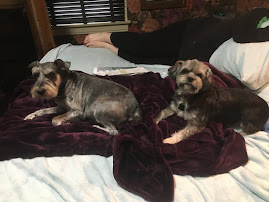
Iko has lived with us for twenty months. He’s a Miniature Schnauzer, about nine years old and twenty-two pounds, full of spunk and sweet as can be. He spent his growing up years in a brothel on Tulane Avenue in New Orleans. Then he escaped, became a street dog for a while, wound up in the pound, and was rescued by our son Justin and his family. When the pandemic began, Justin brought Iko up to Cincinnati for safekeeping, and he’s been here ever since. He enjoys his walks, during which he barks at every dog and person in sight, and is particularly happy to have his daily wrestling match, rolling on his back and feigning fearsome bites to my forearm. 

 Iko has been in good health until a recent night-time walk when he squatted 6 or 7 times but was unable to produce anything. The next day he started vomiting and having diarrhea, became disinterested in food, and slept most of the time. No wrestling even. Katja said she was going to call the vet, but I tried to dissuade her. “The vet costs a fortune, and this is just a routine bug that will go away in a day or two.” Accustomed to my frugality, Katja paid no attention and soon we were on the way to the animal clinic. 

 We sat in the waiting room while the vet examined Iko. After an hour he came back out. They’d done a lot of tests, taken X-rays, and given Iko intravenous fluids. The vet said his symptoms looked like pancreatitis which is common to Miniature Schnauzers, but the X-rays had also revealed a needle in his abdomen. He might have swallowed it recently or it might have been there for a long time. He asked Katja if she were a seamstress, but we couldn’t imagine when or where Iko had found a needle to swallow. The test results for pancreatitis were due back in 24 hours, but the vet was concerned that the needle could pierce his stomach wall and Iko could bleed to death. He recommended that we take him to the emergency 24/7 veterinary hospital where they have more sophisticated equipment that would pinpoint the problem. 

 The 24/7 vet hospital was out in the suburbs. A big elegant place, designed to impress pet owners like us. The technician took Iko in for a sonogram, and Katja and I left for supper at LaRosa’s. The vet had finished by the time we came back. She said that the earlier X-rays might have looked like a needle in Iko’s abdomen, but, in fact, the sonogram showed that he had two needles and they were embedded in the muscle in his back. She thought the needles might have broken off during vaccinations and been in his back muscle for a long time. They weren’t causing any problems and could stay there forever. She agreed with our neighborhood vet that Iko’s symptoms looked like pancreatitus. She offered to keep him for the night, but it would have cost between $1500 and $2000. Given $800 in bills already, we opted for tender loving care at home. 

 I googled “pancreatitis” on the computer. It scared the wits out of us. While the symptoms appear to be ordinary, it’s an inflammation of the pancreas that can be life-threatening. In the worst cases, the enzymes produced by the pancreas actually begin to digest the pancreas itself, causing extreme pain to the dog and ending in an excruciating death. 

 The vet called the next morning with Iko’s pancreatitus test results. The normal range is 200 or below. Iko’s reading was 1000, the highest the vet had ever seen. He prescribed pills for pain and dehydration and recommended a bland diet of white rice and chicken. The vet said that if Iko’s diarrhea continued, we should take him back to the hospital immediately. 

 We were on pins and needles for a week, but Iko improved a little bit each day, and I’m happy to say that he now seems back to normal. He’s eating a veterinarian-prescribed low-fat diet ($50 a bag), his diarrhea is gone, and he’s pretty much his perky self again. Such a relief. I learned two things from the episode. First, I should stop worrying about spending a lot of money for a pet’s health. It’s worth it. Second, my spouse has better instincts in these matters than I do. 

Love, 
Dave

Monday, November 22, 2021

A LETTER TO AARON RODGERS


Dear Aaron, 
I’ve thought about writing a letter to you in the past. I grew up fifty miles north of Green Bay, and, aside from God, family, and country, people in my home town worship the Green Bay Packers. I followed Don Hutson in grade school, cheered rabidly for the Packers during the Lombardi Super Bowl era, and have been thrilled by the team’s resurgence during Brett Favre’s and your tenures as quarterback. In addition to your world-class athletic skills, I’ve also respected you as an intelligent, articulate person with good values and a sense of humor. Needless to say, I’ve been confused and disappointed by the recent uproar regarding your choice to not get a Covid-19 vaccination. You’ve expressed your desire to have a conversation about the issue rather than continued confrontation and hostility. Hence, this letter. 

Here is my understanding of the situation. While the NFL encourages vaccinations, it does not require them of players Approximately 5% of players have chosen not to get vaccinated, and there hasn’t been much hullabaloo about this. According to NFL rules, unvaccinated players are required to be tested daily and to wear masks when in public situations. When you were asked if you were vaccinated on the weekly radio show on which you appear, you replied, “Yeah, I’m immunized.” As you subsequently acknowledged, this was a misleading statement since you haven’t been vaccinated with any of the approved Covid-19 vaccines. Regarding mask-wearing, you’ve said, citing Dr. Martin Luther King Jr., that you consider this to be an unjust rule and have deliberately chosen not to follow it in various situations. 

 The most widespread criticism of your behavior has to do with judgments that you lied to the public about being vaccinated. While you claim that you were telling the truth that you’ve been immunized (by an alternative homeopathic treatment), you have acknowledged and taken responsibility for misleading people with your statement. Personally, I think you made an unfortunate mistake in the radio interview, and owning up to it is the best course available. (You should have just said that you’d chosen to do an alternative treatment.) 

 A further issue is the nature of the treatment you have undergone. The main component is ivermectin, an anti-parasitic drug used to treat intestinal worms and lice in horses. However, the Food and Drug Administration has not authorized ivermectin for use against Covid-19, stating that there is no evidence of its effectiveness in combatting the disease and that use of large doses in humans can cause comas and seizures. You indicate that a major influence in your decision was advice from podcast host Joe Rogan, but, of course, Rogan has no medical expertise. Nor does Fox News host Laura Ingraham, another major proponent of ivermectin. From a medical and scientific standpoint, there don’t seem to be adequate grounds for your decision. Consistent with this, the NFL rejected your appeal to have your alternative treatment accepted as a substitute for Covid vaccines. 

 You’ve also argued that “personal health decisions in my opinion should be private.” While this sounds almost self-evident, it’s also the case that, with a world-famous figure like yourself, health decisions can have significant consequences for teammates, loved ones, the many persons you come into contact with, and millions of fans. That’s neither personal nor private. One concrete example is your being excluded from the Kansas City game because of a positive Covid test, a Packers loss which the team might well have won if you’d been vaccinated and eligible to play. You’ve stated that “I’m not, you know, some sort of anti-vax, flat-earther.” But your public statements have given impetus to the “anti-vax, flat-earther” movement. According to recent CDC data, unvaccinated people are 6 times as likely to contract Covid-19, 10 times as likely to be hospitalized, and 11 times as likely to die from it, compared to vaccinated people. Recommending and modeling non-vaccination to the general public by someone of your celebrity increases the likelihood of infection, hospitalization, and death in the general population. 

My sense is that you’ve been surprised and distressed by the media controversy regarding your health choices and would have much preferred that these matters had remained private. It’s as though you’ve been caught up in a furor not entirely of your own making, and I sympathize with that. What to do about it is a puzzle. You could, of course, opt to be vaccinated and make that information public. I’m struck by the fact that none of your public statements advocate vaccination for the general public. Since your own reasons for an alternative treatment are idiosyncratic (i.e., your report of an allergy to an ingredient in the Pfizer and Moderna vaccines), I personally think that you could draw upon the great bulk of scientific information available and encourage others to get vaccinated. I hope you consider this possibility and change tactics. 
Sincerely yours, 
David L

Friday, November 5, 2021

OPENING NIGHT


Dear George, 
Such a lucky break — I checked my calendar late Saturday afternoon and was shocked to find that we had a symphony concert in just ninety minutes. Katja was sound asleep and she had had no idea either. It always takes me less time to get ready, and I paced the floor, getting more and more jittery. Finally we left a little before 7:00 for the 7:30 concert. I checked out the Washington Square parking garage across from Music Hall, but they were charging $15 (a violation of my principles). Because Katja’s foot was aching, I dropped her off at the front entrance and headed around the block to Central Parkway where the old parking garage costs $10 (still annoying). I always park on the top floor there because you can just drive down the ramp and go right out the 12th St. exit. 

I locked the car and hurriedly walked two blocks to Music Hall. A volunteer at the door asked for my vaccination card and photo I.D. He carefully checked my photo even though my face was covered by my mask. Next I went through a metal detector to get screened for revolvers and knives. The guy asked if I had an umbrella under my raincoat, but I said no. A third man scanned the bar code on my ticket and I was finally cleared to enter. The lobby was filled with chatting symphony fans, but, because all the people were wearing masks, no one looked familiar to me. I couldn’t tell who was pretty or handsome, smiling or frowning, young or old. A strange scene. 

Katja had already gone to her seat. Our tickets were for the third row, the closest we’ve ever been. We had to look upward toward the stage, we could only see the front line of performers, and the music was pretty loud. At precisely 7:30 conductor Louis Langrée came out to welcome the audience. This was the first weekend of the new 2021-22 season, and he was exuberant because it has been nineteen months since the orchestra has given a performance. The audience was excited too, and Louis got a lengthy round of applause. 

The guest artist was the prize-winning pianist Drew Pearson, and he paired with Symphony Concertmaster Stefani Masuo for a rousing piano-violin duet rendition of Brahms” “F-A-E” Sonata. Then Pearson was the soloist with the orchestra for an avant-garde fantasy by contemporary composer Andrew Norman, and the orchestra wound up with Brahm’s Symphony No. 3 in F major, also filled with fire and explosions. Katja is the classical music lover in our family, and I am more like a gigolo who serves as her male companion at high culture events. Perhaps because of our long absence, I found the music more exciting than usual and look forward to our next outing. 

At the intermission the man sitting next to me asked if I had been bothered by the radio broadcast. Apparently somebody sitting behind us had been listening to the Ohio State football game via ear pods throughout the performance. I hadn’t heard it myself (an example of how bad hearing can actually be to one’s advantage), but I agreed with him that this was pitiful. (As a University of Michigan alumnus it also confirmed my worst stereotypes of Ohio State fans.) 

After the concert Katja and I chose a pick-up spot in front of Music Hall, and I went to get the car. I drove down the ramp, but to my horror the exit barricade was closed, and no one was moving. The line of waiting cars extended back as far as I could see. A woman got out of the lead car at the exit and, with a strenuous effort, managed to shove the gate arm up and hold it there while her husband drove through. Then the arm came back down, and the next car was stuck. The car right in front of me gave up, got out of the line, and headed back into the parking garage. Certain that I’d never get out the 12th Street exit, I followed him. We made some right turns and left turns and eventually got back to the main entrance where we’d come in before the concert. Happily, that gate was wide open, and the other driver and I exited onto Central Parkway. I didn’t see any cars following us, and there were no parking employees anywhere. I wonder how many hours it took people to get out. 

Katja was in a happy post-concert mood when I picked her up. I was a bit nervous about having spent two hours at our first mass gathering since the start of the pandemic, even with required vaccinations and masks. Despite my worries, it was another baby step toward normality for us and a huge, life-changing step for our orchestra and the Music Hall staff. 
Love, 
Dave