Thursday, July 21, 2022

ANOTHER OF THOSE BIG BIRTHDAYS


Dear George, 
I remember thirty years ago when Katja and I met with our financial advisor to plot out our remaining years. He said that our financial plan was based on a life expectancy of ninety. At the time, that seemed ridiculous. Who lives that long? Now, with my eighty-fifth birthday having arrived today, it doesn’t seem so preposterous. Since two-thirds of my 1937 age cohort are no longer with us, I consider us fortunate. I’ve no idea how I’ve stayed healthy this long, but I guess I’ll continue doing the same things. I think solving Wordle each morning helps. 

When I was young I viewed old age with trepidation. My only direct experiences were with my grandparents in their final years, and that was depressing. My grandmother had a major stroke and was bedridden for several years before she finally passed away, and my grandfather became very frail and unable to carry out most everyday functions. Years later my mother had severe circulatory problems and couldn’t walk toward the end of her life, while my father developed Alzheimer’s. 

My experience of aging nowadays is very different, mainly because of attending classes at OLLI (the Osher Lifelong Learning Institute). Most of my fellow students are in their seventies and eighties, and they are a robust group — bright, articulate, active, engaged. Every now and then it dawns on me that this isn’t a representative sample — clearly drawing from a healthiest and well-educated subgroup of elders. However, it does leave me with a positive, nonstereotypic experience of “old age”. 

Eighty-five is a big point of transition since gerontologists consider this the beginning of the “Oldest Old” category (85 and over). I’m not convinced about that. Aside from moderate hearing loss, I feel pretty much the same way that I did two or three decades ago. True that lots of people at 85 show serious signs of aging, but there’s also lots of variation. According to my doctor, I don’t look 85 and I don’t act 85 (although he’s careful to remind me that I actually am 85). 

I had planned to go to the Warren County fair with Katja to celebrate my birthday. That was my choice because county fairs were the most exciting events of my childhood and adolescence. Unfortunately today’s 90+ heat advisory put a crimp in that plan. I attended my poetry group this morning, and we will go to a good seafood restaurant for dinner tonight. All in all, a perfect way to start my year number eighty-six. 
Love, 
Dave

Saturday, July 9, 2022

AN IMAGINED CONVERSATION WITH ARNIE EPPO


Dear George, 
It seems like every ten years or so I run into Arnie Eppo, one of my high school friends who lives in lower Michigan. Arnie’s always curious about my goings on and asks me lots of questions. Here’s a sample of how our conversation goes. (This, of course, is recreated from memory and imagination, so some parts may reflect a real-life conversation more than others.) 
Love, 
Dave 

 Arnie (A): So you’ve been retired for quite a while now. 
D (Dave): It’s actually been thirteen and a half years. Whew! That’s gone by so quickly. I’m trying to figure out some way of slowing time down. 
 A: I know the feeling. How has it gone so far? 
D: At first I would usually say that I liked working better, mostly because I missed contact with colleagues. But now I find retirement much more relaxing and less stressful. No bosses, no demands, I enjoy lots of freedom and spend my time doing things that give me pleasure. 
 A: Do you miss teaching? 
D (laughs): Actually I never wish that I were back in a classroom. I always found teaching stressful, even though I think I did o.k. at it. Every now and then I walk past my old classroom and feel a momentary pang of nostalgia. But it’s very momentary.
 A: I know you’ve also been married over sixty years. That’s pretty amazing. 
D: It is amazing. Katja’s really the first girl I ever dated seriously. I knew from the minute I saw her that she was the person I wanted to marry. It was a rocky process though. I was such a shy, introverted kid. Katja’s parents were certain that we would get divorced, and her father told my father that on the night before our wedding. My dad told us in no uncertain terms that nobody in our family had ever been divorced (and that no one ever would). It made a big impression. It probably helps account for why we’ve made it through sixty-two years. 
 A: You and Katja must share a lot of similarities to have stayed together so long. 
 D: If anything, it’s probably that old truism that “opposites attract”. Katja’s from Philadelphia; I’m from Menominee. She went to a prestigious big-city college prep school; I went to a small-town public high school. Her parents were staunch Roosevelt Democrats; mine, Eisenhower Republicans. She grew up with classical music; my family listened to big bands and jazz. Katja is very free with money; I’m very stingy.  She's very outgoing; I'm very introverted.  We did, of course, both go to Antioch College, we agree on most political and social issues, and we were both attracted to academic careers. But basically we’re more different than we are similar. 
 A: It’s sort of strange that you wound up going to Antioch, such a hotbed left-wing politics. 
D: It is strange. My conservative parents picked out Antioch for me based on conversations with an Antioch alumnus who worked at Ansul Chemical Co. in Marinette. But I don’t think they had any idea of the college’s political orientation. The alumnus reassured my mother that that there was a strong Greek system at Antioch (totally untrue) with ballroom dances practically every weekend (equally untrue). Needless to say, my first year at Antioch involved a total culture shock. I think I was probably the only student from the U.P. to ever attend Antioch. 
 A: Are you glad you went there? 
D: Definitely yes. It was an eye-opening experience, and my fellow students were exceptional – intelligent, value-oriented, creative. In many ways the most exceptional people that I’ve met during my life. Antioch, without a doubt, changed my life in important ways and shaped all that was to come, including my marriage, my career, and even our long-time residence in Cincinnati (which I picked in part because of its proximity to Yellow Springs). 
 A: So you met Katja at Antioch? 
D: Yes, I first saw her across the lawn at a freshman mixer, and she was so pretty and gregarious that I decided on the spot that she was the girl I would like to marry. I was much too shy to say hello, but I watched her from a distance for the next year and a half. By chance, I was on my first coop job in Madison, while two of my freshman hallmates and Katja were working at mental hospitals in Milwaukee. I came down for a weekend with my friends, met Katja, and things just developed from there. 
 A: How did you win her over? 
D: I can’t imagine. It’s amazing. Katja was very popular, and she told me at one point that 18 of our college classmates had proposed to her during her freshmen year. Not all of these proposals were serious, but some of them were. On our first date I told her that I’d thought that she was the person I’d like to marry the first time I saw her. Katja got really angry and said that that was the worst line she’d ever heard. I, of course, was completely serious. 
 A: Then what happened? 
D: At the end of our three-months stays in Madison and Milwaukee, I invited Katja to come home to Menominee with me over quarter break, and she accepted. I think she didn’t want to go home to Philadelphia. In any case, she was very taken with my parents and their friends, and they with her. My mother told her that she was the first girl that I had ever brought home. Katja wondered what she’d gotten herself into. 
 A: How about your son J? 
D: He probably thinks we’re sort of a weird couple. Like his mom, J is more gregarious and has better social skills than I do. He likes to travel like Katja does. Temperamentally, he’s may be a little more like me. As a teenager J would sometimes say that he’s a sort of balance between the two of us and that it wasn’t easy for him to integrate these opposite influences. 
 A: So, unlike your parents, you wound up having just one child. 
D: Yes, I think that was mainly Katja’s preference, though I went along with it. J often wishes that he had siblings, although when we asked him as a kid, he wasn’t interested. There were some advantages to having a solo child. In contrast to my own family which was sharply divided into separate parent and child sub-groups, Katja, J, and I operated pretty much as a cohesive threesome, and I think J wound up a lot more mature as a result from all that adult interaction. When J went off to college, he went sort of wild in immersing himself in his peer culture, something he’d never done in the process of growing up in Cincinnati. 
 A: Now, of course, you’re grandparents. 
D: Yes, that’s the biggest life change for us in our older years. Our grandchildren, A and L, are very bright and interesting. They’ll turn fourteen in September, are a lot more mature than we ever were at that age, and are doing very well in school. I’m sorry that they’re so far away in New Orleans, and the pandemic has put a crimp in our traveling. I hope we’ll do more trips during the coming year.

Monday, June 27, 2022

What's the Scoop on the Real Seniors?


Dear George, 
I have a big birthday coming up next month. Eighty-five — the biggest number so far. Since 66% of people born in 1937 are no longer with us (1), I should appreciate being around to celebrate this event, and I do. However, it’s still a bit unnerving. Gerontologists call the “85 and over” age group the “old old” or the “oldest old”, a life stage associated with risk of degenerative disease and disability, loss of autonomy, and physical dependence upon others. I prefer to rely upon a British radio station that asked their 85 and older listeners to vote on a new name for people in their age bracket. (15) The number one choice was “Real Senior” (40%), followed by Long Lived” (26%), Wisdom Warriors (12%), and the “Very Oldies” or the “Venerables”. I googled “Real Senior”, and the first thing I got was an organization that helps people remain in their homes as long as possible. (7) Not too reassuring. Then I tried “age 85”, “85 years old”, “oldest old”, etc. Here are some of the things I found. 

 The first thing I noticed confirmed my belief that statistics lie. Most research studies and reviews use “85 and over” as an age group category. However, “85 and over” has an interesting feature. All the earlier age groups are typically in five-year increments, e.g., 40-44, 55-59, etc. “85 and over”, though, is open-ended. Like we’ll just lump all these ancient people into a single category, whether they’re 86 or 102. In one empirical study the researchers reported that members of the 85 and over category in their sample ranged between 85 and 103. That’s a big spread. Looking at census data, about 66% of 85 and overs are 85-89, 26% are 90-94, and 8% are 95 or older. Consequently. “85 and over” (hereafter 85+) is broader and less precise than other age categories and may not be particularly descriptive of persons who are 85. 

 The second thing is that researchers and reviewers tend to focus on negative attributes of the Real Old, i.e., disease, disability, death. However, there are always alternative ways of viewing any given finding. For example, one research team found that 37% of 85+ people have severe visual impairments. (9) This is, of course, an important and distressing finding. Note, however, that we can conclude with equal validity that 63% of 85+ people do not have severe visual impairments. Below I’m going to report some of the research findings I’ve run across on Real Seniors, but turning the reported results around to state them in an optimistic direction. 

*80% of 85+ people live in their own home or apartment, and only 8% live in nursing homes. (12) 
*A British study found that 59% of 85+ respondents reported feeling no more lonely than they had a decade previously. (5) 
*By age 85 80% of people show no meaningful loss of muscle mass and strength. (6) 
*About 50% of adults over age 85 do not have hearing impairments. (6) 
*82% of people 85 and over do not report clinically relevant depressive symptoms. (8) 
*About 20 out of 100,000 people 85+ commit suicide in a given year (0.000002%). (11) 
*Despite decreasing thirst perception with age, 59% of 85+ people drink sufficient liquids daily. (17) 
*According to Webmd, a study of 1,299 women 85 years and older found that 77% do not have mild cognitive impairment and 82% do not have dementia. (16) 
*47% of persons age 85+ report no difficulty performing any daily living activity. (8) 
*A U.S. survey study found that 51% of elderly persons (85+) did not have a need to be driven places, 65% did not need support in taking care of their residence or assistance in shopping, and 77% did not need assistance with housekeeping activities. (14) 
*In 2018 the percent of adults 85+ who did not need help with personal care was 79%. (2) 
*A study of 125 older adults (85+) found that, compared to younger age groups, they score as high or higher on scales measuring resilience, coherence, purpose in life, and self-transcendence. (13) 

 Here’s my way of summing this up: A majority of people in the 85 and over age bracket in the U.S. live in their own homes or apartments; do not have hearing impairments or severe visual impairments; do not show muscle loss; do not exhibit clinical symptoms of depression; have a near-zero probability of committing suicide; do not need assistance in driving, shopping, housekeeping activities, or personal care. While any given individuals might not show all of these attributes, it seems clear that a hefty number of adults 85 and over function effectively in the world, physically, mentally, and socially. So much for the negative stereotypes of the “oldest old”. The next question is how one can age successfully as a Real Senior. I hope to get back to you on that. 
Love, 
Dave 

 SOURCES: (1) 247wallst.com, “How Many People Are Still Alive From the Year You Were Born,” 7-31-21; (2) sci.gov, “2019 Profile of Older Americans,” May 2020; (3) apa.org, “A snapshot of today’s older adults,” Sept. 2021; (4) assets.aarp.org, “Chronic Conditions Among Older Americans,” undated; (5) cambridge.org, “An investigation into the patterns of loneliness and loss in the oldest old,” 10-30-15; (6) frontiersin.org, “Age-Related Disease and Clinical and Public Health Implications for the 85 Years Old and Over Population,” 12-11-17; (7) help4seniors.org, “Stay Independent at Home,” undated; (8) imaging.org, “Read how IOA views aging in American,” undated; (9) ncbi.nim.nih.gov, “Blood pressure and mortality in elderly people,” 6-13-98; (10), ncoaorg, “Get the Facts on Healthy Aging,” 1-1-21; (11) npr.org, “Isolated And Struggling, Many Seniors Are Turning To Suicide,” 7-27-19; (12) pew research.org, “Growing Old in America,” 6-29-09; (13) pubmed.ncbi.nim.nih.gov, Resilience, sense of coherence, purpose in life and self-transcendence…,” 7-9-05; (14) soa.org, “Retirement Experiences of People Age 85 and Our,” 2019; (15) the guardian.com, “Keep it ‘Real Senior’,” 12-15-14; (16) webmd.com, “Prevalence of Dementia Increases Dramatically After Age 90, Study Finds,” 5-9-11; (17) en.wikipedia.org, “Old age”, undated

Sunday, June 12, 2022

JUNE IS BUSTING OUT ALL OVER


Dear George, 
 I’m confused about where we stand with the pandemic. Some days the news sounds like it’s almost over, even though the disease will continue to be around for the indefinite future. Other days infections and deaths are reportedly on a sharp rise. Our own lives are about halfway back to normal. We’re been going to the Symphony and the Linton chamber music series again with no masks required. Aside from doctors’ offices, most places have dropped a mask mandate. Maybe 10% of people I see on the street are wearing a mask. We’ve also started going out to eat more than we have in the past two years, though we’ve yet to return to the movies. As an older person with a finite number of years left, I’m eager to be doing more in the world and am simultaneously cautious about taking risks. we recently learned that a long-time friend, a few years, younger than us and fully vaccinated, came down with Covid for the third time, was hospitalized for two weeks, and is currently in a nursing home. Gives one pause. 

 One of the best things for us is that OLLI (the university-sponsored Osher Lifelong Learning Institute) has resumed in-person classes, and Katja and I both enrolled this term, having taken a break in the winter. Katja is doing a cooking course on spices, a poetry workshop, a literature course on spies and detectives, and a course called “Let’s Do Lunch” which meets at restaurants around the city on Fridays. I’m taking Advanced Poetry for about the eighth time and a course called “Learning with Laughter through Improv.” I signed up for the Improv course with high hopes that it would offer dramatic personal change, helping transform me to become more open, uninhibited, and spontaneous. So far it’s not as life-changing as I wished, and I’m nowhere near as amusing as I imagined myself to be, but still it’s good for me. My poetry class has pretty much the same people each quarter, we know one another well, and the atmosphere is supportive. We’re not the world’s greatest poets, but everybody appreciates one another’s efforts. 

 Last week Katja couldn’t find her purse. She’d last had it when she went to visit a friend in a nursing home, but she was certain that she’d brought it home with her. I helped look. When she comes home she normally puts her purse in the kitchen, or, if not, she takes it into the solarium. We both searched the kitchen, then the solarium. Then both of them again. The foyer, the living room, all the upstairs rooms. In grocery bags, underneath furniture, behind doors, etc., etc. Every square inch. Katja began to worry that her purse was stolen. I constantly nag at her for living the kitchen door unlocked with her purse in plain sight. Maybe this time my fears had come true. Katja called Visa and American Express to report her missing cards. The next morning we drove to the nursing home, but no luck, and we stopped at all the other places she’d been: The Framery, Whole Foods, CVS. Still no luck. Fortunately I’d made a list of all the cards and documents in her purse. Katja prepared to start calling while I took one last look around. I went into the solarium. There, leaning against the vacuum cleaner near the table, was Katja’s purse. In plain view. We couldn’t believe it. I guess we don’t look near vacuum cleaners. We were very glad that the thief hadn’t gotten it, and we plan to be more mindful about where we put valuable stuff. 

We’ve rarely gotten together with friends since the pandemic started, so we were excited when a poetry class acquaintance from OLLI invited us to a riverboat party on the Ohio. Her daughter had given her the boat cruise as a Mother’s Day gift, and she invited 16 OLLI friends to join her and her partner. It was a lot of fun. The boat was equipped to hold about two dozen visitors. It took off from Newport and cruised up and down the river on both sides of downtown Cincinnati, along with a side trip up the Licking River for a quarter mile or so. Everybody brought tasty food, and we nibbled along the way. I’m not the world’s greatest party-goer, but it was an enjoyable occasion. Katja, on the other hand, is the world’s greatest party-goer so she had the best time. 

 I went down to the kitchen for a midnight snack last Saturday night, and, when I turned the light on, there was a mouse scurrying about the kitchen floor. Then on Sunday night Katja also saw a mouse. Maybe the same mouse, maybe his twin brother. I baited two mousetraps with peanut butter on Monday night. Two little dead mice on Tuesday morning. They were cute creatures with beady black eyes, and it made me sad. I hoped that I’d solved our problem with Mr. and Mrs. Mouse, but I put the traps out again anyway. Two more dead mice on Wednesday morning. Then two more on Thursday. To make a long story short we’ve caught two mice every night for a week. Do all these mice live in our house? Are there a hundred of them? When I was a teenager I used to enjoy catching mice in our kitchen on the river bank, but now it’s a grisly affair, and it’s more unpleasant every day. I’m not sure who’s going to run out of steam first. Me or the mice. 
Love, 
Dave

Sunday, June 5, 2022

OHIO POLITICS 2022


Dear George, 
This is a big year in Ohio politics. In particular, the U.S. Senate race between Democrat Tim Ryan and Republican J. D. Vance will be one of the critical contests determining whether Democrats retain control of the Senate. In addition, the governorship race pits Republican incumbent Mike DeWine against Dayton mayor Nan Whaley, and there are numerous U.S. House seats up for grabs. I’ve spent some time trying to get a firmer grasp on the current Ohio political scene. Here’s what I’ve learned (numbers in parentheses refer to sources at the end). 

 Ohio has long been regarded a swing state, narrowly voting for winning presidential candidates in 14 consecutive elections from 1964 to 2016 (6 Democrat winners, 6 Republicans). However, Trump carried Ohio by comfortable 8-point margins in both 2016 and 2020 despite losing nationally by 2 points in 2016 and by 4 points in 2020. The Republican Party currently controls the Governor’s office, the Ohio House, and the Ohio Senate. All non-judicial state elected officials have been Republicans since 2010, as are currently 12 of 16 members of the U.S. House of Representatives and one of two U.S. Senators. Senator Sherrod Brown is the sole statewide Democratic winner. Most experts suggest that Ohio has migrated from being a battleground state to being a Republican-leaning state. (3, 10, 11, 13) 

A recent Gallup poll asked residents of all 50 states to indicate whether their political views were liberal, moderate, or conservative. In 44 of 50 states residents were more likely to identify as conservative than as liberal. Ohio was the 25th most conservative state, slightly less conservative than the national average. 37% of Ohio respondents identified themselves as conservative; 35% as moderate; and 22% as liberal. (7) As of Oct. 1, 2021, party registration of nearly 8 million voters in Ohio was: Democratic (947,027, 11.8%); Republican (836.080, 10.4%), and Unaffiliated (6,196,547, 77.6%). (16) 

Demographically, Ohio political patterns are similar to other Midwestern states. According to the Pew Research Center, Whites in Ohio are more likely to identify as Republicans, especially white men without college educations. Latinos, Asians, and especially African-Americans identify more often as Democrats. Gender differences are sizable. 46% of Ohio Republicans are women, 51% of Independents are women, and 59% of Democrats are women. 44% of Ohio Republicans have household incomes of $50,000 or more, compared to 34% of Democrats. Educational levels are quite similar. 26% of Republicans have college or post-graduate degrees compared to 25% of Democrats. (11) 

Like other Midwestern states, Ohio has a strong urban/rural political divide. Over the last twenty years urban areas in Ohio have become more reliably Democratic, while rural areas have become more reliably Republican. (7) In 2020 Biden won by 510,000 votes in Ohio urban counties, but lost by 615,000 votes in rural counties and by 373,000 votes in suburban counties. (7) Biden carried just 7 of Ohio’s 88 counties in 2020 (those containing Cleveland, Columbus, Cincinnati, Akron, Toledo, Dayton, and the university town of Athens). All 81 countries with smaller demographics went for Trump. Biden won decisively in Hamilton County (Cincinnati, 57.2%), but lost by still larger margins in neighboring Butler County (37.3% for Biden), Warren County (33.9%), and Clermont County (30.9%). (13) Ohio’s three largest urban counties (where Cleveland, Columbus, and Cincinnati are located) represent only 44% of the state’s population. Consequently Democrats have to increase votes from rural and suburban voters in order to win in statewide elections. (7) 

The religious right has enthusiastically endorsed the Republic party and vice versa. A Pew Research Center survey on party affiliation and religion among Ohio adults found marked differences. Majorities of Catholics, Evangelical Protestants, and Mainline Protestants were more likely to identify as Republicans than as Democrats. Unaffiliated respondents (no religious preference) were more likely to identify as Democrats (53% vs. 23%). Compared to Democrats, Republicans were more likely to be absolutely certain of their belief in God, regard religion as very important to their life, attend religious services at least once a week, pray daily, and look to religion most often for guidance on right and wrong. (11) 

The congressional map in Ohio is gerrymandered in favor of Republicans. Though Republican candidates generally receive no more than 55% of the statewide popular vote, they make up 65% of Ohio House members (64-35) and 76% of Ohio state senators (25-8). In 2018 Ohio voters passed a constitutional amendment to reform redistricting in the state and make it harder to gerrymander. However, efforts to put the new law into effect have been a disaster, and the most recent congressional map approved by the Republican legislature and governor is as gerrymandered as ever. The current map gives Republicans 75-80% of Ohio’s congressional seats. Because only Republicans voted for it, this map will only be valid for two election cycles, with Ohio going through another redistricting process in 2025-26. (6) Of local interest, Republican U.S. representative Steve Chabot is now running in a newly drawn district in the Cincinnati area that Biden would have carried by 9 points in 2020 and faces a tough re-election campaign against Cincinnati city councilman Greg Landsmann. (14) 

The polices and agenda of the Ohio Republican and Democratic parties are similar to their national counterparts. The Ohio GOP website states that “Ohio Republicans are working hard to enact policies that grow our economy, shrink government and protect our freedoms. (9) Ohio Democratic party principles include an efficient yet understanding government, fair and equal representation, strengthening families and protecting children, affordable housing, condemnation of discrimination, top priority to health and safety, protection from violence and crime, respect for elders, and pursuing these ideals with honest and integrity. (8) The Republican-dominated state legislature has recently passed or is currently proceeding with bills to allow teachers to carry guns in the classroom, reduce the amount of training needed for gun-carrying teachers, remove a requirement that concealed carry permit holder notify law enforcement that they are armed when stopped, ban transgender girls from girls’ sports, prohibit green-card-holding immigrants from voting in local elections, require that courts consider public safety when setting bail amounts, begin sports gambling in the state, limit the governor’s ability to issue health orders, put R or D next to names on the ballot for Supreme Court candidates (because 3 Democrats were elected in the past two years), allowing doctors to deny treatment if it violates their personal beliefs, enacting a 3% income tax cut, and a bill encouraging that Canada be added to a watch list of countries which violate religious freedom. (4)(5) 

The 2022 Republican primary election suggests how the party has changed in Ohio in recent years. While the party used to nominate and elect mainstream conservatives like George Voinovich, John Kasich, Rob Portman, and Mike DeWine, this year’s Republican Senate hopefuls included mostly ideological extremists who are tied to Trump and the Freedom caucus (Josh Mandel, J. D. Vance, Jane Timken, and Mike Gibbons). The sole moderate Republican in the race, wealthy businessman Matt Dolan, received only 23% of Republican primary votes (i.e., 77% went to Trumpites). Endorsed by Trump, “Hillbilly Elegy” author J. D. Vance won the primary with 32% of the votes and will face Democratic candidate U.S. Rep.Tim Ryan in the general election. (13) The most recent Ohio senate poll by Suffolk University (6/2/22) shows a neck-and-neck race, with Vance leading slightly (42%) over Ryan (39%). The researchers suggest, however, that because of economic problems and Biden’s low approval ratings this gap will likely grow larger between now and the election. (1) RacetotheWH, one of the nation’s most accurate political forecasters, currently predicts winning chances of 74% for J. D. Vance and 26% for Tim Ryan, with a projected margin of victory of 3.3% for Vance. (13) In the Ohio governor’s race the Suffolk University poll found that Republican incumbent Mike DeWine has a substantial lead (45%) over Dayton mayor and Democratic gubernatorial candidate Nan Whaley (30%). (4a) 

What does the future hold? If you are a Republication, you are probably feeling quite content. If a Democrat, probably anxious. The American Enterprise Institute, the Republican-affiliated conservative think tank, points out that rural areas have become much more Republican in the last three years, urban areas have become increasingly Democrat, and the suburbs are the new swing areas. Because the Ohio vote is more concentrated in rural areas and small towns, the state is likely to become more solidly red in coming years if these trends in urban-suburban-rural voting continue. (1a) I haven’t run across any sources that are more optimistic about the Democrats’ prospects. It looks like they have their work cut out for them. 
 Love, 
Dave 

 SOURCES: 270towin.com, Ohio 2022 Senate Election Polls. June 3, 2022; (1a) aei.org, Ohio, Texas, and the Future of American Politics. Dec.10, 2021; (2) ballotpedia.org, Ohio General Assembly. Undated, accessed June 3, 2022; (3) blogs.lse.ac.uk, What Happened?: The 2020 election confirmed that Ohio is no longer a swing state. Sept. 2, 2021; (4a) crowdwisdom.live. Ohio Governor Race 2022 Polls. June 3, 2022; (4) dispatch.com, “Ohio lawmakers have introduced at least 28 gun bills.” May 27, 2022. (5) dispatch.com, “Ohio Politics: Guns in classrooms, transgender sports ban…” June 2, 2022; (6) fivethirtyeight.com, Ohio’s Redistricting Process Has Been a Roller Coaster. Apr. 28, 2022; (7) news.gallup.com, Conservatives Greatly Outnumber Liberals in 19 U.S. States. Feb. 22, 2019; (8) ohiodems.org, Ohio Democratic Party Constitution and By-Laws 2021. Undated; (9) ohiogop.org, Ohio Republican Party. Undated; (10) ohiosos.gov, Secretary of State Provides Update on Party Affiliation Data. Oct. 1, 2021; (11) pew research.org, Party affiliation among adults in Ohio. Undated; (12) politico.com, Ohio presidential results. Jan. 6, 2021; (13) racetothewh.com, Ohio Senate Forcast and Polls. Jun 3, 2022; (14) rollcall.com, As Ohio became reliably red, the Republican Party was changing. Feb. 24, 2022; (15) rollcall.com, New Ohio map leaves Chabot, Kaptur facing tough races this fall. May 2, 2022; (16) en.wikipedia.org, Politics of Ohio. May 17, 2022.

Monday, May 23, 2022

STUFF I USED TO DO


Dear George, 
 I’ve started up again in my OLLI class in Advanced Poetry after a three-month break. This week I’ve written a poem inspired by our growing up on the Menominee River. I’ve enclosed it here with a dedication to my siblings Steven, Peter, and Vicki, with whom I shared these experiences. 
Love, 
Dave


STUFF I USED TO DO 

So many things I did in the past 
Like climb our willow tree to the top 
Cops and robbers, such a blast 
Collect the caps from bottles of pop 

Put a worm upon his hook 
Barefoot races in the snow 
Catch a tadpole in the brook 
Pull a bloodsucker off my toe 

Ride no handsies on my bike 
Find a four-leaf clover in the grass 
Toss a snowball at a girl I like 
Fish the lagoon for perch and bass 

Marbles for keepsies after school 
Trap fireflies in a Mason jar 
Wear an eye patch, that’s so cool 
Search the sky for a shooting star 

Crawl underneath a barbed wire fence 
Carve my initials in a beechwood tree 
Ice cream cones, two dips for five cents 
Take second place in the spelling bee 

Poke a stick into an ant hill 
Find new treasures at the City Dump 
Bumper car driving, such a thrill 
Stand at the pier, hold my nose and jump 

Collect nightcrawlers at the graveyard after dark 
Listen to boxing on the radio 
Pitch my tent at Mason Park 
Shoot some free throws like a pro 

Row to Pig Island in our boat 
Eat wild berries off the forest floor 
Carry a frog in the pocket of my coat 
Read Batman comics at my uncle’s store 

Battle my brothers in an acorn fight 
Skip a stone upon the lake 
Light a campfire in the dark of night 
Lift the rocks, catch a garter snake 

I miss these things from days of old 
Netflix gets boring when all is told

Wednesday, April 27, 2022

FAST TIMES IN NOLA


Dear George, 
 It felt like ages since we’d been to New Orleans to visit our family (i.e., before the pandemic), so our recent trip was very special. Here are some photos that capture the highlights. 
Love, 
Dave


J and K recently bought a spacious new house in Uptown, close to Tulane University, Audubon Park, the kids’ school, and an excellent restaurant strip on Freret St. All our family members are overjoyed with their new home.


Katja and I enjoyed eating at Dat Dog on Freret St. which has the best frankfurters, bratwursts, and alligator sausages we’ve ever tasted. We went once, and then Katja treated the whole family there for a second visit.


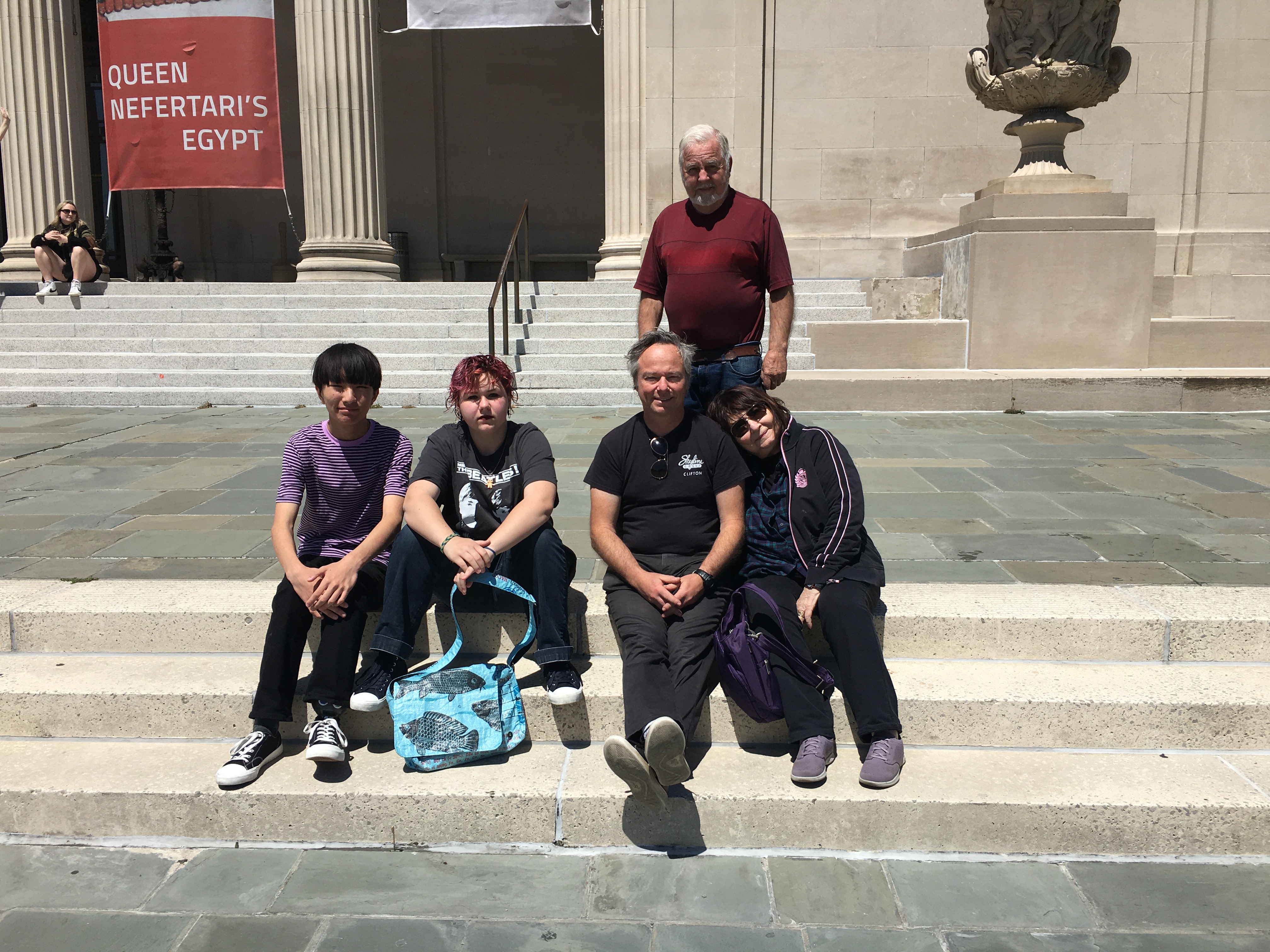
We went to see the Queen Nefertari’s Egypt exhibit at the New Orleans Art Museum in City Park. A trip to ancient times. In front: L, A, J, Katja. In back: Ted, K’s dad.


Then we went next door and visited the Bischoff Sculpture Garden, our favorite outdoor place in New Orleans. The Sculpture Garden has recently doubled in size.


Getting beignets at Cafe du Monde in City Park is a lot easier than in the tourist-crowded French Quarter location.


We missed Iko a lot, but his little brother Lil Paws was just as much fun.


Here is our group enjoying dinner at the chic Israeli restaurant, Saba. I had Harissa roasted chicken, and Katja had lamb kofta. From the left: Katja, A, K, L, J.


On Sunday we picnicked at Audubon Park, famed for its live oaks. J and L practiced distance running, in preparation for the upcoming Crescent City race.


Monday J took us on a trip to Biloxi and to Ocean Springs, Mississippi, where we visited the wonderful Walter Anderson Museum and the Shearwater Pottery.


Dickie Brennan’s Bourbon House on Bourbon Street in the French Quarter is one of our favorite oyster places.


Katja and I went to the Historic Orleans Collection in the French Quarter where they were featuring a “Streetcar Named Desire” exhibition.

We lunched at Pesch in the Arts District, A stranger asked Katja if she could take her picture because she looked so pretty in her outfit.


We loved the paintings of Luis Cruz Azaceta at the Ogden Museum of Southern Art.


J and K took us to the concert by Louisiana Philharmonic cellists and dancers at the Marigny Opera House.  Eight cellists, no less.

On Thursday St. Andrews Episcopal School had Grandparents Day. These are the seventh graders, including A and L, performing a song with the bells. We were very impressed with the school and our grandkids’ accomplishments.


Katja and I enjoyed our annual oyster lunch at Desire in the Royal Sonesta on Bourbon Street.


On our last day we had a family brunch at the Ruby Slipper in the Marigny. That’s J, L, and Jayme, K’s sister who arrived from California. J’s artwork is on the rear wall at the right.


Our last big outing was to the Audubon Aquarium. A very attractive facility with many interesting fishies.


It looks like we needed a nap by the end of the trip.


Monday, April 18, 2022

OLDIES ON THE ROAD


Dear George, 
Katja and I are just back from a memorable family visit in New Orleans. We hadn’t been on an airplane since before the the pandemic began, so it was more eventful than usual. I think our traveling skills have gotten rusty since we had a rocky journey. We left for the airport about 30 minutes later than I’d planned, and I was annoyed to find that the daily charge for long-term parking had increased from $7 to $11. We took the shuttle bus to the airport terminal and got in the TSA security line. I’d printed out our boarding passes at home so I gave Katja hers. The line was pretty long, and, when we’d gotten about halfway through, I suggested that we get our driver’s licenses out. Much to her consternation, Katja couldn’t find hers. She looked through her purse, her wallet, and her pockets. It was baffling because she had checked in the car to make sure she had it. I looked through her purse and wallet too, but with no luck. Deciding that she must have left it in the car, we got out of the security line and began to head back to the shuttle bus — a perilous choice since we didn’t have surplus time. However, an airport employee was standing nearby, and I explained our dilemma to him. He said that we could get through security with credit cards or similar I.D. with Katja’s name on it and advised us to go back into the line. 

The security line was a bit longer the second time around. When we got halfway through I suggested that we get out our boarding passes. Katja looked in her purse, but she couldn’t find her boarding pass there, and it wasn’t in her pockets either. I looked in her purse too. No luck. This was crazy — she had just had the boarding pass in her hand ten minutes before. We knew that they could print out boarding passes at the ticket counter for a $5 fee, so I suggested that Katja go back there while I stayed in the line. She said she would call me on her cell phone when she got the new boarding pass. 

Going through the security check I failed to take my cell phone out of my pocket and set off the alarm bells, so the guy had to give me a full-body putdown. Then I got confused and left my carry-on bag on the conveyor belt until a TSA lady pointed out that the purple bag was mine. At first I thought it wasn’t but the tag had my name on it. In the meantime I hadn’t heard from Katja, and I was getting worried about the time. It was a long walk to our departure gate, the very last one in the terminal. I explained to the airline representative at the check-in counter that my wife had had to go back and get a new boarding pass and that I was worried about her getting back in time. He said that the airplane door would close in exactly twenty minutes and there were no exceptions. If she didn’t make it back by then, we would have to reschedule. Their next flight to New Orleans was in three days. 

I got more anxious by the minute, but Katja did finally make it with seven minutes to spare. All the other patrons had boarded at least fifteen minutes earlier. We breathed a sigh of relief and took our seats. Katja said she had intended to call me, but she hadn’t been able to find her cell phone. Apparently she had left it in the car. A few minutes later she opened up the paperback book she had brought along to read. Much to our surprise, there was the original boarding pass that she’d lost. 

Our New Orleans visit was thoroughly enjoyable and proceeded without incident. We worried a bit about our return flight since Katja still lacked a photo I.D. However, since they’d accepted other forms of I.D. in Cincinnati, it seemed sensible that they’d do the same in New Orleans. That wasn’t exactly true. We went through the security line in the New Orleans airport, and Katja explained to the TSA official that she had left her driver’s license in our car in Cincinnati and only had other forms of I.D. She gave the man her Medicare card, her covid vaccination card, her American Express card, and her Macy’s credit card. The man, however, said these weren’t adequate because none of them listed her home address. Katja carries dozens of cards in her purse. She started going through them, and the TSA official started looking through her wallet too. None of the cards had a home address. Then, suddenly, the TSA man said, “Well, here’s a surprise.” He held up Katja’s driver’s license which he’d found in one of the deeper pockets of her wallet. Problem solved. 

Our 8:37 p.m.flight to Cincinnati was delayed 45 minutes for unknown reasons. Then, once we boarded the plane, we sat on the ground for another two hours, waiting for a worker to replace a filter in the rear lavatory sink. We arrived in Cincinnati about 3 a.m. I had some trouble with the automated checkout system at the long-term parking lot, but a human voice eventually came on an intercom and guided us through it. A thirty minute drive to home. We slept till noon the next day. Our air travel had its ups and downs, but I have nothing but happy memories of being in New Orleans. 
Love, 
Dave