Saturday, May 18, 2024

DOGS OF OUR DAYS


Dear George, 
Last week Katja and I watched the Westminster Kennel Club Show, an annual tradition in our household. Such beautiful animals. We were thrilled this year because four of our own family pets’ breeds wound up as winners or runners-up in their respective groups: the German Shepherd and the Old English Sheepdog (herding group), the Poodle (toy group), and the Schnauzer (working group). Here are a few stories about our pet sweeties from 1960 to the present, running the gamut from tragedy to joy.

Heather (1960-61). Katja and I got married in August 1960, and we moved to Ann Arbor for graduate school two days later. A few weeks later I came home to our apartment and was surprised to find that Katja had bought a German Shepherd puppy. It was love at first sight. We named her Heather, and she became the center of our young married lives. I spent so much time playing with Heather, it was hard to keep up with my studies. By early spring our eighty-year-old landlady was tiring of Heather’s barking while we were away, so we arranged with a friend to have her stay in his backyard during the daytime. We came home one afternoon, and our friend was waiting there in tears. Heather had been tied to a chain, and she tried to climb over the fence, got hung by the neck, strangled, and died. I still get teary-eyed writing about it. 

Jacques (1966-1973).  We were winding up our time in Ann Arbor a few years later when my brother Steven started law school at Wayne State in Detroit. He and his wife Margie had acquired a black poodle named Jacques in Florida, but their new apartment complex in suburban Detroit didn’t allow dogs so we agreed to take him. Jacques was a remarkably smart and loyal dog, though also capable of mischief. One evening during exam week we stayed on campus much later than normal, basically forgetting that Jacques was at home and needed a walk. Katja had recently sewn red velvet curtains for the living room and dining room. When we got home, we found that Jacques had pulled every curtain down onto the floor and pooped on each one. A clear message for his negligent owners. Like Heather, Jacques came to a tragic end. We spent the summer of 1973 on a research project in Bethel, Maine. On our last night we hired a baby-sitter so we could have a farewell dinner out. The baby-sitter was crying when we returned home. She had let Jacques out of the house, and he had gone out to the road and was run over by a lumber truck. We buried him by the little creek in back of our rented mobile home. 

Winston (circa 1975-1992). I came home from work one day in the mid-70’s and was surprised to find an exotic-looking dog in our house. He was a Bedlington Terrier that Katja had had flown in from a breeder in Northern Illinois. Winston was our most sociable dog, prone to approaching every passerby on the street to get petted. Because of his unusual appearance, people frequently asked if he were a dog. After a while I started saying, “No, he’s a lamb,” and people didn’t know whether to believe me or not. His groomer participated in national grooming competitions, and she took Winston on trips through the Midwest and the East Coast. We felt like we were parents of a Hollywood star. Winston lived to a ripe old age — blind, deaf, demented, and incontinent in his final year. 

Mike and Duffy (circa 2000-2015). Some years later I came home one day from work, and Katja was on the porch talking to a neighbor. The back door was open, and I saw two little furry creatures which I first took to be baby raccoons. In fact, they were Old English Sheepdog puppies, three months old and frisky as could be. Katja had gone to see the litter in Fairfield, thinking she might buy one, but two of the puppies were so attached to one another that she couldn’t bear to separate them, and she brought both of them home. Mike and Duffy became a famous fixture in our Clifton neighborhood, and everyone wanted to give them a pet or take a selfie. I spent a lot of time with our friend Donna and her sheepdog Sophie walking our group in Mt. Airy, Miami Whitewater Forest, Eden Park, and Burnet Woods. Our hearts were broken once again when the dogs had to be put down in old age. 

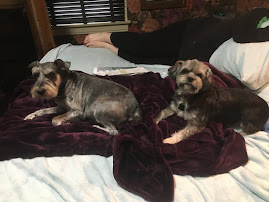
Iko (2020 - present). Our son J and his family live in New Orleans, but, when the pandemic began, they decided to move temporarily to California where the “plague” was less severe. J drove up to Cincinnati with their two family dogs, Iko and Li’l Paws, and we took care of them for about three months. Iko, a miniature schnauzer, had spent his early years in a brothel on Tulane Avenue in New Orleans, then became a street dog until my daughter-in-law K and a friend Alex rescued him at an SPCA Outreach event. When J returned from California he asked if we would like to keep Iko, and we said yes. Iko is the cuddliest of our dogs. He gets on the couch to watchTV with us, resting his head on one or the other of his parents’ legs. He’s definitely made our lives more enjoyable. 

I think we’ve always been meant to be a dog family, and we’ve treated our dogs pretty much like human beings and as full-fledged family members. Getting a dog is a complicated matter. They can be expensive, require walking whether rain or shine, make traveling more complicated, and have a relatively short life span. However, in my mind, they’re such a source of happiness than it outweighs all of the cons. All of our dogs have been wonderful. If one is craving love and affection, hardly any living creature can rival a pet dog. They go out of their minds every time you walk in the door. 
 Love, 
Dave

Friday, May 10, 2024

CUTTING TIES: A NASTY BUSINESS


Dear George, 

I have a huge decision to make. When I took a job as a social psychologist at the university I held a joint appointment and had separate offices in Psychology and Sociology. I retired some forty plus years later and moved out of my Psychology office. However, Sociology had access to some vacant space in their high-rise building, and they offered me a new office as an emeritus faculty member. Though the department was on the tenth floor and my new office would be on the thirteenth floor, it suited my purposes and I took them up on it. I like having a place to work other than home, and having an office at the university made my transition into retirement much easier. I went into work regularly — I just didn’t get paid. None of the other retired faculty were interested in an office, so I got to have my own space. Perhaps the biggest attraction for me was that I didn’t have to dispose of the five large file cabinets full of stuff that I’d accumulated throughout my career. Tons of lecture notes, data and records from research projects, published and unpublished papers, assorted graduate student files, miscellaneous angry memos, and my library of a couple hundred books. I’ve used my emeritus office mainly for writing — most recently for poetry, OLLI writing classes, stories for my blog, and papers for my writers’ group. While I had occasional contact with former colleagues on the tenth floor when I first retired, that’s declined over the years, and my visits have become less frequent and more solitary. 


Recently I got an email from the Sociology department head saying that in August the department will move to a different building on campus. The head said that I could have office space in the new location though it would be shared with several adjunct faculty members. She added the adjuncts spend little time at the office. I went over and looked at the space. It’s much smaller than my current office, with room for one desk and one or two file cabinets at best. It didn’t seem to me that two people could use it at the same time. This office will be right in the middle of the department, allowing for more potential contact with faculty and staff, though I’m not attracted to that. Now I am pondering what to do. It’s a quandary. The most clearcut option is to discontinue office space on campus, discard all the stuff I’ve accumulated over the decades, and move a few things home to our crowded attic. I can write poetry at home just as well as on campus. That choice, however, would close down one of the main places outside of home in which I spend time. Alternatively I could move a few things to the new office and see whether I want to spend time there. Part of me says it’s better to have crummy office space on campus than no office at all. I waver back and forth on a daily basis. I have started to throw things away, and I must say it’s been brutal so far. Fortunately I have some time available to make a final decision. 

Love, 

Dave


Sunday, April 21, 2024

NIL: A Nightmare for College Sports?


Dear George, 

College sports have been turned upside down in the last few years. For over a century the NCAA treated college sports as an amateur enterprise and prohibited college athletes from earning anything beyond a free education (tuition and fees, room and board). Following the Supreme Court’s rejection in 2021 of the NCAA’s “amateurism” argument, the NCAA ended virtually all restrictions on what athletes could earn from deals involving their own identities. 

“NIL” stands for “names/images/likenesses” and refers to an NCAA rule change that allows athletes to earn money from endorsements, social media postings, personal appearances, and other similar activities involving their personal identities. They can even accept money from boosters, usually longtime wealthy donors with ties to a university. Social media influencing is most frequent NIL activity performed by athletes, accounting for nearly 75% of NIL deals. If athletes have 10,000 or more followers on Instagram, Tik Tok, Facebook, etc., they can earn money from companies by adding personal endorsements of products and services to their media posts. 

The main rationale for NIL is that college athletes generate billions of dollars for their universities, TV and radio networks, and the NCAA. Up until recently athletes haven’t been able to profit a single penny from their own names and images. Advocates of NIL argue that it’s simply fair for athletes to be compensated for the value they create. 

Soon after the NCAA changed its rules in 2021, groups called “NIL collectives” formed in order to help athletes profit from NIL. These groups are most often composed of boosters and fans, and they operate independently from the university. There are also new NIL collective business firms that specialize in connecting athletes with potential sponsors. Most NIL collectives raise money from boosters, alumni, fans, and businesses, then use the funds to compensate athletes for their NIL activities. It’s estimated that over 250 NIL collectives are currently in operation nationwide. 

In 2022 about 17% of athletes at Division I universities participated in NIL activities. Local deals have been far more prevalent than national brands. It’s expected that NIL earnings will reach over $1.5 billion in 2024. The size of NIL deals for individual athletes varies dramatically. The average NIL deal during the first year was about $1,300, and the median was $65 (meaning that about half of all NIL earnings were below $65). However, top athletes are known to have secured NIL deals exceeding $1 million or more, sometimes 30 or 40 times annual faculty salaries at their university. To take a few examples, the University of Alabama quarterback received 3.1 million in NIL deals in his senior season, and the University of Colorado quarterback earned between $4.8 and $5.1 million. A freshman on the USC basketball team earned $7.5 million this season before he played a single game. Last year a high school quarterback in Florida was offered $9.5 million by a booster to commit to the University of Miami. He initially accepted the offer but changed his mind with University of Florida boosters offered him $13.5 million. Evaluations of NIL are all over the map, with lots of arguments pro and con. 

My own opinion is mostly skeptical. Here are some of the problems: 

     (1) Negative team effects. Star players are much more likely to secure lucrative NIL deals, potentially creating resentment or jealousy by teammates, many of whom do not receive any NIL money. 
    (2) Inequality across universities. Schools with wealthy boosters are likely to offer richer NIL opportunities to attract top recruits, widening the gap still further between well-funded and less-funded schools. Likewise, athletes may be even more prone to use the transfer portal to transfer to schools with better NIL deals. 
    (3) Gender inequity. Female athletes have fewer NIL opportunities compared to males. Studies indicate that male athletes receive about 70% of total NIL earnings. The top 100 recent NIL earners this past season included 94 men and 6 women. 
     (4) Inequality across sports. NIL deals are concentrated in a few revenue-generating sports, mainly football and basketball. Athletes in those sports have a much higher chance of getting NIL deals (i.e., 92 of the top 100 earners in 2023-24). Further, as donors redirect their donations to individual athletes in football and basketball, athletic departments will receive less general funding which they could have used to support secondary sports. 
     (5) Academic disruption. With its emphasis on financial gain , some athletes might give NIL money-making activities priority over academics. 

Overall, I think that the NIL system is potentially unfair in lots of ways. However, the situation is rapidly evolving, and it will be interesting to see what happens in the future. 
 Love, 
 Dave 

SOURCES: 
Carter, Bill. Seven data points that will tell the story of NIL in 2023. sportsbusinessjournal.com, Jan. 17, 2023 
Grady Capstone. Collegiate Female Athletes Pay As Males Dominate Revenue: Exploring the NIL Gender Pay Gap. gradynewsource.uga.edu, Apr. 12, 2024. 
Rudder, Paul. Who is the highest paid college athlete? NIL endorsement deal money in NCAA sports. en.as.com, Mar. 25, 2024. 
Schoenfeld, Bruce. “Student Athlete. Mogul.” New York Times, Jan. 24, 2023. 
Teamworks.com. A Changing Game: The Rise of NIL Collectives. Sept. 6, 2023. 
Wikipedia. Student athlete compensation.

Sunday, April 7, 2024

AN ODE TO APRIL


Dear George, 
All the months have something special about them, but I think that April might be the best. It’s the month when the flowering trees in our neighborhood come into full bloom — dogwood, redbuds, magnolias — signaling the full-fledged arrival of spring. The trees are not only beautiful, but they symbolize rebirth, new beginnings, the warm and abundant future that is waiting for us. The birds return, the squirrels and lizards are busy, the flowers begin sprouting in our garden, and Katja and I go to Rahn’s greenhouses to pick out pansies for planting. I do still wear my winter coat on the cooler April days, but the college kids I pass by are dressed in T-shirts and Bermuda shorts, probably viewing me as a daffy old geezer. 

When I was a kid our family lived in the country on the Menominee River, and April meant the total transformation of our forest world. As the snow and ice melted our gravel road turned into muddy ruts, and we couldn’t get to town, consequently enjoying our own personal holidays from school. The ice on the river melted and flowed out in early April, making a massive tinkling sound that led my parents to name it “Chinese Bells Day.” My brother Steven and I would put on hip waders and step into the flowing ice near the shore with bamboo poles, retrieving miscellaneous objects that were floating along with the ice, e.g., tin cans, rubber balls, lawn furniture, whatever. The trillium were the first spring flowers to bloom in the forest, and my mother would have us bring potted plants to our grade school teachers. Once the road dried out sufficiently we were able to ride our bikes to town and school. 

Easter, of course, occurs in early April, and we painted Easter eggs in school to bring home in preparation for the Easter Bunny’s visit. The public schools in my home town closed for the Good Friday and Easter Monday holidays. Our family was not very religious, but we did go faithfully to the First Presbyterian Church every Easter. My brother and I were always amazed at the amount of the check that my father put in the collection basket. He explained that he was covering the whole year. 

In Cincinnati the warm weather arrives earlier than in Northern Michigan, and April, with average high temperatures of 65 degrees, is one of the most pleasant months of the year. When our son was a teenager he played high school tennis for Walnut Hills, and we parents waited all winter for the arrival of April and the beginning of the boys’ tennis season. In retrospect, I would say that we were the stereotypic insane tennis parents. We attended all of our son’s matches, ecstatic with victories, anguished with defeat. In addition to Cincinnati, we travelled as a family to other tournaments in the region, e.g., Middletown, Dayton, Columbus, Indianapolis, Charleston, West Virginia . 

In addition to tennis, Cincinnati Reds baseball starts around the beginning of April, and the Cincinnati Zoo hosts its annual “Zoo Blooms” event throughout the month with its millions of tulips, daffodils, and hyacinths. The Greater Cincinnati Restaurant Week is held in late April, as is the Greater Cincinnati Earth Day Festival. 

It’s believed that April was named after Aphrodite, the Greek goddess of love. Diamonds are the April birthstone, daisies and sweet peas are the April birth flowers, and April is the National Poetry Month. George Washington was inaugurated on April 30, 1789, and the Titanic sank on April 15, 1912. Of course, many famous people have been born in April. These include William Shakespeare (April 23, 1564), Leonardo da Vinci (April 15, 1452), Queen Elizabeth II (April 21, 1926), Babe Ruth (April 8, 1895), and Billie Holiday (April 15, 1915). 

I’ve been around for well over eighty Aprils, and each becomes more significant as time goes by. Our sweet family from New Orleans already came to visit this April, making it a special month this year. I look forward to what’s to come. 
Love, Dave
Wednesday, March 20, 2024

REVISITING THE ATOMIC AGE


Dear George,

Oppenheimer won Best Picture at the Academy Awards so we finally got around to watching it.  It covered arguably the most significant events of our lifetimes: Hiroshima and Nagasaki, the Cold War with Russia, the nuclear arms race, the threat of annihilation -- an era of great tension and fear.  And lots of personal memories. 

I was just about to enter fourth grade when the U.S. dropped its atomic bombs on Japan in August, 1945. At school our Weekly Reader contained regular articles on the peacetime benefits of atomic energy, but we children were more concerned that humankind now possessed the capacity to destroy all life on the planet. A difficult prospect for young minds to digest. We had regular classroom rehearsals in preparation for nuclear war. This consisted mainly of bending over and putting our heads under our wooden desks. 

Russia exploded its first atomic bomb in August 1949. The Cold War was in full sway, and the possibility of nuclear war seemed increasingly real. The hysteria gripping the nation spread as well to my home town of Menominee in Michigan’s Upper Peninsula. Menominee was located 150 miles east of the Soo Locks, the latter likely to be a prime target of Russian bombers because of their economic importance to the nation. Local prognosticators reasoned that if enemy bombers drifted off course by as little as a single degree they would pass directly over Menominee. Our town, with its location on the Menominee River and its adjoining port, factories, and warehouses could easily be mistaken for the Soo, resulting in the accidental delivery of atomic bombs. Local anxiety about a possible atomic attack remained at a fever pitch throughout my teenage years. 

Whether or not my father, my uncle Ralph, and my grandfather, V.A. Sr., believed in the Soo Locks theory, they decided that it would be prudent to build an atomic bomb shelter in the basement of my grandfather’s drugstore. V.A. enjoyed carpentry projects of various sorts and took charge of construction, recruiting me as his assistant. The bomb shelter was in a room the size of a small bedroom along the south wall of the drugstore basement, a cramped space for the eleven members of our two families. I forget the exact materials, but we lined the walls with some sort of insulation to protect us from radioactive fallout. Then we stocked the room with bottles of water, candles, canned food items, toilet paper, fresh underwear, and other essentials. The adults had an ongoing debate about whether to stock the bomb shelter with guns in case neighbors tried to break in. We settled for multiple interior locks on the door. 

I left for college in 1955 and my second coop job was in New York City two years later. New Yorkers assumed, probably correctly, that their city would be the number one target for a nuclear attack by the Russians, and I was nervous about moving there. By this time the U.S. and Russia had both developed hydrogen bombs, each about 700 times more powerful than the Hiroshima bomb. I vividly remember attending the Barnum & Bailey Circus in Madison Square Garden one Saturday afternoon. Suddenly the entire interior of the arena went black, search lights began flashing on and off, and sirens wailed at full blast. I nearly collapsed from anxiety, fully convinced with the rest of the audience that the end had arrived. Then a bevy of clowns came charging out, tooting their horns, and we breathed a sigh of relief. Just another amusing circus joke. 

In 1960 my brand new bride Katja and I moved to Ann Arbor for graduate school, and we voted for JFK in our first presidential election. Two years later President Kennedy delivered a TV address to the nation, announcing that the Soviet Union had built nuclear missile bases in Cuba and was delivering nuclear warheads by sea. Kennedy had ordered U.S. naval ships to blockade Cuba. Khrushchev responded that the blockade was “an act of aggression propelling humankind into the abyss of a world nuclear-missile war.” A military confrontation seemed imminent. Katja and I met on campus to decide what to do. Detroit, one of the nation’s most important industrial centers, was a mere 40 miles away, and Ann Arbor seemed a likely candidate for deadly radioactive fallout. We thought about leaving immediately for my parents’ Upper Peninsula home, a 400-mile trip. However, Soo Lock fears were still fresh in my mind. and we had the terrible feeling that no place was safe. Fortunately the crisis finally ended thirteen days later. Historians today agree that the world was actually on the brink. That was my last personal nuclear crisis, even though, in fact, the potential for nuclear disaster has probably increased with rogue states like Pakistan and North Korea possessing the bomb. But we have survived for almost 80 years, and I think we’ve become desensitized. Oppenheimer did bring it all up again. 

Love, 
Dave

Friday, March 1, 2024

HOW DOES POETRY DIFFER FROM PROSE?


Dear George, 
I’ve been taking poetry classes through UC’s OLLI program for the last 5 or 6 years. I don’t know if I’m getting any better, but I am enjoying myself. Katja is a Ph.D. candidate in French literature, and, from the beginning, she’s been telling me that my poems don’t sound very poetic. I’ve come to agree. My background is in scientific writing, the very opposite of poetic writing. My OLLI teacher agrees, saying that I write “prosy poems,” though he sees no problem in that. Every class I’ve been in winds up, at some point, discussing the differences between poetry and prose. I’ve asked Google about it, and here are some of the things experts say. 

Both “prose” and “poetry,” of course, refer to written literature. Prose is what we encounter most often in everyday life. Novels, short stories, nonfiction works, essays, newspaper and magazine articles, scientific papers, emails, blogs, and so forth ad infinitum. Various commentators say that prose is “regular” writing, while poetry is a more specialized form. I’m going to hazard a guess that prose constitutes about 99.9% of the written products out there in the world, leaving poetry with about 0.1% or less. To my knowledge, prose writers never worry about how prose differs from poetry. Only poets interested in the question, perhaps because their creations are specialand unique. 

Many authors compare and contrast poetry and prose. Here I am going to describe eight distinctions that are commonly made: structure; length; capitalization; punctuation; rhyme and meter; language; understandability; and purpose.

(1) STRUCTURE. The clearest and most obvious difference between prose and poetry is how they look on the page. Prose is written in sentences that are arranged in paragraphs. A line of text begins at the left and ends at the right margin of the page, with prose text appearing as large blocks of writing. Poems, in contrast, use shorter lines that are broken before the right page margin, and the lines are organized into stanzas. Thus, the shape of a poem varies, depending on the line and stanza breaks chosen by the author.    

(2) LENGTH. Poems are relatively short, like a painting in words, while prose is usually longer (think of an article or work of fiction). 

(3) CAPITALIZATION. In prose, the first word of every sentence is capitalized. Traditionally, poets capitalize the first letter of every line whether or not it corresponds to a sentence beginning. However, many modern poets do not follow this rule. 

(4) PUNCTUATION. Prose writers follow standard grammatical rules of punctuation (e.g., periods at the end of the sentence; commas to connect independent clauses ). Poets sometimes use standard grammatical rules, but they may also break rules for creative effect or not use standard punctuation at all (relying on line breaks instead of periods, commas, etc.). 

(5) RHYME AND METER. Historians suggest that poetry existed long before written language, and used rhythm and rhyme to help people to memorize information and hence pass down knowledge. Some argue that rhyme and meter are the most importance differences between poetry and prose. However, both rhyme and meter have been on the wane in poetry for many decades, and contemporary poets show a near-universal preference for free verse. 

(6) LANGUAGE. Prose typically relies on straightforward and literal language (e.g., the current essay), while poets often use figurative language (e.g., metaphor, similes, symbols) to create images or expressive ideas. Edgar Allan Poe wrote, “Poetry is the rhythmical creation of beauty in words.” 

(7) UNDERSTANDABILITY. Prose typically aims for a relatively clear message and usually requires only a single reading. Poems often leave a lot unsaid, rely on the imagination of the reader for interpretation, and may require more than one reading. My own opinion is that a lot of contemporary poets seem to worship ambiguity or obscurity and are needlessly frustrating to the everyday reader as a consequence. 

(8) PURPOSE. A quick summary is that prose aims to convey information, tell a story, or explain a concept in a clear way, while poetry focuses on expressing emotions and ideas in an aesthetically pleasing and evocative way. 

PROSE POEMS. It’s a mistake to regard “prose” and “poetry” as mutually exclusive, binary categories. There’s a lot of overlap and a lot of variety in each category. Prose can be highly expressive and employ metaphors and symbols. Poetry can be literal and descriptive, telling a story. The prose poem is a good illustration of the fusion of the two, since it employs the structural form of prose with the expressive language of poetry. Here is an excerpt from the prose poem, “Bath”, by Amy Lowell:  
      
“Little spots of sunshine lie on the surface of the water and dance, dance, and their reflections wobble deliciously over the ceiling; a stir of my finger sets them whirring, reeling.  I move a foot and the planes of light in the water jar.  I lie back and laugh, and let the green-white water, the sun-flawed beryl water, flow over me.” 

It’s also possible to turn this around and consider poems which employ a standard poetry form but also use literal, descriptive language rather than flowery, “poetic” language. William Carlos Williams’ poem, “This Is Just to Say,” might be an example: 

I have eaten 
the plums 
that were in 
the icebox

and which 
you were probably 
saving 
for breakfast 

Forgive me 
they were delicious 
so sweet 
and so cold 

All of this points to a rather murky conclusion. It’s certainly possible to make generalizations about differences between poetry and prose, but both of these categories are so diverse that there are many exceptions to any assertion. Former U.S. Poet Laureate Howard Nemerov sums it up best when he says that distinguishing poetry from prose “is rather like distinguishing rain from snow — everyone is reasonably capable of doing so, and yet there are some weathers that are either-neither.” 
Love, 
Dave 

SOURCES: brittanica.com, “Poetry(literature). ; immerse.education, “What Is The Difference Between Prose and Poetry?”; keydifferences.com. “Difference Between Prose and Poetry”; poets.org, “Poetry”; readwritethink.org, “Poetry and Prose: What’s the Difference?”; theadvocate.org. “The Difference Between Prose And Poetry”; tiatalk.me, “What is poetry?”; twinkl.com,“What is poetry?”; writers.com; “Prose Vs. Poetry: Their Differences And Overlap.”

Thursday, February 15, 2024

VALENTINE'S DAY MUMBLINGS


Dear George,
Another Valentine’s Day has come and gone. I did spend some time looking up the holiday’s history. According to legend, Valentine, the Bishop of Interamna in central Italy, was imprisoned in 273 A.D. by the emperor Claudius who was persecuting Christians. In violation of Roman law, Valentine had been aiding Christians to escape from prison, and he’d also been marrying Christian couples so that the new husband would not have to go to war in Claudius’ army. Claudius demanded that Valentine renounce his beliefs or be executed. Valentine’s faith was unwavering. In the days before his execution, Valentine, through his prayers, restored the sight of his jailer’s blind daughter, Julia. Asterius, the jailor, was so amazed and grateful that he converted to Christianity on the spot. Valentine had fallen in love with Julia who had been visiting him in the jail. On the day of his execution, February 14th, Valentine left Julia a note that was signed, “From your Valentine”. This, of course, is the origin story of the first Valentine card. St. Valentine’s skull is on display today in the Basilica of Santa Maria in Rome. He is known as the patron saint of lovers, beekeeping, epilepsy, and the plague. 

Historians speculate that the Valentine’s Day holiday had its origins in the Roman festival of Lupercalia which was held in mid-February. The festival celebrated the coming of spring and included fertility rites and a lottery which paired up single women and men. In the fifth century the pope banned Lupercalia celebrations and declared February 14th “St. Valentine’s Day.” In 1382 Geoffrey Chaucer wrote the first Valentine poem about birds selecting their mate on February 14th. Commercially printed Valentine cards were manufactured by the late 1700’s, and they became available in the U.S. by the mid-1800s. These days about a billion Valentine cards are exchanged worldwide per year. Teachers are the most frequent recipients, outdoing wives, mothers, and sweethearts. Nearly 30% of all flower sales in the U.S. are done around February 14th. Americans spend an average of $193 on Valentine’s gifts (though not true in my house). Of most importance, 25% of pet owners in the U.S. give Valentine’s Day gifts to their pets. 


We Menominee children celebrated Valentine’s Day in my grade school each year by exchanging cards in the classroom. This was an activity fraught with peril. There was a lot of trepidation about boys sending Valentine cards to other boys, though it was deemed o.k. if the card downplayed sentiment and featured cowboys, Indians, prizefighters, or other hyper-masculine characters. Boys sending Valentines to girls was almost as difficult, and senders of mushy cards to girls were unmercifully taunted by their peers. The other issue was how many cards one should send. A few children chose to send cards to everybody else in the class. However, this was generally frowned upon since it defeated the main purpose of exchanging cards — i.e., determining who were the most popular and least popular children by the number of cards received. Five or six cards per sender were regarded as a good number. In my classes there was usually one person who received cards from everyone and one or two who received almost none. I can’t remember exactly where I ranked among my classmates, but I wasn’t near the top and I wasn’t at the very bottom. Last week in my OLLI art class I made two handcrafted Valentine’s to give to Katja, but I’ve lost the knapsack in which I brought them home. That’s how it goes. 

Love,  Dave


Thursday, December 28, 2023

2023: OUR NEW YEAR'S NEWSLETTER


Dear George, 
It’s time once again to wrap up another year. I’d say 2023 has to be an outstanding year because, to our happy surprise, we’re still hanging in there. We got an e-mail from the Cincinnati Art Museum which listed the year’s highlights month by month. The seemed a good way to organize stuff so I did the same for Katja and myself. Here is our 2023 story. 
Love, 
Dave 

JANUARY. Katja came down with Covid but recovered in time to begin our winter quarter OLLI courses. Katja did literature and history; David, poetry writing. We bought a giant TV for the den and watched the Bengals lose to the Chiefs in the AFC Championship game. 

FEBRUARY. We enjoyed Greek and Roman Mythology at OLLI and “Beyond Bollywood” at the Art Museum. At my annual wellness exam the doctor said I am “85 young,” and he actually agreed to give me an Rx for 24 Lorazepam to help sleep. 

MARCH. We celebrated the arrival of spring with fish dinners at Bonefish Grill, the Oakley Fish Market, and Red Lobster. We got the very sad news that our daughter-in-law K’s mom Linda died. 

APRIL. I was the only student at my Zumba class for the third week in a row and decided it was time to discontinue. Katja loved King Charles’ coronation on TV, and we enjoyed Rachmaninoff and Shoshtakovich at the Symphony. The cardiologist said I was doing fine and added, “Don’t screw it up.”
    
MAY. I did terribly on my first hearing test in several years but got some new hearing aids which did help a lot. J sent flowers for Mother’s day and urged me to get a Covid test (which turned out positive, much to my surprise). Because of Covid, we cancelled our flight to New Orleans to attend our grandkids’ graduation. 

JUNE. The visiting nurse tested me for dementia and I remembered all three words perfectly (chair, banana, sunrise). We watched a lot of French Open tennis, including finals victories by Swiatek and Djokovic. We went to East Lansing for Linda’s memorial service and hung out with our sweet family. Having experienced severe jaw pain, Katja had oral surgery to extract an under-the-gum wisdom tooth. 

JULY. Lots of Wimbledon this month. My dentist moved her office from next door to our house to a half mile away, good for walking and exercise. I started exploring Bard, Google’s artificial intelligence chatbox, asking Bard to write poems about this and that (only so-so as a poet). We celebrated my 86th birthday at the Chart House, enjoying the Cincinnati skyline view across the Ohio River. Our son J cancelled his planned trip to Cincinnati because of family sickness. 

AUGUST. On her way from Richmond to Albequerque, our friend Jennifer stopped by for a get-together. The retinal specialist said my left eye was doing o.k., didn’t need surgery. Katja and I celebrated our 63rd anniversary (amazing) at La Bar A Boeuf. 

SEPTEMBER. We were happy that our favorites, Gauff and Djokovic, won their U.S. Open Finals. Pianist Sara Daneshpour was wonderful at Matinee Musicale. We saw an excellent women’s photography show at the Taft Museum. Quarterback Joe Burrow, who missed the preseason with an injury, was rocky in his first few games with the Bengals. 

OCTOBER. The plasterer fixed our living room wall. J came for a visit, and we ate at Skyline Chili twice, did multiple thrift shops, and saw art shows at the Art Museum, the Miller Gallery, and Hebrew Union’s Skirball Museum. Katja had a second oral surgery (the first one was botched), and, because of a paperwork screw-up, our insurance wouldn’t cover anything and we wound up paying a huge amount out of pocket. 

NOVEMBER. Big election victories for the Democrats. After months of terrible pain, the insurance company finally approved Katja’s epidural, and she is a new woman. Joe Burrow injured his wrist and is out for the season. J, K, A, and L flew up from New Orleans for a Thanksgiving visit, and we had a great time. I discovered jazz singer Andrea Motis on YouTube. 

DECEMBER. We celebrated Katja’s birthday at La Bar a Boeuf. J sent beautiful flowers. The furnace guy found that the raccoons had done a lot of damage to our ducts. Backup quarterback Jake Browning led the Bengals to three victories in a row before a Steelers collapse. Ami and Bruce sent Zabar’s delicacies, and David and Susan sent See’s Candy for Christmas. We enjoyed the Charles White exhibition at the Art Museum and made New Year’s dinner reservations at La Bar a Boeuf to celebrate a very good year.
Love,
Dave